What Is Sugawara Denju Tenarai Kagami?
Sugawara Denju Tenarai Kagami is a celebrated masterpiece of both Kabuki and ningyō jōruri (traditional puppet theater), inspired by the life of the Heian-period scholar and statesman Sugawara no Michizane. The work explores enduring themes of loyalty, the bond between parent and child, and the deep connection between master and disciple.
Basic Information
- Year of Composition: 1746
- Authors: Takeda Izumo, Miyoshi Shōraku, and Namiki Senryū
- First Performance: Takemoto-za Theater, Osaka (as a ningyō jōruri production)
- Later Adaptation: The play was later adapted for Kabuki and remains a popular and frequently performed work today.
Historical Background
The story is based on the historical event in which the real-life figure Sugawara no Michizane was exiled to Dazaifu after being falsely accused by his political rivals.
However, the drama does not use the historical names directly. Instead, the characters appear under fictionalized names:
- Sugawara no Michizane → Lord Sugawara (Kanshōjō)
- Fujiwara no Tokihira → Shihei
Famous and Frequently Performed Scenes
- The Kamo Embankment Scene
- The Hippō Denju Scene (Transmission of the Secret Art of Calligraphy)
- The Dōmyōji Scene
- The Kuruma-biki (Car-Pulling) Scene
- The Celebration Scene
- The Terakoya (Village School) Scene
Among these, “The Terakoya Scene” is especially renowned as one of the greatest and most moving moments in the Kabuki repertoire.
Synopsis — Overview
Lord Sugawara is driven from the capital on false charges and exiled to Dazaifu. Meanwhile, in the capital, Shihei seizes power and plots to wipe out the Sugawara bloodline by targeting Lord Sugawara’s son, Kan Shūsai.
At the heart of the story are profound human choices:
- unwavering loyalty to one’s lord,
- a parent’s resolve to sacrifice even their own child, and
- the bond between master and disciple that carries learning into the next generation.
Though the tale unfolds as a tragedy, it ultimately reaches a grand and transcendent conclusion, as Lord Sugawara ascends to the heavens as the Thunder God, transforming suffering into divine retribution and eternal legacy.
Scene-by-Scene Synopsis
What Is “The Kamo Tsutsumi no Dan” — Sugawara Denju Tenarai Kagami
“The Kamo Tsutsumi no Dan,” which opens Sugawara Denju Tenarai Kagami, is a pivotal episode that sets in motion the tragedy of the entire story. It introduces the three triplet brothers—Umeōmaru, who serves Lord Sugawara; Matsuōmaru, who serves Fujiwara no Tokihira; and Sakuraōmaru, who serves Prince Sayo—each of whom will be drawn toward a starkly different fate because of their loyalty to different masters.
On the day of the pilgrimage to the Kamo Shrine to pray for the Emperor’s recovery from illness, Sakuraōmaru learns of the secret romance between Kariya-hime, the adopted daughter of Lord Sugawara, and Prince Sayo, the Emperor’s younger brother. With the help of his wife, Yae, he arranges a clandestine meeting for the lovers.
However, as officials led by Miyoshi no Kiyotsura search for the missing prince in the midst of the sacred rites, the affair is nearly exposed. In the chaos that follows, the prince and the princess finally flee together.
Sakuraōmaru’s actions leave behind the seeds of a grave calamity that will lead to Lord Sugawara’s downfall. From this moment on, the tragedy of people torn between loyalty and human feeling begins to unfold. As an opening scene, it carries great weight, foreshadowing the suffering and sacrifices that will befall each of the three brothers in the acts to come.
What Is “The Hippō Denju no Dan” — Sugawara Denju Tenarai Kagami
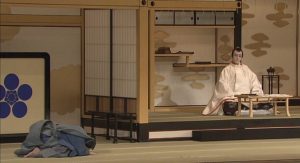
Sugawara Denju Tenarai Kagami is a classic historical drama inspired by the life of Sugawara no Michizane, a scholar and statesman of the Heian period. The play portrays themes of loyalty, political intrigue, and the profound bond between master and disciple. Among its many scenes, “The Hippō Denju Scene” stands out as a highly symbolic moment at the heart of the entire story, depicting the transmission of a sacred secret.
In this scene, Lord Sugawara (Kanshōjō) resolves to pass down the hidden art of calligraphy, known as hippō, not to his own son, but to his devoted disciple, Takebe Genzo. Traditionally, this secret was reserved exclusively for the Sugawara family, and deciding who would inherit it was a choice that carried the weight of Lord Sugawara’s entire life and legacy.
Valuing learning and personal character over blood ties, Lord Sugawara recognizes Genzo’s sincerity and ability and entrusts him with the teachings. The scene portrays the master’s strict discipline, deep compassion, and quiet acceptance of his own fate. At the same time, this decision foreshadows the political struggles and tragedies that will later unfold, setting the larger drama into motion.
“The Hippō Denju Scene” is not merely about the transmission of a writing technique; it represents the passing on of spirit, ideals, and a way of life to the next generation. Though restrained in action, the scene is filled with solemn tension, leaving a powerful impression of the nobility of the master-disciple bond and the human destiny shaped by the tides of history.
What Is “The Dōmyōji no Dan” — Sugawara Denju Tenarai Kagami
“The Dōmyōji no Dan” is a richly atmospheric episode that depicts Lord Sugawara’s exile to Dazaifu, the sorrow of those who must part from him, and a miraculous act of substitution that borders on the supernatural.
At Kakujū’s residence, Kariya-hime, who has unwittingly caused her father’s downfall through her romance with Prince Sayo, longs to see him one last time before he departs. Still consumed by anger, Kakujū punishes her. Then, from within an inner chamber, Lord Sugawara’s voice is heard. When Kariya-hime slides open the paper screen, what appears before her is not her father himself, but a wooden statue that Lord Sugawara has carved with his own hands.
Meanwhile, Sukune Tarō and Haji no Hyōe, allies of Tokihira, plot to have Lord Sugawara killed by forcing the rooster to crow early, signaling a false dawn. To silence a witness, they murder Tatsuta. A decoy escort is arranged, making it seem as though Lord Sugawara has already departed. But when the palanquin is opened, its contents are revealed to have been switched—the wooden statue and the living Lord Sugawara appear, astonishing everyone present.
Lord Sugawara explains that the statue he carved with heartfelt devotion has been infused with a spirit and has taken his place, saving his life.
When the true moment of departure finally arrives, he sets off for Dazaifu, leaving behind Kariya-hime’s cries of grief.
“The Dōmyōji Scene” condenses parental love, betrayal and murderous intent, and a miracle born of faith into a single, powerful stage moment. It stands as one of the most fantastical and tragic highlights of Sugawara Denju Tenarai Kagami.
What Is “The Kuruma-biki no Dan” — Sugawara Denju Tenarai Kagami
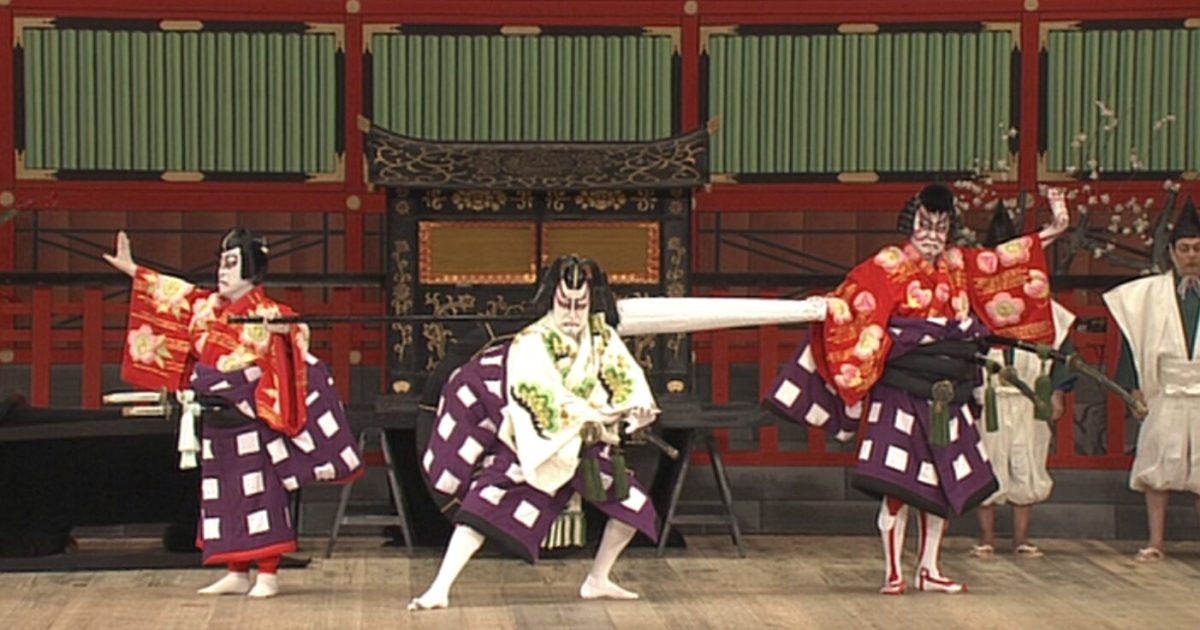
“The Kuruma-biki (Car-Pulling) Scene” is one of the most famous aragoto (bold, heroic-style) episodes in the first half of Sugawara Denju Tenarai Kagami. It powerfully conveys the injustice of a world after Lord Sugawara’s downfall and leaves a lasting impression of the fate of the “three triplet retainers” who run through the entire story.
As Tokihira, now Left Minister and the holder of political power, advances proudly through the streets in his ox-drawn carriage, Umeōmaru and Sakuraōmaru, who have lost their lord, step forward to block his way. Matsuōmaru, who serves Tokihira, soon appears, and the three brothers—once united in loyalty to the same master—now face one another as enemies because they serve different lords.
Amid the fierce struggle around the carriage and the overwhelming authority of Tokihira, Umeōmaru and Sakuraōmaru are forced to withdraw without achieving their revenge. Here, the brothers’ paths decisively diverge, and the seeds are sown for the tragedies and conflicts that will unfold in the later scenes, including “The Celebration Scene” and “The Terakoya Scene.”
Through its bold aragoto style, this scene dramatizes the abuse of power, the clash between loyalty and brotherly love, and the unfulfilled hopes of those who long for the restoration of Lord Sugawara’s honor. It is an essential episode for understanding the dramatic structure and emotional force of Sugawara Denju Tenarai Kagami.
What Is “The Ga no Iwai no Dan” — Sugawara Denju Tenarai Kagami
The story begins in the “Ga no Iwai” (Celebration) scene, set at the rural villa of Lord Sugawara no Michizane in the village of Satamura, deep in the countryside. This estate is overseen by Shiradayū, the father of three brothers. In the garden stand three trees—plum, pine, and cherry—planted by the Lord himself and cherished by him.
On the day of Shiradayū’s celebration, the wives of the three brothers gather and busily prepare for the festivities: Haru, the wife of Umeōmaru; Chiyo, the wife of Matsuōmaru; and Yae, the wife of Sakuraōmaru. Umeōmaru and Matsuōmaru soon appear, but old grudges flare up once more, and the two men fall into a fierce quarrel. In the scuffle, a branch of the cherry tree is broken—an ominous and unlucky sign.
After the two leave, Sakuraōmaru arrives. Without a word, Shiradayū presents him with a dagger for ritual suicide. Sakuraōmaru already feels prepared to die, burdened by the guilt that his actions—secretly arranging the love affair between Prince Saisei and Kariya-hime—led to Lord Sugawara’s exile.
The broken cherry branch seems to symbolize Sakuraōmaru’s fated destiny, quietly foreshadowing the tragedy that is yet to come. Though set as a celebration, “Ga no Iwai” serves as a crucial scene that foretells the sorrow and drama that will unfold throughout the entire play.
What Is “Terakoya no Dan” — Sugawara Denju Tenarai Kagami
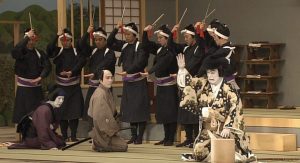
The “Terakoya” (Temple School) scene is set at a small village school in Seri-no-sato, on the outskirts of Kyoto. It is one of the most famous and emotionally powerful acts of the play, where loyalty to one’s lord and the love of a parent collide in a heartbreaking conflict.
The schoolmaster, Takebe Genzo, is secretly sheltering Kan Shusai, the young heir connected to Lord Sugawara. However, the pressure from Tokihira’s forces is closing in. Tokihira’s retainer, Shundo Genba, arrives with Matsuōmaru—who has ties to the Sugawara family—demanding the boy’s head.
Facing an impossible choice, Genzo steels himself to make a cruel decision: he resolves to use a newly enrolled boy, Kotaro, as a substitute. Genzo kills Kotaro and presents the head to Matsuōmaru. After examining it, Matsuōmaru declares it to be Kan Shusai’s, and the pursuers withdraw.
Just as it seems the danger has passed, Kotaro’s mother arrives to collect her son. It is then revealed that Kotaro was in fact Matsuōmaru’s own child, and that the entire plan had been devised by Matsuōmaru himself to save Kan Shusai’s life.
The resolve of Matsuōmaru and his wife, who sacrificed their own child for the sake of loyalty, moves Genzo, his wife Tonami, and even the rescued Kan Shusai to tears. In the final moments, Lady Sugawara and Kan Shusai depart for Kakujū’s care, while Matsuōmaru and his wife carry Kotaro’s body toward Toribeno, each family walking a separate path of farewell.
The tragic power of this scene—where devotion to one’s lord and parental love confront each other head-on—makes it one of the most deeply moving moments in all of Kabuki.
Main Characters – Sugawara Denju Tenarai Kagami
Lord Sugawara (Kan Shōjō)
The protagonist, modeled on Sugawara no Michizane, later revered as the god of learning.
An upright and sincere man, he is falsely accused by his political rival Tokihira and exiled to Dazaifu. Even in disgrace, he speaks no words of resentment, accepting his fate with quiet dignity. His eventual transformation into a thunder deity symbolizes the manifestation of justice beyond the human world and forms the spiritual core of the play.
Shihei
Sugawara’s political enemy, who wields absolute power after engineering his downfall.
To secure his own position, he orders the complete eradication of Sugawara’s bloodline. More than a simple villain, he represents a man consumed by the logic of power, bringing tension and oppressive weight to the drama.
Matsuōmaru
The eldest of the triplet brothers and a retainer of Tokihira.
Though he appears cold and calculating on the surface, he carries deep inner conflict and resolve. In the “Terakoya” scene, he sacrifices his own child to protect his lord’s lineage and the legacy of learning, creating one of the most tragic and powerful moments in the play.
Umeōmaru
One of the triplets, a retainer loyal to Lord Sugawara.
Hot-tempered and impulsive, yet fiercely devoted to his master. His readiness to act on anger and sorrow embodies the human struggle against an unjust world, giving the stage energy and emotional force.
Sakuramaru
The youngest of the triplets, gentle and kind-hearted.
A seemingly small act leads indirectly to Sugawara’s downfall, and burdened by guilt, he takes his own life. His death leaves a lasting impression of the play’s tragic tension between loyalty and personal responsibility.
Kan Shūsai
Sugawara’s son, a gifted young scholar.
After his father’s exile, his life becomes the focus of pursuit and protection, placing him at the center of the story’s suspense. Though he appears on stage only briefly, his existence shapes the fate of many others.
Takebe Genzo
A retainer of Sugawara and tutor to Kan Shūsai.
He runs a village school while secretly sheltering the boy. In the “Terakoya” scene, he is forced into an unbearable decision as both teacher and human being, and his silent actions and restrained presence deeply move the audience.
Tonami
Genzo’s wife.
She understands her husband’s resolve and suffering, supporting him quietly without words. Her restrained presence highlights both the weight of the tragedy and the warmth of family life.
Chiyo
Matsuōmaru’s wife and the mother of Kotaro, a boy at the temple school.
Though she senses her husband’s true intentions, she cannot suppress her maternal love. In the “Terakoya” scene, her struggle between loyalty and motherhood becomes one of the most heartrending portrayals in the play.
The Appeal of the Play – Sugawara Denju Tenarai Kagami
- One of the Three Great Masterpieces of Kabuki, standing alongside Yoshitsune Senbon Zakura and Kanadehon Chūshingura.
- A profound and weighty human drama that cannot be neatly reduced to simple moral justice or “good versus evil.”
- Intense emotional expression woven into the refined beauty of traditional theatrical form and stylization.
- A work that distills a distinctly Japanese aesthetic: the spirit of endurance, restraint, and entrusting one’s hopes to others.
Recommended for Beginners?
Yes—this play is especially welcoming to first-time viewers. Each scene can be enjoyed on its own, so it’s a great idea to start with famous episodes such as “Terakoya no dan” or “Kuruma-biki no dan”
If you watch with an understanding of the story beforehand, the emotions conveyed through the characters’ silences and pauses (ma) will resonate more deeply and make an even stronger impression.
Related Reading
🎭 Want to See Kabuki Live?
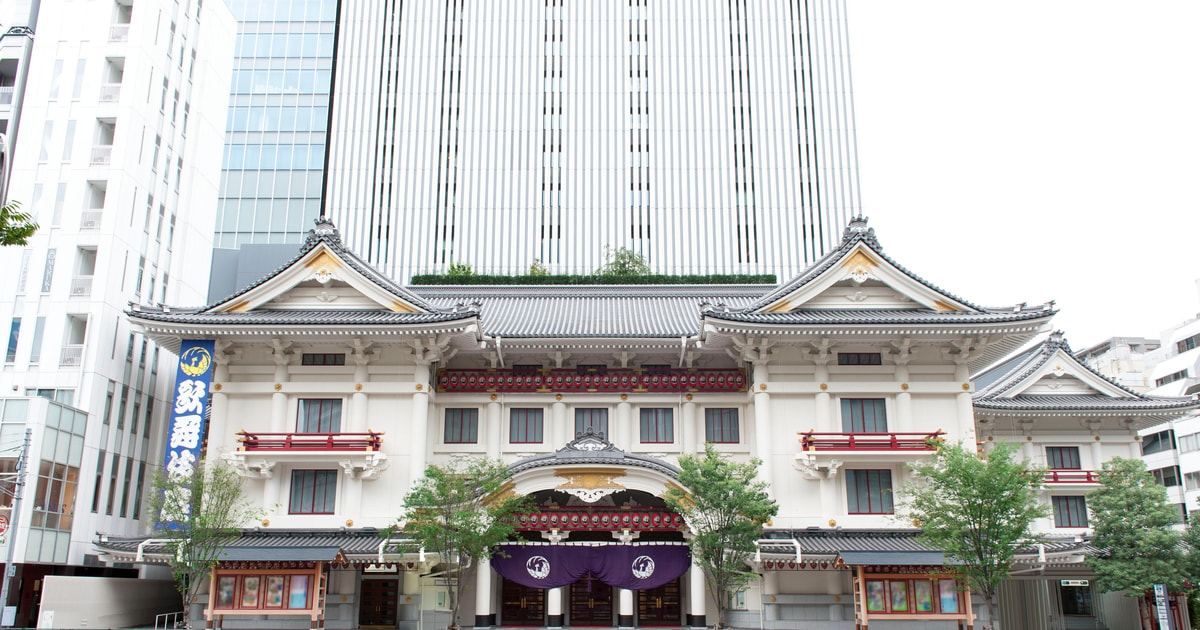
If you’re planning a trip to Tokyo, Kabuki-za is one of the most memorable ways to experience Japanese culture firsthand. GetYourGuide offers English-friendly Kabuki-za tickets and guided experiences, including options with headset translation and pre-show introductions for first-time viewers.
👉 Check Kabuki-za Tickets on GetYourGuide
This section may contain affiliate links. Booking through them costs you nothing extra and helps support this site.



コメント
コメント一覧 (1件)
[…] あわせて読みたい What Is Sugawara Denju Tenarai Kagami(菅原伝授手習鑑)? What Is Sugawara Denju Tenarai Kagami? Sugawara Denju Tenarai Kagami is a celebrated masterpiece of both Kabuki and ningyō jōruri (traditional puppet theat […]