What Is “The Hippō Denju Scene” — Sugawara Denju Tenarai Kagami
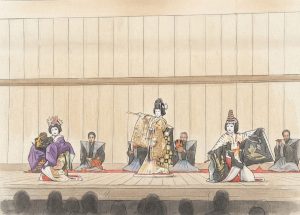
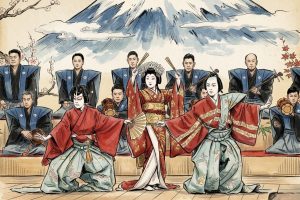
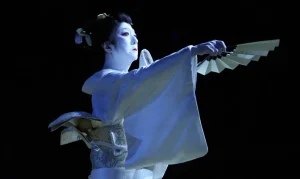
Sugawara Denju Tenarai Kagami is a classic historical drama inspired by the life of Sugawara no Michizane, a scholar and statesman of the Heian period. The play weaves together themes of loyalty, political intrigue, and the deep bond between master and disciple. Among its many scenes, “The Hippō Denju Scene” stands out as a highly symbolic moment that forms the spiritual and dramatic core of the entire story, depicting the transmission of a secret and sacred tradition.
In this scene, Lord Sugawara (Kanshōjō) resolves to pass down the hidden art of calligraphy, known as hippō, not to his own son, but to his devoted disciple, Takebe Genzo. Traditionally, this secret technique was reserved exclusively for members of the Sugawara family, and deciding who would inherit it was a choice that carried the weight of Lord Sugawara’s entire life and legacy.
Valuing learning and personal character over blood ties, Lord Sugawara recognizes Genzo’s sincerity and ability and entrusts him with the art. The scene portrays the master’s strict discipline, profound compassion, and quiet acceptance of his own fate. At the same time, this decision foreshadows the political struggles and tragedies that will later unfold, setting the larger drama into motion.
“The Hippō Denju Scene” is not merely about the transmission of a writing technique; it represents the passing on of spirit, ideals, and a way of life to the next generation. Though restrained in action, the scene is filled with solemn tension and leaves a powerful impression of the nobility of the master-disciple bond and the human destiny shaped by the tides of history.
Synopsis and Commentary on “The Hippō Denju Scene” — Sugawara Denju Tenarai Kagami
Scene 1: The Inner Chamber of the Sugawara Residence
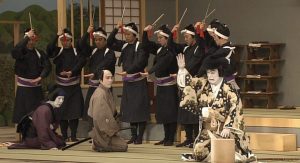
Lord Sugawara (Kanshōjō) has received an imperial command to pass down the secret art of calligraphy to future generations. Deeply troubled over whom he should entrust with this sacred responsibility, he refuses to make the decision lightly. He performs rituals of purification, bathes, and surrounds a secluded chamber of his residence with sacred ropes (shimenawa), withdrawing in solitude to cleanse his body and mind and contemplate his choice.
Meanwhile, in the residence, an old disciple, Sachūben Mareyo, arrogantly assumes that he is the obvious heir to the secret teachings. He behaves frivolously, flirting with the maidservants and showing little self-restraint. Though he is reprimanded by Lady Sugawara, his conduct does not improve. His shallow demeanor stands in stark contrast to the dignity and character expected of someone worthy to inherit the sacred tradition.
At this moment, Takebe Genzo is summoned, accompanied by his wife, Tonami. Genzo was once a retainer of Lord Sugawara, but he was banished after his improper relationship with Tonami—then a maidservant—came to light. Since then, the couple has lived in poverty, running a humble village school and leading a quiet, modest life. As Genzo steps once more into the Sugawara residence, his presence conveys the maturity and integrity he has gained through hardship and repentance.
Scene 2: The Study Hall of the Sugawara Residence
Guided by an attendant, Genzo proceeds down a long corridor—expressed on stage through the revolving platform—toward the study hall deep within the estate. As the stage slowly turns, his measured steps suggest that he is approaching a decisive turning point in his fate.
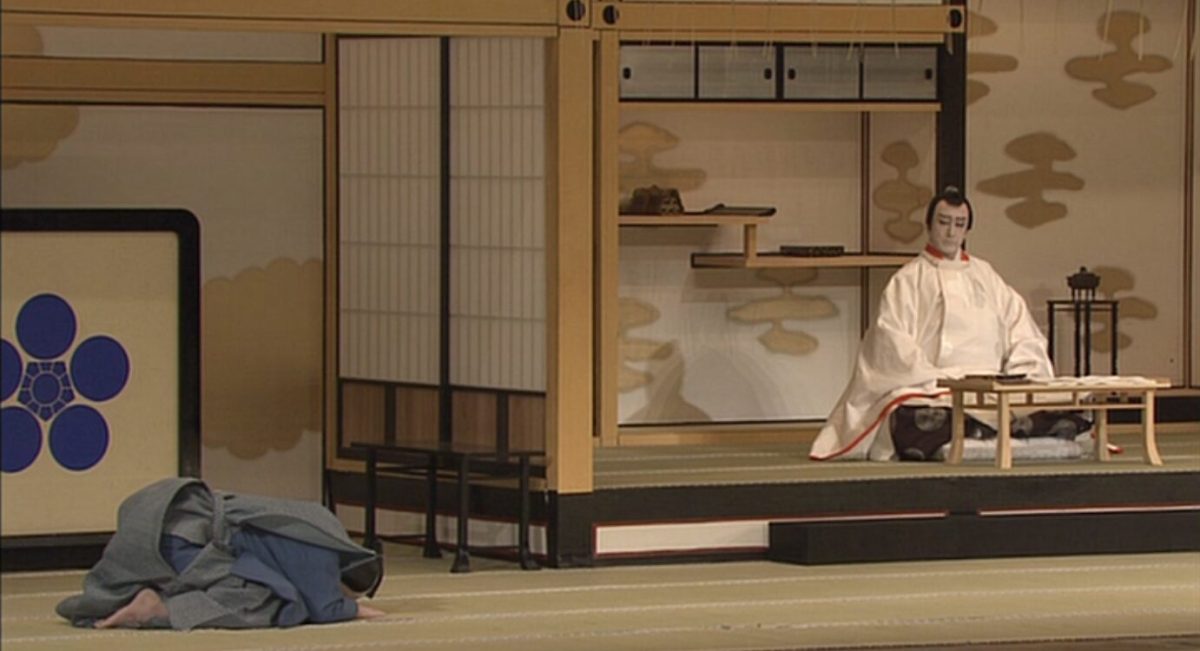
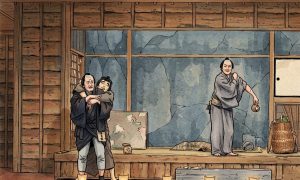
In the study hall, Lord Sugawara asks Genzo to write characters before him. Genzo’s brushwork is steady and confident, revealing years of diligent training and the sincerity of his character. Convinced that Genzo alone is worthy of inheriting the secret art, Lord Sugawara presents him with a scroll containing the hidden teachings.
Overwhelmed, Genzo is deeply moved by this unexpected honor. Yet Lord Sugawara sternly declares, “The transmission is one matter; your banishment is another,” making it clear that personal feelings will not sway his judgment.
Just then, an urgent summons arrives from the Imperial Court, ordering Lord Sugawara to present himself at once. As he prepares to depart, his court cap falls to the ground—an ominous sign. Though he senses the foreboding, he says nothing and leaves for the palace. Genzo and Tonami, anxious for their lord’s safety, reluctantly take their leave as well.
Scene 3: Outside the Gate of the Sugawara Residence
Soon after, Umeōmaru, one of Lord Sugawara’s attendants, rushes back in a panic. Moments later, Lord Sugawara is brought to the gate on foot, surrounded by officials wielding iron staffs and split bamboo rods. According to Miyoshi Kiyotsura, an alleged secret meeting between Prince Sayo and Princess Kariya at the Kamo Shrine has been interpreted as a plot by Lord Sugawara to seize the throne. As a result, he has been stripped of his rank and sentenced to exile in Dazaifu.
Sakyōben Kiyo betrays his former master and sides with Tokihira, raising his bamboo rod to strike Lord Sugawara. Umeōmaru shoves him aside in outrage. Enraged, Umeōmaru is ready to resist, but Lord Sugawara sternly commands him not to oppose the Imperial Court. He warns that anyone who disobeys will be disowned for seven lifetimes. Swallowing his tears, Umeōmaru obeys, and he and Lord Sugawara retreat into the residence as the gates are shut tightly behind them.
Amid the chaos, Genzo and Tonami arrive, having learned of the situation. They drive away Kiyo and Kiyotsura. Determined to save at least Lord Sugawara’s young son, Kan Shūsai, Genzo enlists Umeōmaru’s help. Over the wall, the child is handed to him. When officials discover them, Genzo cuts one down and, with Tonami, escapes into the darkness, carrying the boy to safety.
In this way, the secret art of calligraphy and the spirit of the Sugawara family are entrusted to the future through Genzo’s resolve and sacrifice.
Closing Commentary
“The Hippō Denju Scene” quietly yet powerfully portrays the depth of the bond between master and disciple, while marking the solemn beginning of the tragedy that will befall Lord Sugawara and his household. Beneath its restrained action lies a heavy emotional weight, leaving a lasting impression of loyalty, fate, and the transmission of both skill and spirit across generations.
Main Characters (The Hippō Denju Scene)
Lord Sugawara (Kanshōjō)
A high-ranking court official and the foremost master of calligraphy of his age. By imperial command, he must pass down the secret art of writing to a successor. He values character and ability above bloodline or status, and deliberately summons the banished Genzo to test his brushwork with his own eyes. Though he entrusts him with the secret teachings, he firmly declares, “The transmission is one matter; the banishment is another,” showing both compassion and unwavering discipline. He later accepts the cruel fate of exile to Dazaifu, becoming the catalyst for the tragedy that unfolds throughout the play.
Takebe Genzo
A retainer of Lord Sugawara and his most gifted disciple, truly worthy of inheriting the secret art of calligraphy. Once disowned for his forbidden love with Tonami, he now lives in poverty as a village schoolteacher. His brush, honed through hardship and integrity, reveals unwavering skill and sincerity, earning him the hidden teachings. After his lord’s exile, he resolves to protect the bloodline and spirit of the Sugawara family, becoming a central figure in the later stages of the story.
Tonami
Formerly a maidservant in the Sugawara household. After her romance with Genzo is exposed, she is banished with him, and the two walk a difficult path as husband and wife. She supports Genzo through their poverty, and in the scene of the transmission, her quiet, steadfast presence leaves a strong impression. Later, she joins Genzo in protecting the young Kan Shūsai, becoming a silent pillar in the effort to restore the Sugawara family.
Sachūben Mareyo
An old disciple who has served Lord Sugawara for many years. He is convinced that he alone will inherit the secret teachings and shows little regard for his own conduct. Both his calligraphy and his character fall short of Genzo’s. His arrogance and frivolity serve as a sharp contrast, highlighting the true standards by which Lord Sugawara chooses a successor.
Sonoo no Mae
Lord Sugawara’s lawful wife and the dignified mistress of the household. Even during the period of ritual purification, she keeps a watchful eye over the residence and admonishes Kiyo for his improper behavior. Though she is not directly involved in the transmission of the secret art, she represents the moral order and dignity of the Sugawara family, lending the story a quiet sense of gravity.
Kan Shūsai
Lord Sugawara’s young son, who bears the future of the family’s bloodline and learning. After his father is exiled, he can no longer remain in the capital and is spirited away under the protection of Genzo and Tonami. Though still a child in this scene, he later becomes a symbol of hope for the restoration of the Sugawara house.
Miyoshi no Kiyotsura
A court noble who sides with Tokihira and plays a key role in bringing about Lord Sugawara’s downfall. He denounces the alleged secret meeting between Prince Sayo and Princess Kariya at the Kamo Shrine as a plot by Lord Sugawara to seize the throne, and publicly reads out the charges against him. Though outwardly loyal to the Imperial Court, his actions reveal a cold obedience to power and a strong instinct for self-preservation.
Umeōmaru
A servant of Lord Sugawara and one of three triplet brothers. Rough and quick-tempered, he is a man of action who acts on emotion rather than reason. Beneath his blunt manner lies an unshakable loyalty to his lord. His willingness to risk his life for what he believes is just leaves a powerful and lasting impression on the audience.
Highlights of “The Hippō Denju Scene”
The greatest appeal of this scene lies not in flashy swordplay or dramatic incidents, but in the quiet tension created by moments of “choice” and “resolve.” Though outwardly restrained, it is a scene in which the inner lives of the characters emerge with remarkable intensity, making it one of the most distinctive passages in the play.
First and foremost is the moment of transmission itself. As Lord Sugawara asks Genzo to write before him and carefully observes his brushwork, the act goes beyond judging technical skill. It is performed as if he were measuring Genzo’s very character. The movement of the brush, the pauses between strokes, even the rhythm of breathing become part of the drama, distilling the play’s central idea: that true skill is born from the heart.
This tension is heightened by the staging of the long corridor using the revolving stage. Guided by an attendant, Genzo proceeds down the passage leading deep into the residence toward the study hall. As the stage slowly turns, the audience senses that while he is moving forward, he is also being drawn into the currents of fate. The scene change thus becomes an extension of psychological expression, a subtle and ingenious device unique to this episode.
Another major highlight is Lord Sugawara’s decision to choose a successor not by bloodline or rank, but by “worthiness.” By selecting the banished Genzo over the long-serving disciple Sakyōben Kiyo, the transmission is framed not as a reward, but as the passing on of a sacred使命. His declaration—“The transmission is one matter; the banishment is another”—underscores a severity that defines his moral integrity.
The presence of the women, Sonoo no Mae and Tonami, also adds depth to the scene. Though they do not overtly drive the action, they bring a quiet dignity and emotional warmth to the stage, lending a human dimension to a story otherwise dominated by men and power.
In the final scene outside the gate, it is crucial that Lord Sugawara offers no defense. He neither proclaims his innocence nor denounces Kiyotsura. Instead, he accepts the court’s decision in silence. This is portrayed not as defeat, but as the last expression of pride of a man who has devoted his life to learning and principle.
In contrast, Umeōmaru bares his anger and seeks to strike down Kiyotsura and Kiyo, while Genzo chooses to carve out the future through action and resolve. Through these three figures, the play vividly presents three paths of life:
- those who wield power through schemes and manipulation,
- those who uphold loyalty through raw emotion, and
- those who protect the next generation by inheriting learning and commitment.
Finally, by entrusting the young Kan Shūsai to Genzo, the scene does not end in despair. Though learning and justice are trampled by those in power, they are quietly passed on to the next generation, leading toward the later “Terakoya Scene.”
“The Hippō Denju Scene” stands as one of the most refined and dignified highlights of Sugawara Denju Tenarai Kagami, portraying with serene clarity the nobility of learning, the cruelty of power, and the unbroken transmission of spirit that endures beyond tragedy.
Related Reading
🎭 Want to See Kabuki Live?
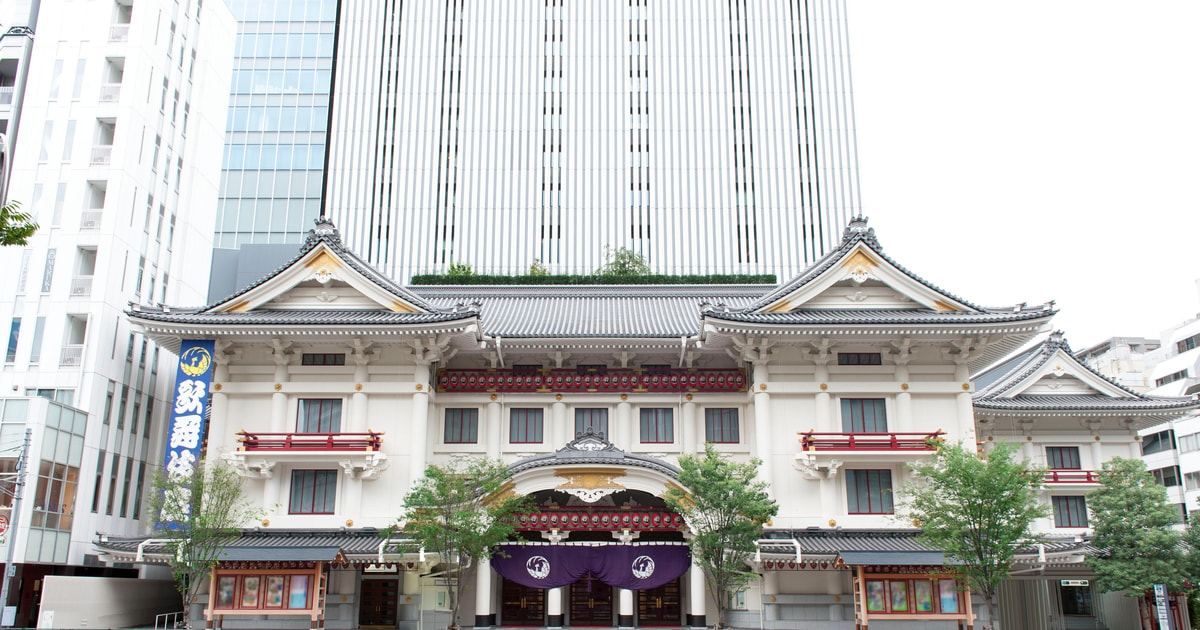
If you’re planning a trip to Tokyo, Kabuki-za is one of the most memorable ways to experience Japanese culture firsthand. GetYourGuide offers English-friendly Kabuki-za tickets and guided experiences, including options with headset translation and pre-show introductions for first-time viewers.
👉 Check Kabuki-za Tickets on GetYourGuide
This section may contain affiliate links. Booking through them costs you nothing extra and helps support this site.



コメント
コメント一覧 (1件)
[…] あわせて読みたい The “Hippō Denju(筆法伝授の段)” Scene — What Is Sugawara Denju Tenarai Kagami? What Is “The Hippō Denju Scene” — Sugawara Denju Tenarai Kagami Sugawara Denju Tenarai Kagami is a classic historical dr […]