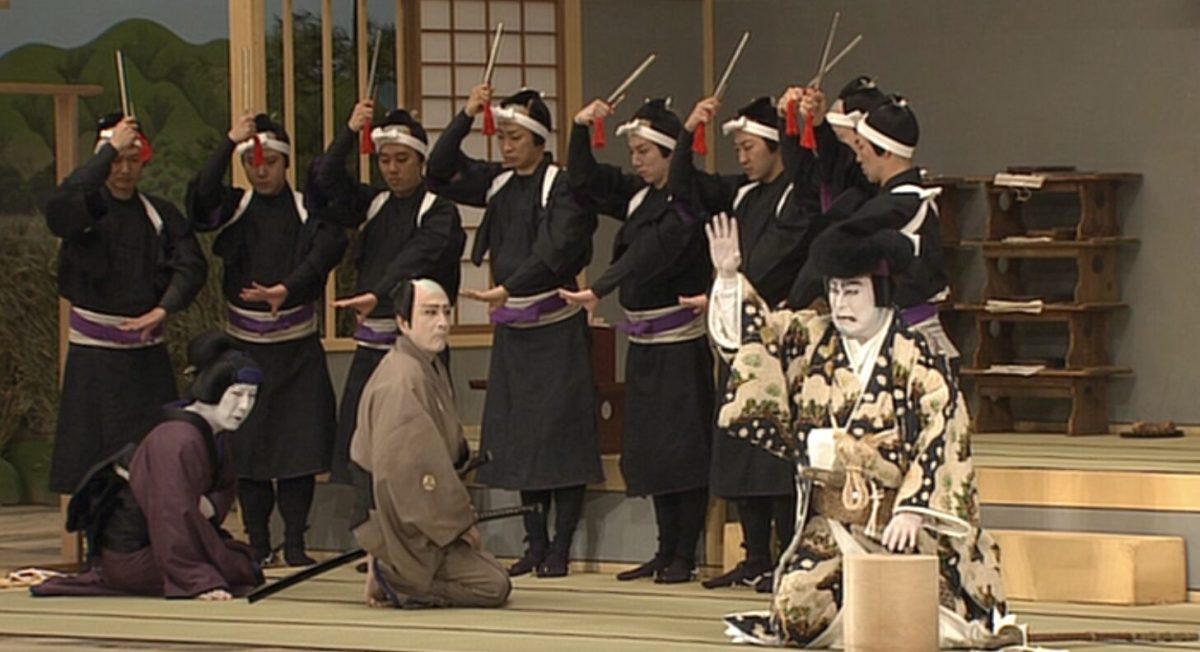
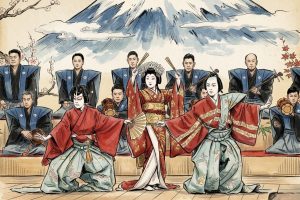
A terakoya was a private elementary school for commoners in Japan during the Edo period (17th–19th centuries).
Terakoya no dan— Sugawara Denju Tenarai Kagami
Set in a small village school in Seriō, on the outskirts of Kyoto, this scene is one of the play’s most celebrated moments, where loyalty to one’s lord and the love between parent and child collide with heartbreaking intensity.
The schoolmaster, Takebe Genzo, is secretly sheltering Kan Shūsai, the son of his lord Kan Shōjō. As the pursuit by Shihei closes in, Shihei’s retainer, Shundō Genba, arrives along with Matsuōmaru, who has ties to the Sugawara family, demanding Kan Shūsai’s head. Faced with an impossible choice, Genzo steels himself to use a newly enrolled boy, Kotarō, as a substitute.
Genzo kills Kotarō and presents his head to Matsuōmaru. After examining it, Matsuōmaru declares it to be Kan Shūsai’s, and the pursuers withdraw. The danger seems to have passed—until Kotarō’s mother arrives to collect her child. It is then revealed that Kotarō was in fact Matsuōmaru’s own son, and that everything had been arranged by Matsuōmaru himself in order to save Kan Shūsai’s life.
Moved by the resolve of Matsuōmaru and his wife, who sacrificed their own child for the sake of loyalty, Genzo, his wife Tonami, and even the rescued Kan Shūsai are brought to tears. In the final moments, Kan Shōjō’s wife and Kan Shūsai depart to seek refuge with Kakujū, while Matsuōmaru and his wife set off toward Toribeno, carrying Kotarō’s body—each pair walking a separate path.
The tragic clash between devotion to one’s lord and the love of a parent makes this scene one of the most powerful and emotionally moving moments in all of kabuki.
“Terakoya Scene” – Sugawara Denju Tenarai Kagami
Summary and Explanation
The Terakoya Entrance
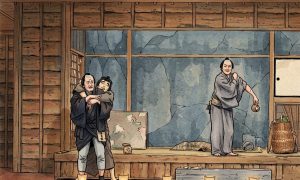
On the outskirts of Kyoto, in the village of Seryō, peasant children sit side by side at the temple school run by Takebe Genzo, practicing their writing. Genzo is away at a village meeting, and in his absence Kan Shusai, disguised in humble clothing, studies quietly among the other children. When an older child misbehaves, Shusai gently corrects him, revealing his intelligence and kind nature. The scene portrays a peaceful, everyday moment.
Inside the Terakoya
Genzo returns, but his face is pale with tension. The “village meeting” was merely a pretext: in reality, he has been confronted by Shundo Genba and Matsuomaru, retainers of Shihei, who have demanded that he surrender the head of Kan Shusai. The village is already surrounded, and there is no way to escape.
At this moment, Genzo’s wife Tonami introduces a boy who wishes to enroll at the school. His name is Kotaro. Seeing the boy’s refined features, Genzo suddenly brightens.
The woman who brought Kotaro says she lives in the same village and asks that the child be accepted into the school. Tonami agrees to take him in, and the woman leaves, saying she must attend to an errand in a neighboring village, entrusting her son to their care.
With no other choice, Genzo resolves to use Kotaro as a substitute for Kan Shusai. If the deception is discovered, he plans to cut down Matsuomaru and the others on the spot, and if that fails, to take his own life together with Kan Shusai. Yet both Genzo and Tonami are overcome with grief at the thought of killing an innocent child who has only just entered their school. They lament, “There is nothing more cruel than serving at court,” and weep.
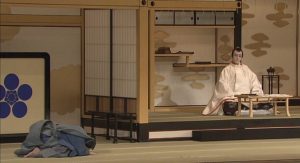
Soon, Shundo Genba and Matsuomaru arrive to demand Kan Shusai’s head. Matsuomaru presides over the head inspection. Genzo goes into the inner room, kills Kotaro, and places the head in a wooden tub, presenting it to them. In the suffocating silence, Matsuomaru declares that it is indeed Kan Shusai’s head, and the pursuers depart.
The immediate danger has passed, but before long, Kotaro’s mother returns to fetch her child. When Genzo raises his sword against her, she blocks the blade with a document case and reveals that she had already resolved to sacrifice her own son as a substitute.
At that moment, Matsuomaru reappears and reveals the truth: Kotaro was in fact his own son, and everything had been arranged in order to save Kan Shusai. Overwhelmed by the depth of loyalty that led the Matsuomaru couple to sacrifice their child, Genzo, Tonami, and the rescued Kan Shusai all weep.
Finally, Matsuomaru calls for a palanquin. From it emerges Sono no Mae, the wife of Lord Sugawara, who is reunited with Kan Shusai. It is revealed that the mountain priest who once rescued and escorted her away in Kita-Saga was none other than Matsuomaru himself. Dressed in white mourning robes, Matsuomaru and his wife lift Kotaro’s body and set off toward Toribeno, the place of cremation.
Main Characters (Terakoya Scene)
from Sugawara Denju Tenarai Kagami
Takebe Genzo
A former retainer of Lord Sugawara, now running a temple school in the village of Seryō on the outskirts of Kyoto. He risks his life to hide Lord Sugawara’s son, Kan Shusai. When pursued by Shihei’s forces, he is driven to the merciless decision of using a substitute child. Torn between loyalty to his lord and basic human compassion, Genzo acts with grim resolve.
Tonami
Genzo’s wife, who manages the temple school and stands closest to him in his anguish. She takes in Kotaro and, knowing how young and innocent he is, suffers deeply over the plan to use him as a substitute. Together with Genzo, she laments, “There is nothing more cruel than serving at court,” conveying to the audience the immense sacrifice demanded by loyalty.
Kan Shusai
The son of Lord Sugawara. Living in disguise and studying at the temple school while fleeing his pursuers, he is the central figure of the story, yet remains largely passive—his life is preserved through the loyalty and sacrifice of the adults around him. Upon learning of the Matsuomaru couple’s decision, he weeps in gratitude and sorrow.
Kotaro
A boy newly enrolled at the temple school. In truth, he is Matsuomaru’s own son. Though still very young, he accepts his role and gives his life as a substitute for Kan Shusai. His innocence and bravery most powerfully underscore the tragedy of the entire scene.
Chiyo
Appearing as Kotaro’s mother, she is in fact Matsuomaru’s wife. Having already resolved to offer her own child as a substitute, she arrives prepared with burial garments and funeral banners. She embodies quiet sorrow, suppressing a mother’s love in order to uphold loyalty.
Matsuomaru
Once a cowherd in the service of Lord Sugawara, now aligned with Shihei. Outwardly he acts as one of the pursuers, yet in his heart he remains loyal to the Sugawara family. He makes the harrowing decision to sacrifice his own son and conceals the truth during the head inspection, embodying loyalty at its most extreme.
Shundo Genba
A retainer of Shihei. He comes to the temple school to confirm Kan Shusai’s head and, having completed his duty, departs. He represents the cold, impersonal authority of power, throwing into sharp relief the inner conflicts of Matsuomaru and Genzo.
Sono no Mae
The wife of Lord Sugawara, who appears at the end to reunite with Kan Shusai. Having once been saved by Matsuomaru, she symbolizes hope for the restoration of the Sugawara family. Bearing the weight of the Matsuomaru couple’s sacrifice, she sets out with Kan Shusai toward a new future.
Highlights of the Terakoya Scene
from Sugawara Denju Tenarai Kagami
The Direct Clash Between Loyalty and Parental Love
The central appeal of this scene lies in the head-on collision between two equally undeniable values: loyalty to one’s lord and love for one’s child. Genzo must kill another person’s child to protect his master’s son, while Matsuomaru goes even further, sacrificing his own son in the name of loyalty. Neither choice can be called wholly “right,” and their overlap leaves the audience with a profound moral question.
The Tension of the Head Inspection and the Power of Silence
When the head is taken offstage and the head box is presented, the scene is ruled not by movement but by silence and stillness. Matsuomaru’s inspection lasts only a moment, yet for the audience it feels like an eternity, where every glance and breath of the actor determines the outcome. Even without flashy action, it becomes one of the most suspenseful moments in all of kabuki.
The Lament Summed Up in “There Is Nothing More Cruel Than Serving at Court”
This line spoken by Genzo and Tonami transcends personal tragedy and comes to symbolize the suffering of all who serve those in power. The irony—that the more faithfully one serves, the further one is driven from ordinary human happiness—is distilled into these few words.
Chiyo’s Quiet Resolve as a Mother
Chiyo’s true intention is revealed not through dramatic outbursts, but through the silent fact that she has already prepared burial garments. By speaking through action rather than emotion, the staging brings her deep sorrow into even sharper relief.
The Catharsis of Matsuomaru’s Dual Role
Matsuomaru appears as a pursuer, yet is in truth the greatest ally. When this is revealed, the tension of the head inspection suddenly shifts in meaning, and the entire story is turned on its head. This structural reversal provides one of the most powerful cathartic moments in the whole play.
The Aftertaste Created by a Child’s Innocence
The account that Kotaro smiled as he offered his head is never shown onstage, yet it leaves the strongest impression on the audience. By placing an innocent child at the center of sacrifice, the story transcends a simple tale of loyalty and lingers as a deeply haunting experience.
This “Terakoya” is not only a scene meant to move the audience to tears,
but also one that compels reflection—
a masterful moment that succinctly reveals the spiritual depth of kabuki.
A Story Not Told in Kabuki
In the original version, Sugawara no Michizane, exiled to Dazaifu, lives out his days in quiet purity under the care of Shiradayū, the father of the triplet brothers. Though living in banishment, he maintains a life of integrity and calm. However, when Umeōmaru comes to visit and reveals that Fujiwara no Tokihira is plotting a great act of treason—scheming even to seize the imperial throne—Sugawara is struck by a surge of fierce anger. His resentment and fury transform him into a thunder god who flies back toward the capital.
In the capital, the thunder destroys Tokihira’s followers. The ghosts of Sakuramaru and Yae also appear, tormenting Tokihira until his life finally comes to an end. When all is over, the skies clear and Sugawara’s spirit is at last appeased. The restoration of the Sugawara clan is proclaimed, and Sugawara is enshrined as Tenman Tenjin, a divine protector of the Imperial Palace. Thus the story reaches a grand conclusion, in which loyalty and unfulfilled resentment are transfigured into divine power.
Related Reading
🎭 Want to See Kabuki Live?
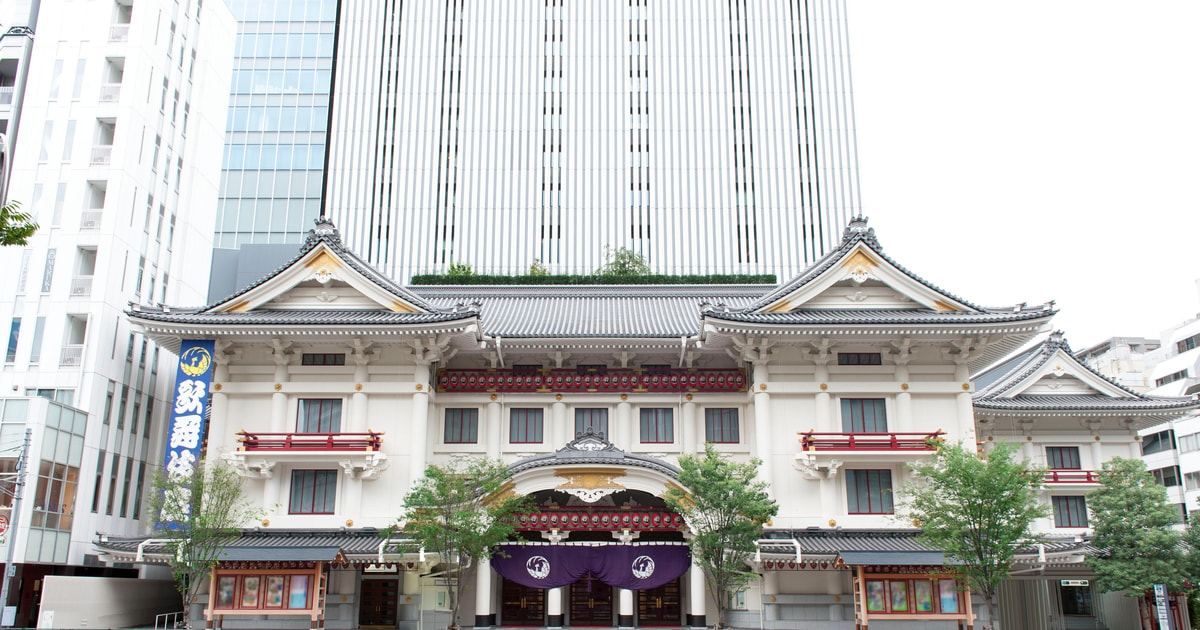
If you’re planning a trip to Tokyo, Kabuki-za is one of the most memorable ways to experience Japanese culture firsthand. GetYourGuide offers English-friendly Kabuki-za tickets and guided experiences, including options with headset translation and pre-show introductions for first-time viewers.
👉 Check Kabuki-za Tickets on GetYourGuide
This section may contain affiliate links. Booking through them costs you nothing extra and helps support this site.




コメント