Kago-tsurube Sato no Eizame(籠釣瓶花街酔醒):A Classic Kabuki Tragedy Explained
A Beginner-Friendly Overview of a Famous Kabuki Tragedy
Kago-tsurube Sato no Eizame is one of the most famous tragic plays in Kabuki, based on a real incident that happened in the Yoshiwara pleasure district of Edo (old Tokyo).
The play was first performed in 1888 and is still regularly staged today as a classic of Kabuki theater.
Story Setting
The story takes place in Yoshiwara, Edo’s most glamorous and exclusive red-light district.
The main character is Sano Jirozaemon, a silk merchant from the countryside.
While visiting Edo, he goes to Yoshiwara looking for souvenirs—and there, his life changes forever.
He encounters Yatsuhashi, the most beautiful and famous courtesan in Yoshiwara, and falls in love with her at first sight.
Love, Jealousy, and Betrayal
Jirozaemon becomes one of Yatsuhashi’s regular patrons and eventually decides to buy her freedom (a practice called “michuke”).
However, Yatsuhashi already loves another man:
a poor but sincere ronin (masterless samurai) named Shigeyama Einosuke.
Because of the selfish actions of Yatsuhashi’s foster father, Gongorō, the secret plan to buy her freedom is revealed.
This puts Yatsuhashi in an impossible situation.
To protect the man she truly loves, she cruelly rejects Jirozaemon, breaking his heart.
The Tragic Turning Point
Deeply wounded, Jirozaemon leaves Yoshiwara.
But later, he returns—this time holding the cursed sword “Kago-tsurube”, a legendary blade said to be so sharp that it cannot even hold water.
What follows is one of the most famous tragic endings in Kabuki history.
Why This Play Is So Famous
This work is loved for its unforgettable Kabuki highlights:
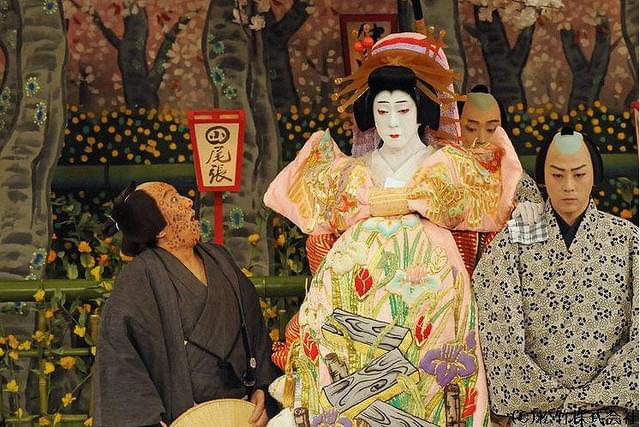
- The spectacular Oiran (courtesan) procession
- The emotionally painful breakup scene
- Jirozaemon’s famous line: “That’s too cruel… even for you.”
- The contrast between beauty, love, obsession, and madness
Although the original play has eight acts, modern performances usually focus on Acts 5, 6, and 8, making it easier for beginners to follow the core story.
Meaning of the Title
The title “Kago-tsurube” refers to the sword used in the final act.
It symbolizes unstoppable sharpness and fate, reflecting how human emotions—love, jealousy, pride—can become uncontrollable.
In One Sentence
Kago-tsurube Sato no Eizame is a powerful Kabuki tragedy that shows how beautiful love can slowly turn into madness, hidden beneath the glittering world of Yoshiwara.
Related Reading

🎭 Want to See Kabuki Live?
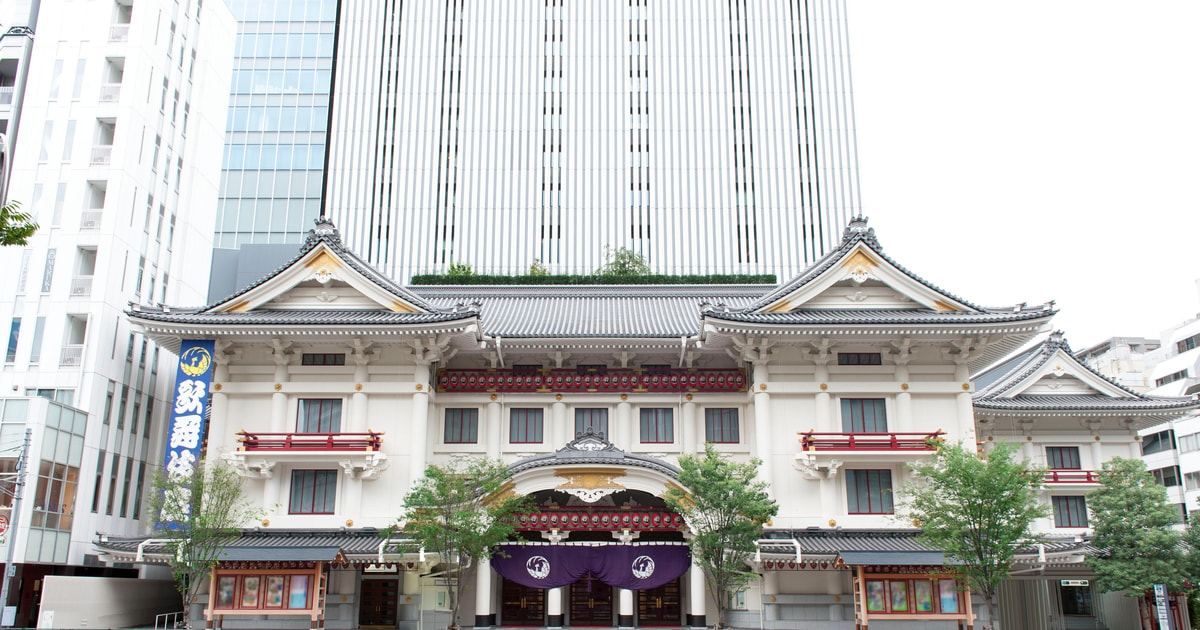
If you’re planning a trip to Tokyo, Kabuki-za is one of the most memorable ways to experience Japanese culture firsthand. GetYourGuide offers English-friendly Kabuki-za tickets and guided experiences, including options with headset translation and pre-show introductions for first-time viewers.
👉 Check Kabuki-za Tickets on GetYourGuide
This section may contain affiliate links. Booking through them costs you nothing extra and helps support this site.



コメント