What Is Sekai no Hana Musubu Kotonoha? (Overview)
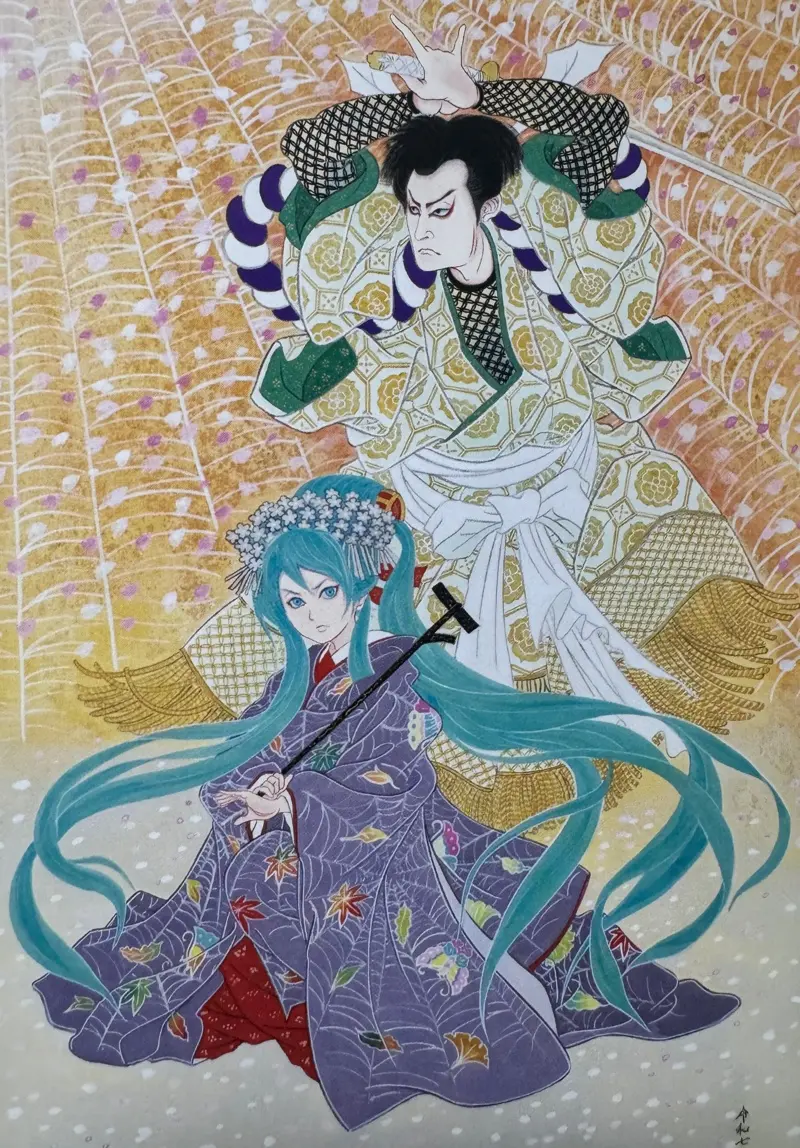
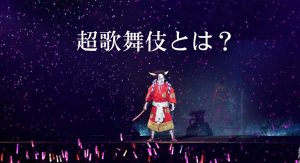
Cho-Kabuki, born from the Niconico Chokaigi event at Makuhari Messe in April 2016, is a new form of theatrical entertainment that fuses classical Kabuki with cutting-edge technology.
Using advanced stage innovations such as NTT’s IOWN technology, Cho-Kabuki has evolved year by year, even expanding to major events such as Expo 2025 Osaka Kansai.
Sekai no Hana Musubu Kotonoha was created as a commemorative production marking the 10th anniversary of Cho-Kabuki.
The play incorporates famous scenes and stage effects from earlier productions such as:
- Hanakurabe Senbonzakura
- Kuruwa Kotoba Awase Kagami
- Tsumoru Koi Yukinosekino To
- Otogizoshi Koi no Sugatae
- Towa no Hana Homare no Isao
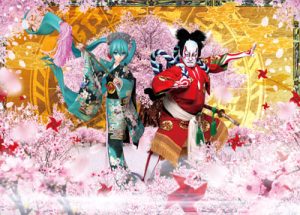
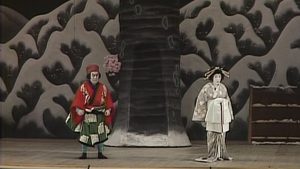
Like an Edo-period kaomise (all-star showcase performance), the production condenses the greatest attractions of Cho-Kabuki into one spectacular work.
The story begins when the bandit Kidomaru learns he is the hidden son of Fujiwara no Sumitomo.
Soon, the dancer played by Hatsune Miku is revealed to be an enchanted painted figure. Her transformation back into a painting during a dance sequence is one of the play’s most iconic scenes.
The first act features dance sequences inspired by classical Kabuki works, encounters involving the demon legends of Rashomon, and lavish stage spectacle.
By the third act, the story deepens through shifting loyalties, revenge, romance, and dazzling quick-change transformations (hayagawari) by the actors.
The fourth act adds emotional weight through tragedy and brotherhood, before building toward a climactic finale.
At the end, digital effects powered by NTT technology, including duplication techniques and the audience’s synchronized penlight participation during the famous line:
“Countless words of the people, and white lights…”
create a uniquely Cho-Kabuki ending in which performers and audience become one.
With its all-star cast and cutting-edge stagecraft, Sekai no Hana Musubu Kotonoha stands as a fitting culmination of ten years of Cho-Kabuki—where tradition and innovation resonate together.
Plot Summary of Sekai no Hana Musubu Kotonoha
Prologue: Parting at Hiiragino Outside the Capital
At the outskirts of the capital, the bandit Kidomaru hears a mysterious voice calling his name.
As he tries to destroy an ancient burial mound, smoke rises and the spirit of Fujiwara no Sumitomo, destroyed in the Tengyo Rebellion, appears.
Kidomaru learns he is actually Sumitomo’s son, Fujiwara no Motozumi.
The spirit commands him to find Princess Nanaori, daughter of Taira no Masakado, and together take revenge against Minamoto no Raiko.
To aid him, Sumitomo summons supernatural allies:
- The spider demon Kumo no Akari
- The mountain witch Ibaraki Baba
Before vanishing, Sumitomo leaves Kidomaru his skull as a keepsake.
Chaos follows as warriors, thieves, and supernatural beings gather in darkness.
Among them is the outlaw Hakamadare Yasusuke, who steals a secret scroll revealing how monsters can be defeated using two sacred arrows and the blood of a man born under specific zodiac conditions.
Act One, Scene One: The Pond at Shinsen-en
At Shinsen-en, attendants capture and beat a white heron that has been eating fish.
Minamoto no Yorinobu intervenes, recalling an old legend in which Emperor Daigo granted rank to a sacred heron.
He orders the bird released.
The white heron takes flight into the sky.
This moment will later prove deeply significant.
Act One, Scene Two: The Dance Pavilion at Shinsen-en
A celebration is held for Raiko and Yorinobu.
There, dancers perform—including a mysterious dancer with emerald hair, played by Hatsune Miku.
Raiko is captivated.
The sorcerer Kumo no Akari reveals that she is no ordinary woman, but a painted figure brought to life.
With a spell, she returns into a folding screen as an image.
The court is astonished.
Raiko then learns the woman’s true counterpart is Nanaaya Tayu, the most celebrated courtesan in the Nine-Article Quarter.
Determined to meet her, he leaves for the pleasure quarter.
Meanwhile, news arrives that thieves have invaded the Imperial Palace treasury.
Yorinobu rushes to stop them.
Act One, Scene Three: The Imperial Treasury
The intruder is Kidomaru.
Using the power of Sumitomo’s skull, he breaks into the treasury to steal the sacred arrows.
Yorinobu confronts him, but is mortally wounded.
Before dying, he tells his fiancée Hatsune-hime that Kidomaru called him an enemy for some hidden reason.
Hatsune-hime vows to recover the arrows and uncover the truth.
Yet something supernatural already surrounds her.
Act Two, Scene One: The Imperial Garden
Kidomaru disguises himself as a gardener.
Hatsune-hime appears disguised as an umbrella seller.
Suspicion grows between them until they reveal their true identities.
Kidomaru confesses he is Fujiwara no Motozumi.
Hatsune-hime reveals she is actually the spirit of the white heron Yorinobu once saved.
She recovers the sacred arrows and escapes into the sky.
Act Two, Scene Two: Rashomon Gate
Hakamadare Yasusuke waits atop Rashomon beneath full spring cherry blossoms.
A white heron delivers a letter and a brocade pouch containing the sacred arrows.
Learning of Yorinobu’s death and Kidomaru’s identity, Yasusuke entrusts the arrows to Sayokaze Gozen, wife of the warrior Watanabe no Tsuna.
The conflict grows closer.
Act Three, Scene One: The Nine-Article Pleasure Quarter
Minamoto no Raiko has fallen deeply in love with Nanaaya Tayu, the famed courtesan of the Nine-Article Quarter, and has become absorbed in pleasure.
Meanwhile, the witch Ibaraki Baba has infiltrated the quarter in disguise, watching events unfold.
Raiko’s loyal retainer Hirai Yasumasa arrives to warn his lord, but tensions rise when misunderstandings in the pleasure house provoke Raiko’s anger.
For a moment, conflict threatens to erupt.
Act Three, Scene Two: The Inner Chamber of the Izumiya
Late at night, Hakamadare Yasusuke secretly enters the chamber of Nanaaya Tayu.
He claims he has come to steal not treasure, but her heart.
But Yasusuke sees through her disguise.
He reveals that she is actually Princess Nanaaya, daughter of Taira no Masakado.
Forced to confess, she admits she approached Raiko seeking revenge—but has truly fallen in love with him.
What follows is one of the play’s darkest turns.
Believing it is the only way to protect Raiko, Yasusuke kills her.
But Kumo no Akari and Ibaraki Baba exploit her jealousy and grief, reviving her as the monstrous Jorogumo (Spider Woman).
Act Four: Raiko’s Mansion
Raiko lies mysteriously ill.
Then the spirit of Nanaaya Tayu appears.
Disguised as a dancing woman named Kochō, she attempts revenge, but Raiko and Yasumasa recognize her true form and drive her back.
Then Hakamadare Yasusuke appears and reveals a shocking truth:
He is actually Yasumasa’s younger brother.
He also brings a secret scroll explaining how to destroy the Spider Woman.
Because he alone was born under the required zodiac signs, only his blood can empower the sacred arrows.
He asks his brother to help him die.
In one of the play’s most moving scenes, Yasumasa tearfully grants his brother’s final wish.
Final Act: Kiyomizu Temple
At the inner sanctuary of Kiyomizu Temple, the final battle begins.
Kidomaru, Kumo no Akari, and Ibaraki Baba clash with the Minamoto warriors.
With help from the White Heron Spirit and Sayokaze Gozen, the tide turns—
but the hatred of the Spider Woman remains.
At the final moment, Raiko appears and calls out:
“Countless words of the people, and white lights…”
And the story reaches its spectacular conclusion.
Main Characters
Kidomaru (Fujiwara no Motozumi)
A feared bandit whose true identity is the son of Fujiwara no Sumitomo.
Driven by revenge, yet torn by human emotion, he stands at the heart of the drama.
Minamoto no Raiko
The legendary warrior leader of the Minamoto clan.
Heroic, flawed, and deeply human, he becomes central to both the political and emotional conflicts of the play.
Hatsune-hime (White Heron Spirit)
A sacred spirit who takes human form after being saved by Yorinobu.
She brings grace, loyalty, and supernatural power to the story.
Nanaaya Tayu (Princess Nanaaya)
A courtesan hiding a secret identity.
Torn between revenge and love, she becomes one of the play’s great tragic figures.
Hakamadare Yasusuke
A master thief with unexpected honor and compassion.
His sacrifice forms one of the emotional peaks of the production.
Highlights of Sekai no Hana Musubu Kotonoha
A 10th Anniversary All-Star Celebration
This production serves as a grand culmination of ten years of Cho-Kabuki.
It brings together memorable elements from earlier productions in a format inspired by traditional kaomise showcase performances.
For longtime fans, it feels celebratory.
For newcomers, it serves as a perfect introduction.
The Fantastical Stage Magic of Hatsune Miku and Kabuki
One unforgettable moment comes when Hatsune Miku’s dancer transforms back into a painted image.
Dance, digital projection, and stage illusion merge into a dreamlike scene unlike anything in conventional Kabuki.
It is Cho-Kabuki at its most magical.
Hatsune Miku Performing a Kabuki Mie Pose
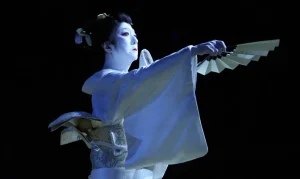
A particularly striking moment comes when Hatsune Miku performs a dramatic mie pose—a stylized freeze central to traditional Kabuki acting.
Seeing a virtual performer execute such a classical technique with precision creates a fascinating contrast between tradition and technology.
It is one of the production’s most memorable visual moments.
Classical Kabuki Beauty Beneath the Technology
Despite its advanced digital effects, the production is rooted in classical Kabuki.
Dance sequences inspired by traditional works, stylized movement, and historical theatrical conventions remain central to the performance.
This is not simply “digital entertainment.”
It is Kabuki transformed.
The Spectacle of Rashomon
The Rashomon scene is visually extraordinary.
Cherry blossoms, supernatural atmosphere, and lavish set design combine into one of the production’s grandest sequences.
Actor Quick-Change (Hayagawari)
The dazzling hayagawari, or rapid costume and role changes, showcase the extraordinary skill of the actors.
These transformations heighten both suspense and theatrical excitement.
Emotional Human Drama
Beyond demons and revenge, the fourth act delivers powerful human drama.
The brotherly farewell between Yasumasa and Yasusuke is among the play’s most moving scenes.
A Finale That Unites Stage and Audience
The climax includes digital duplication effects, synchronized audience penlights, and the iconic shared chant.
It transforms the theater into a festival-like space where performers and spectators become part of the same experience.
This is one of Cho-Kabuki’s defining qualities.
Final Thoughts
Sekai no Hana Musubu Kotonoha is not simply a new Cho-Kabuki production.
It is the culmination of ten years of artistic experimentation.
Blending:
- Classical Kabuki tradition
- Hatsune Miku and virtual performance
- Cutting-edge stage technology
- Revenge, romance, and supernatural drama
it presents a bold vision for the future of Kabuki.
For longtime Cho-Kabuki fans, it feels like a celebration.
For newcomers, it may be the ideal first Cho-Kabuki to experience.
If you want to understand what makes Cho-Kabuki unique, this is the perfect place to begin.
🎭 Want to See Kabuki Live?
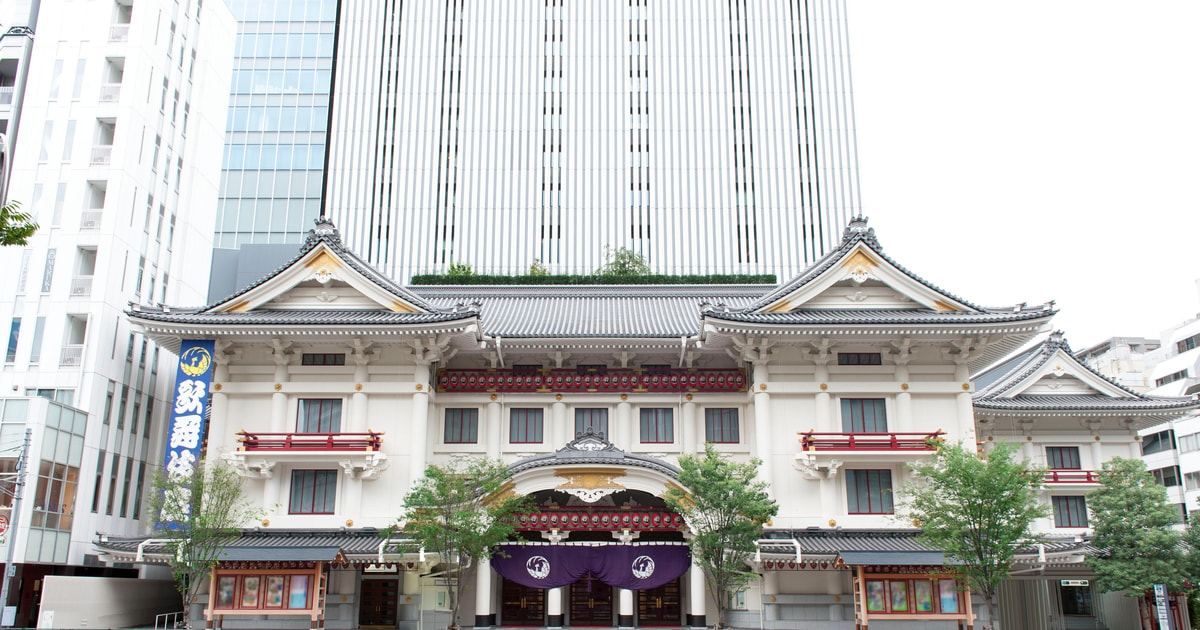
If you’re planning a trip to Tokyo, Kabuki-za is one of the most memorable ways to experience Japanese culture firsthand. GetYourGuide offers English-friendly Kabuki-za tickets and guided experiences, including options with headset translation and pre-show introductions for first-time viewers.
👉 Check Kabuki-za Tickets on GetYourGuide
This section may contain affiliate links. Booking through them costs you nothing extra and helps support this site.



コメント