Introduction: What is “Sekinoto”?
Tsumoru Koi Yuki no Sekinoto (often shortened to Sekinoto) is a celebrated masterpiece of Tokiwazu dance-drama.
It was originally created as the grand finale (Ozumari) of a longer play titled Jujuhitoe Komachi Zakura.
Today, it is performed independently as a standalone dance-drama.
In the tradition of the time, such plays followed specific rules: the protagonist had to be a rebel seeking to overthrow the government, and the finale had to feature the spirit of a tree, bird, or beast.
Sekinoto perfectly follows these conventions by featuring the rebel Otomo no Kuronushi and the Spirit of the Komachi Cherry Tree.
Despite being a dance piece, it is highly regarded for its strong narrative, featuring the human drama of lovers reuniting and spectacular stagecraft like bukkayeri (quick costume changes).
Main Characters
- Yoshimine no Munesada: A loyal retainer to Emperor Ninmyo.
After losing his position in a political upheaval, he lives in seclusion near the Ausaka Barrier. - Ono no Komachi: Munesada’s lover and a woman of legendary beauty and talent.
She is the first to notice Sekibei’s suspicious behavior. - Sekibei (actually Otomo no Kuronushi): The gatekeeper of the Ausaka Barrier.
While he appears to be a simple guard, his true identity is a traitor plotting to seize control of the country. - Keisei Sumizome (actually the Spirit of the Komachi Cherry Tree): A courtesan from the capital.
In reality, she is the spirit of the cherry tree who loved Munesada’s late brother, Yasusada. She seeks to avenge his death. - Yoshimine no Yasusada: Munesada’s brother. His death in a political conspiracy becomes the catalyst for the conflict in the latter half of the play.
The Storyline
The Appearance of Komachi
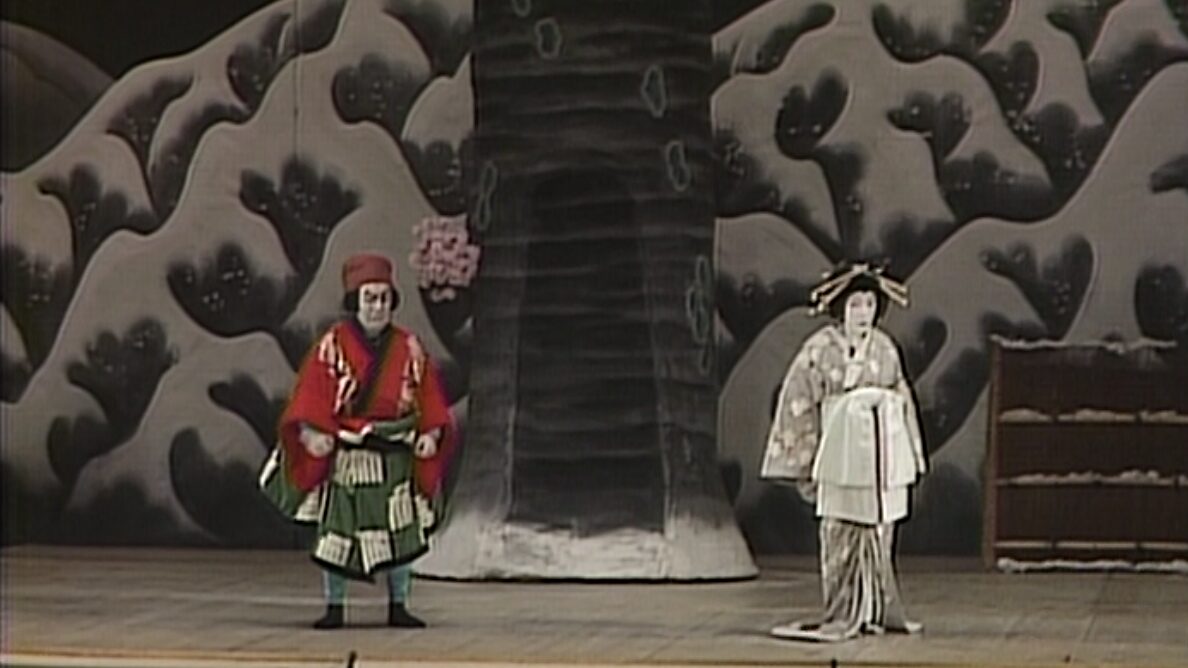
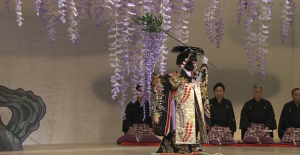
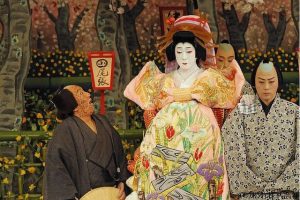
At the snow-covered Ausaka Barrier, a magnificent “Komachi Cherry Tree” is in full bloom.
As the gatekeeper Sekibei works nearby, Ono no Komachi passes by on her way to a temple.
Guided by the sound of a koto (Japanese harp) played by Munesada, she finds her heart drawn toward his dwelling.
Sekibei stops her, suspicious of a beautiful woman traveling alone, and challenges her with difficult questions.
An Unexpected Reunion
Munesada appears and realizes the woman is his lover, Komachi.
The two celebrate their unexpected reunion amidst the snow.
However, the peaceful mood shifts when a document regarding a lost imperial treasure falls from Sekibei’s clothes.
Munesada and Komachi begin to suspect the gatekeeper is not who he claims to be.
The Omen of the Hawk
A hawk flies in, carrying a blood-stained sleeve.
On it is written the message “Two sons in a boat” (Niko Jofune).
This is a secret message from Munesada’s brother, Yasusada, informing him of his death during the coup in the capital.
Suspecting Sekibei is actually the rebel Kuronushi, Munesada sends Komachi back to the capital to investigate further.
The Night Garden
Deep in the night, Sekibei gets drunk on sake.
While peering into his cup, he performs a divination using the stars and concludes: “If I cut down this cherry tree and burn it as a sacred fire, my dark ambition will be realized.”
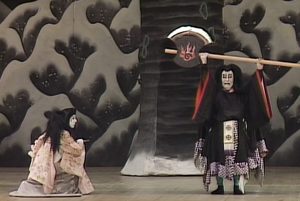
He reveals his true self as Otomo no Kuronushi and prepares to strike the tree with a massive axe.
However, as he swings, a mystical power from the tree causes him to lose strength and faint.
The Appearance of Sumizome
When Sekibei awakens, a beautiful woman named Sumizome emerges from the trunk of the cherry tree.
She claims to be a courtesan in love with him. In reality, she is the Spirit of the Cherry Tree, seeking revenge on Kuronushi for the death of her lover, Yasusada.
The Seduction and Revelation
Sumizome pretends to flirt with Sekibei, teaching him the sophisticated manners of the pleasure quarters.
Sekibei plays along, and they engage in a playful “lovers’ quarrel.” However, Sumizome catches sight of the blood-stained sleeve in Sekibei’s robe, and her expression turns cold with vengeful intent.
The Final Transformation (Mi-arawashi)
Trapped, Sekibei performs a bukkayeri (quick costume change), shedding his gatekeeper’s outfit to reveal his true form as the grand villain Otomo no Kuronushi.
Sumizome also reveals her true nature as the Cherry Tree Spirit. The two face off in a dramatic and stylized battle (tachimawari) amidst the falling snow—a breathtaking climax of visual beauty and power.
Key Highlights (Midokoro)
- The Shock of “Bukkayeri”: The moment the simple gatekeeper transforms into a black-clad villain is the highlight of the show.
The sudden shift in atmosphere is a classic example of Kabuki’s theatrical magic. - The Dual Role of the Onnagata: In many productions, the same actor plays both the elegant Princess Komachi and the ethereal Sumizome. Watching one actor portray such different characters is a testament to the skill of the onnagata (female role specialist).
- Narrative Dance: Unlike abstract dances, this is a “dance-drama” with a clear plot involving love, conspiracy, and supernatural elements, making it accessible even for beginners.

コメント