Kuruma-biki no dan(車引の段) — Sugawara Denju Tenarai Kagami
“Kuruma-biki” is one of the most celebrated aragoto (bold, heroic-style) scenes in the first half of Sugawara Denju Tenarai Kagami. It vividly conveys the injustice of the world after the fall of Kan Shōjō and powerfully impresses upon the audience the fate of the “three triplet attendants” that runs through the entire play.
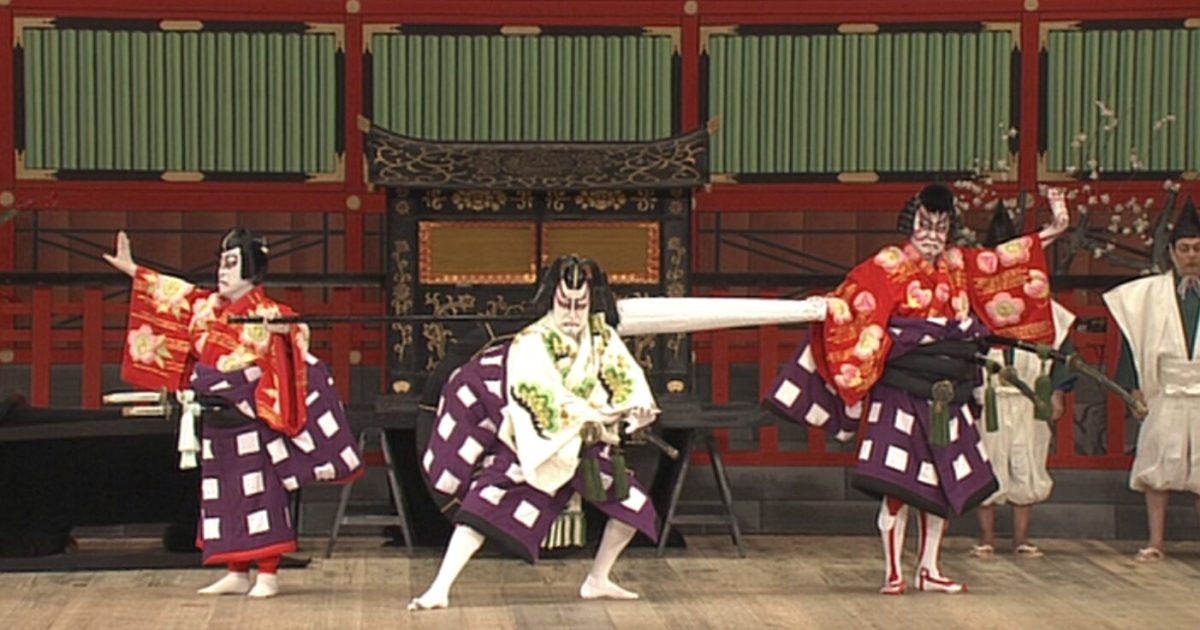
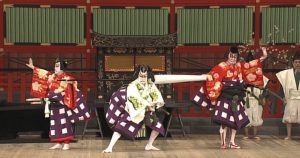
As Left Minister Shihei, who has seized power following Kan Shōjō’s unjust exile, proceeds down the road in his ox-drawn carriage, the now-masterless Umeōmaru and Sakuramaru block his path. Matsuōmaru, who serves Shihei, soon appears, and the three brothers—once united in loyalty to the same lord—are forced into a fierce confrontation as enemies because they now serve different masters.
Amid the rough, energetic struggle centered on the carriage and under the overwhelming authority of Shihei, Umeōmaru and Sakuramaru are compelled to withdraw without achieving their revenge. Here the brothers’ paths decisively diverge, laying the groundwork for the tragedies and inner conflicts that will unfold later in scenes such as “The Ga no Iwai” and “The Terakoya”
Through its flamboyant aragoto style, this scene portrays the arrogance of power, the clash between loyalty and brotherly love, and the deep resentment of those who long for Kan Shōjō’s restoration—making it an essential episode for understanding the dramatic structure of Sugawara Denju Tenarai Kagami.
Kuruma-biki no dan — Synopsis and Commentary from Sugawara Denju Tenarai Kagami
After Kan Shōjō is unjustly exiled and Prince Saisei is forced to leave the court, the triplet attendants—Umeōmaru, Matsuōmaru, and Sakuramaru—are each sent down separate paths by fate. Umeōmaru and Sakuramaru become masterless retainers, and the two unexpectedly meet again on a road in the capital. Thinking of their torn-apart lord and princess, and of Kan Shōjō’s misfortune, they speak tearfully of what has been lost.
At that moment, Left Minister Shihei approaches in an ox-drawn carriage on his way to pray at Yoshida Shrine. When his advance guards arrogantly order everyone to clear the road, the anger and resentment that Umeōmaru and Sakuramaru have long suppressed burst forth. Determined to make Shihei—the source of all their tragedy—pay for his deeds, they step directly in front of the carriage.
However, the one who appears to defend it is their own brother, Matsuōmaru, now in Shihei’s service. The three brothers, once united in loyalty to the same lord, now face one another as enemies because they serve different masters. As they struggle fiercely over whether the carriage will be pulled or stopped, the ox-cart is finally smashed, and the scene descends into chaos.
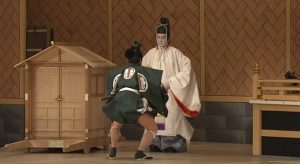
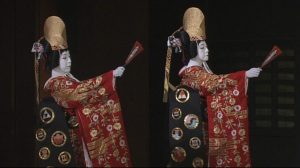
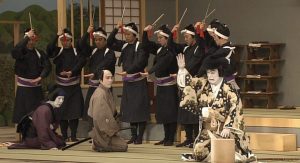
From the turmoil emerges Shihei himself, dressed in white robes and a golden crown. He hurls contemptuous insults at Umeōmaru and Sakuramaru, glaring at them with overwhelming authority and piercing eyes. Confronted by his intimidating presence, the two—burning with rage only moments before—are rendered powerless, and their revenge goes unfulfilled.
Realizing the vast difference in power, the three brothers part ways, each carrying his own position and destiny in his heart. They promise to meet again at the upcoming “Ga no Iwai” the following month, and then depart. This scene, filled with the force of aragoto performance, vividly portrays loyalty to one’s lord, the bonds of brotherhood, and the deep frustration of human beings tossed about by the weight of political power.
Main Characters (Kuruma-biki)
Umeōmaru
One of the triplet brothers and a former retainer of Kan Shōjō. After his lord’s exile, he becomes a masterless warrior. Straightforward and hot-tempered, he harbors fierce loyalty to his former master and deep resentment toward Shihei. In this scene, he boldly stands before the ox-drawn carriage, embodying his unresolved grief and rage through his violent, confrontational actions.
Sakuramaru
Umeōmaru’s brother and another former retainer of Kan Shōjō. More gentle by nature, yet equally devoted to his lord. When he reunites with Umeōmaru on the road, they mourn their master’s misfortune together, and his restrained anger gradually flares as he joins his brother in challenging Shihei’s carriage. He adds emotional depth as a figure torn between fraternal bonds and loyalty.
Matsuōmaru
The third of the triplets, now serving Shihei as an ox-handler. Though he once served Kan Shōjō as well, his change in allegiance places him in direct opposition to his brothers. By standing guard over the carriage and upholding his duty to his current master, he foreshadows the complex moral choices that will define his role in the later “Terakoya” scene.
Shihei
The political enemy who engineered Kan Shōjō’s downfall and now stands at the height of power. In this scene, he appears in white robes and a golden crown atop the carriage, portrayed as a ruthless and overbearing authority figure. With a single, commanding glare, he subdues Umeōmaru and Sakuramaru, symbolizing his absolute dominance and reinforcing his role as the play’s central antagonist.
Zōshiki (Attendant)
A low-ranking retainer who clears the road ahead of Shihei’s procession. His rough, imperious commands highlight the arrogance and excess of Shihei’s entourage, and his actions ignite the anger of Umeōmaru and Sakuramaru, setting the scene’s conflict in motion.
Highlights of the Kuruma-biki Scene
The greatest appeal of this scene lies in its bold aragoto style and the way the fated conflict among the triplet brothers erupts all at once. The ox-drawn carriage itself becomes a central stage device: through the simple physical actions of pulling and blocking, emotions such as loyalty, rage, and defiance of power are powerfully condensed into a single, dynamic spectacle.
First, attention should be drawn to the surge of grief and indignation that builds from the moment Umeōmaru and Sakuramaru appear. Their quiet, tearful remembrance of Kan Shōjō suddenly gives way to their fierce attempt to block the carriage. This sharp contrast highlights the depth of their resentment after their lord’s downfall, and makes it clear to the audience that their anger is not personal vengeance, but an expression of unwavering loyalty.
Next, the tension intensifies with the entrance of Matsuōmaru. Though bound by blood, the brothers now stand on opposite sides because they serve different masters. This confrontation symbolizes the tragic core of Sugawara Denju Tenarai Kagami as a whole. Matsuōmaru’s cool, dutiful composure—still concealing his true intentions—hints at the dramatic developments to come.
The climax comes with the appearance of Shihei and the sheer force of his gaze. Dressed in white robes and a golden crown, he emerges to hurl insults and, with a single, commanding stare, subdue Umeōmaru and Sakuramaru. This moment represents the height of kabuki’s expressive exaggeration, confronting the audience not with logical argument, but with the visceral, physical presence of power itself.
Finally, this scene is more than a mere display of spectacular action. It serves as a crucial turning point that leads into the later “Ga no Iwai” and “Terakoya” scenes. The positions and resolve of the three brothers established here deepen the tragedy and emotional impact that follows—this is precisely why the Kuruma-biki is remembered as one of the play’s most iconic moments.
コメント