
Sagi Musume (The Heron Maiden) – Overview
Sagi Musume is a classic Kabuki dance that tells a tragic love story through the image of a white heron spirit.
The work expresses the pain and obsession of unfulfilled love by blending human emotion with a supernatural presence.
A heron spirit appears in the form of a young woman, conveying longing, sorrow, and quiet desperation through refined, lyrical movement that alternates between stillness and dynamic expression.
Historically, Sagi Musume originated as one dance within a larger multi-role performance called Yanagi ni Hina Shōchō no Saezuri, first performed by the second Segawa Kikunojo in the Edo period.
Although the dance later fell out of the repertory, it was revived in 1886 by the ninth Ichikawa Danjūrō.
From that point on, Sagi Musume began to be performed independently and has since become one of the most celebrated works in the onnagata (female-role) dance tradition.
The music is a major piece in the Nagauta style, characterized by its use of san-sagari tuning, which creates a soft, melancholy atmosphere throughout the performance.
At the opening, all lights in the theater are extinguished, allowing the figure of the white heron to emerge slowly from darkness—a moment that leaves a lasting impression on the audience. In contrast to this quiet mood, the dance also features visually striking highlights such as rapid costume changes (hikinuki), where costumes are transformed in an instant.
Through its combination of poetic music, elegant choreography, and dramatic visual effects, Sagi Musume offers an unforgettable theatrical experience, balancing restraint and brilliance while capturing the beauty and tragedy of obsessive love.
Sagi Musume (The Heron Maiden)
Scene-by-scene synopsis (standard modern performance)
1. Accumulating Feelings
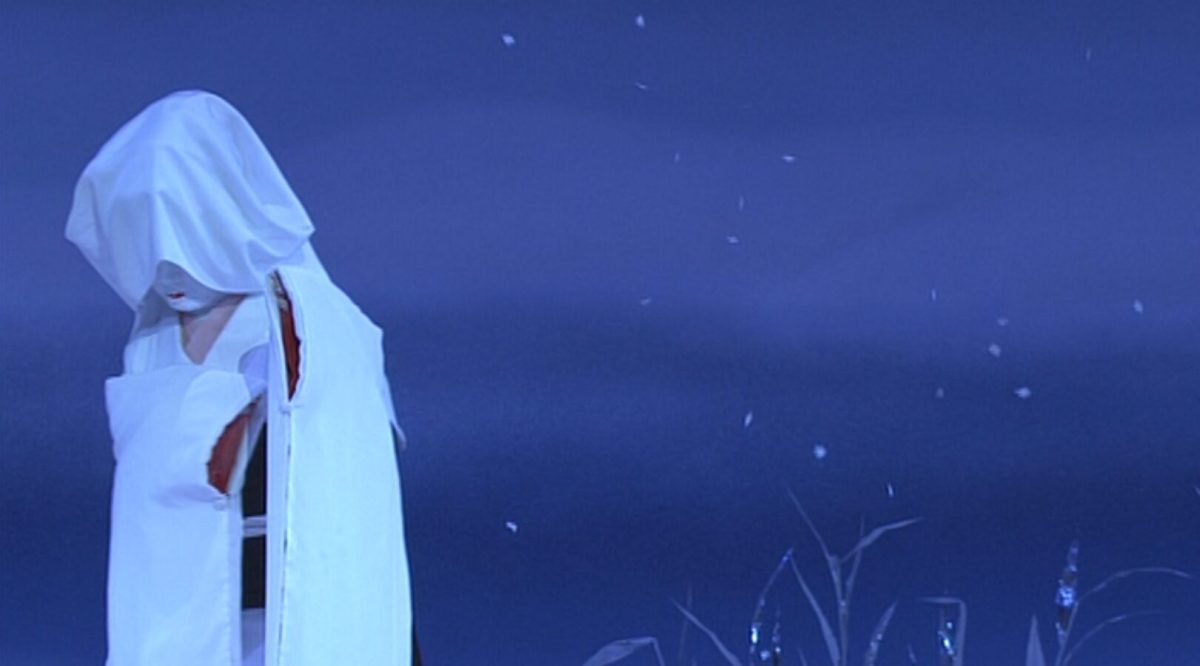
The stage opens on a world of snow.
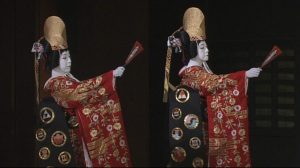
A young woman stands quietly, dressed in a pure white kimono with a hood and holding an umbrella.
Her figure appears both human and avian, as if a white heron has descended into the human world.
As she sings of snow piling up despite the wind, her words describe feelings of love that silently accumulate in her heart. Subtle movements—suggesting wings or the tilt of a bird’s neck—hint at her true nature.
In this still, wintry scene, her unfulfilled love and quiet resentment are expressed with deep melancholy.
2. A Maiden’s Love (Kudoki)
With a sudden costume change, she transforms into a stylish town girl, and the stage brightens.
Using props such as a hood or hand towel, she portrays the delicate emotions of a young woman in love.
This kudoki section focuses on emotional storytelling: longing for a love that cannot be fulfilled, embarrassment at secret meetings, and the tender vulnerability of a human heart. Here, her humanity is most strongly felt.
3. Popular Song (Hayariuta)
She reappears in yet another costume, dancing lightly to a fashionable song of the time.
The lyrics tease and complain about the elusiveness of a man’s heart, and she expresses her love with playful, rhythmic movements.
This bright and lively section contrasts sharply with the sadness that frames the dance as a whole.
4. Umbrella Dance (Kasa-zukushi)
The stage darkens again. After a mournful musical phrase, she performs another quick costume change and begins dancing with an umbrella.
The “umbrella-themed” lyrics lead into a rhythmic and energetic dance section, temporarily stepping away from the narrative. This passage highlights elegance, timing, and visual beauty, offering one of the most entertaining moments of the performance.
5. The Torments of Hell
The mood shifts dramatically.
In the dim light, she appears in a red under-kimono, her movements growing intense and unrestrained.
Overcome by obsession and bitterness, she finally reveals her true form through a dramatic transformation, returning to the figure of a heron.
Condemned to suffering for her obsessive love, the heron spirit endures the torments of hell.
Blood seeps from her wounded shoulder as she struggles to fly through falling snow.
Even as her strength fades, she continues to beat her wings in desperate defiance—until she finally collapses, leaving behind a profound sense of tragedy.
Sagi Musume unfolds through the transformation
from a human girl in love → to the revelation of a heron spirit → to punishment in hell.
Through music, choreography, and spectacular costume changes, the dance weaves beauty and sorrow into a haunting portrayal of love that transcends the boundary between human and supernatural.
Highlights of Sagi Musume (The Heron Maiden)
The appeal of Sagi Musume lies in the way fantasy, deep sorrow, and the refined beauty of Kabuki dance merge into a single, unforgettable stage experience.
One of the most striking features is the blurred boundary between human and heron.
The figure first appears in pure white robes, neither clearly human nor clearly a bird, then becomes a young woman consumed by love, and finally transforms back into a heron.
These changes are never explained through dialogue or story, but are suggested through movement, posture, and atmosphere.
As a result, the audience remains suspended between interpretations, drawn into a dreamlike world where identity is never fixed.
Another major highlight is the symbolic use of costume changes.
Techniques such as hikinuki (instant costume change) and bukkaeri visually transform the performer from a white-robed figure, to a lively town girl, to a red under-kimono, and ultimately into a wounded heron.
These transformations are not merely decorative; they reflect emotional shifts and changes in existence itself.
The final image of the bleeding heron is especially powerful, leaving a lasting impression of love carried to the point of self-destruction.
Equally important is the close relationship between music and movement.
The Nagauta score, played throughout in the melancholic san-sagari tuning, guides the emotional flow of the dance—from quiet stillness, to playful rhythm, and finally to violent torment.
Music and choreography move as one, expressing inner turmoil more eloquently than words.
Finally, the work showcases the exceptional expressive skill of the onnagata performer.
Through subtle gestures—tilts of the neck, flowing arm movements, and wing-like motions—the heron is suggested rather than literally portrayed.
This restrained, symbolic style allows human passion and animal instinct to appear simultaneously, revealing the depth of the actor’s artistry.
Rather than telling a dramatic story, Sagi Musume speaks through form, sound, and presence. The true key to appreciating the dance lies in sensing the intense emotion hidden beneath its quiet beauty.
Characters in Sagi Musume
Sagi Musume features an extremely simple cast.
The entire story is carried by a single presence: the Spirit of the Heron.
The Spirit of the Heron is a white heron that has taken on the form of a young woman.
When she first appears in a pure white kimono, her figure feels ambiguous—she seems neither fully human nor fully bird.
As the dance unfolds, she transforms into a stylish town girl, openly expressing very human emotions: longing, resentment, joy, and sorrow born from an unfulfilled love.
Yet her obsessive attachment ultimately reveals her true nature.
In the final moments, she returns to the form of a heron and endures the torments of hell, suffering as a creature bound by instinct and desire.
In Sagi Musume, a single dancer moves back and forth between human and animal, embodying both within one performance.
Through this transformation, the work explores the depth of passion and the weight of karmic suffering.
No other characters appear on stage, and the man she loves is never shown—he exists only through her emotions and the music.
The audience is thus invited to experience a haunting, poetic world shaped entirely by the inner journey of the heron spirit.


コメント