
Dōmyōji no dan — Sugawara Denju Tenarai Kagami
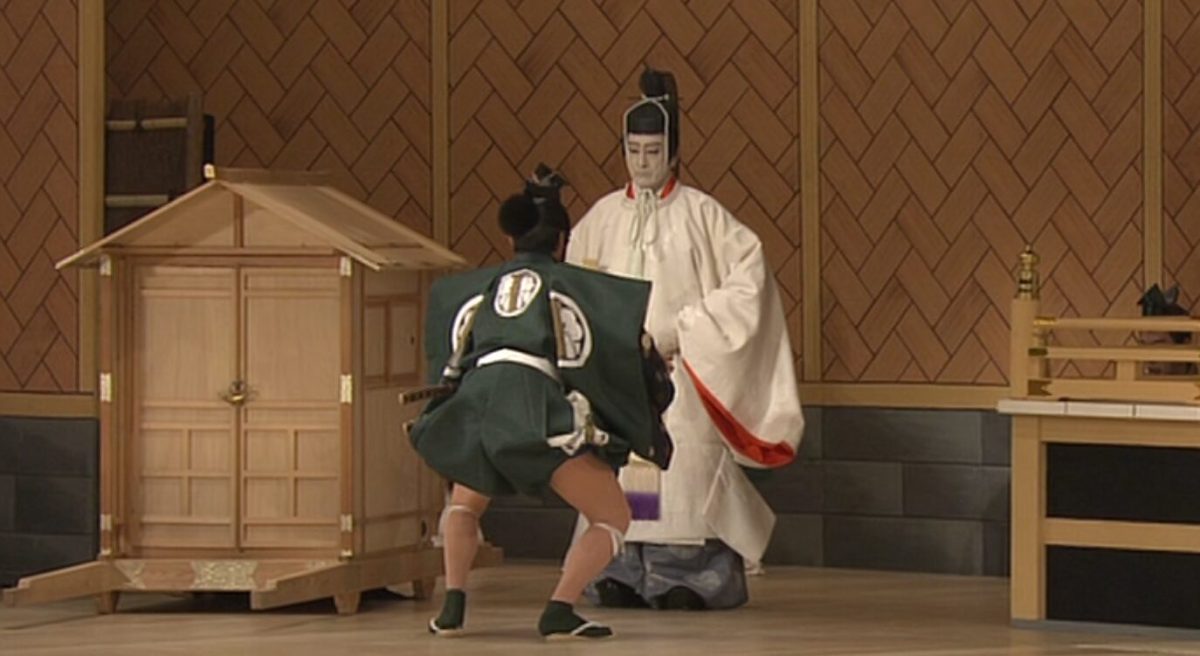
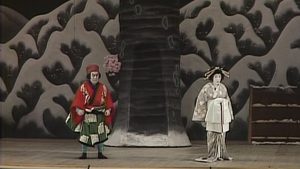
The “Dōmyōji Scene” is a highly lyrical and fantastical episode depicting the sorrow of those parting from Sugawara no Michizane as he is exiled to Dazaifu, along with a miraculous act of substitution.
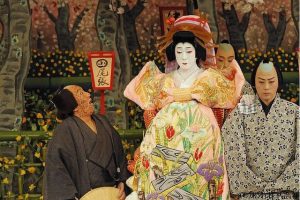
At Kakujū’s residence, Kariya-hime, whose love for Prince Sainyo led to her father’s downfall, longs to see her father one last time before their separation. Enraged, Kakujū punishes her. Just then, a voice is heard from within the room. When Kariya-hime opens the sliding door, she finds not her father himself, but a wooden statue carved by Michizane’s own hand.
Meanwhile, Shukune Tarō and Haji Hyōe, allies of Shihei, plot to have Michizane killed by making a rooster crow early, deceiving him into departing too soon. To silence witnesses, they murder Tachibana. A false escort appears, and it seems as if Michizane has already set out, but the contents of the palanquin are revealed to have been switched: the wooden statue and the living Michizane appear, astonishing everyone.
Michizane explains that a spirit has entered the statue he lovingly carved, allowing it to take his place and save his life.
At last, the true moment of departure arrives. Leaving behind Kariya-hime’s sorrowful cries, Michizane begins his journey to Dazaifu.
The Dōmyōji Scene is renowned as one of the most dreamlike and tragic episodes in Sugawara Denju Tenarai Kagami, condensing parental love, betrayal and murderous intent, and a miracle born of faith into a single, unforgettable stage moment.
Dōmyōji Scene — Sugawara Denju Tenarai Kagami: Detailed Summary
The Cane Beating (Tsue Orikan) Scene
Late at night in Kakujū’s residence, Kariya-hime longs to see her father, Sugawara no Michizane, before he is exiled to Dazaifu, and tells her sister Tachibana of this wish. Kakujū, enraged that her own father lost his post due to Kariya-hime’s love affair, punishes her with a cane. Suddenly, Michizane’s voice is heard from within a small room, and Kakujū, moved by emotion, halts his punishment. When Kariya-hime opens the sliding door, her father is nowhere to be seen; only a wooden statue carved by Michizane himself is placed there.
Tōtenkō (東天紅) Scene
Tachibana’s husband, Shukune Tarō, and her father, Haji Hyōe, allies of Shihei, plot to kill Michizane by luring him out of the residence before dawn with the sound of a rooster. To prevent Tachibana from revealing their plan, they deceive and kill her, sinking her body in a pond. Haji Hyōe then uses this corpse in a clever scheme to mimic a rooster’s crow to signal dawn, carrying out his cruel plot.
(Tōtenkō is the Edo-period way of writing the rooster’s crow “cock-a-doodle-doo” in kanji, symbolizing the break of dawn.)
Parting Cup (shōjō Nagori) Scene
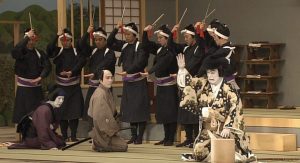
Believing the rooster’s crow signals dawn, the household prepares a farewell cup for Michizane and sends him off with a fake escort. Soon, the death of Tachibana is discovered, and Kakujū realizes the culprit is Tarō when he finds him biting Tachibana’s sleeve and strikes him down. A formal escort, the Hangan-dai Terukuni, arrives, but Michizane has already departed.
Substitute (Miraculous) Scene
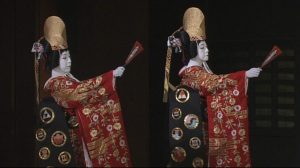
Amid the confusion, Michizane appears from within the small room, hiding with Terukuni. When the fake escort returns and examines the palanquin, Michizane and the wooden statue have been swapped, astonishing everyone. Michizane explains that the wooden statue he carved himself had received a soul, acting as a miraculous substitute to save his life.
Departure (Shuttatsu) Scene
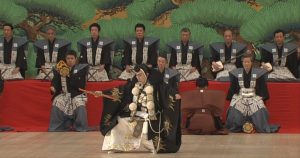
As the time of departure approaches, Kakujū offers Michizane a kimono for warmth, but hidden inside the garment is Kariya-hime herself. Michizane, as a father, suppresses his emotions and declines the gift, setting out on his journey. With Kariya-hime’s cries in the background, Michizane, accompanied by Terukuni, travels to his assigned post in Dazaifu.
This Dōmyōji segment condenses intense parental affection, betrayal and murderous intent, and miraculous intervention into a single, highly dramatic and fantastical stage sequence.
Main Characters (Dōmyōji Scene)fromSugawara Denju Tenarai Kagami:
Kanshōjō
The tragic protagonist, exiled to Dazaifu for a crime he did not commit. In the Dōmyōji scene, he is depicted with nobility, accepting everything without showing anger or resentment. The miraculous event in which the wooden statue he carved comes to life as a substitute symbolizes his virtue and deep emotions. His decision to part from his adoptive daughter, Kariya-hime, while thinking of her as a parent, highlights the height of his character and spirit.
Kakuju
shōjō’s aunt and Kariya-hime’s biological mother, a strict elder woman. She initially punishes Kariya-hime harshly, resenting the romance with Prince Saisei that led to shōjō ’s downfall. However, hearing shōjō’s voice makes her realize her mistake. Torn between loyalty and familial affection, she struggles but ultimately seeks to protect shōjō, eliciting audience sympathy.
Kariya-hime
shōjō’s adopted daughter, and Kakuju’s biological daughter. The young princess whose romance with Prince Saisei brought tragedy. Her pure wish to see her father one last time, combined with the guilt over the consequences of her love, is moving. Her attempt to hide in a box to accompany her father symbolizes the depth of parental and filial affection.
Tatsuta no Mae
Kakuju’s daughter and Kariya-hime’s older sister, a kind woman who cares deeply for her younger sister. She discovers her husband and father-in-law plotting to assassinate shōjō and tries to stop them, but is killed in the process. Her unjust death stands out as the story’s most senseless sacrifice, emphasizing the cruelty of evil.
Sukune Tarō
Husband of Tatsuta no Mae and supporter of Fujiwara no Tokihira. Alongside his father, Haji Hyōe, he plots to kill shōjō, displaying ruthless coldness by willing to kill his own wife to achieve his goals. The discovery of his actions through Tatsuta’s death leads to his downfall, embodying karmic retribution.
Haji Hyōe
Father of Sukune Tarō and an even more ruthless schemer. He devises the cunning plan involving the rooster’s crow to lure and kill shōjō. Ultimately captured by the official envoy, he is depicted as intelligent but merciless, providing tension and drama to the story.
Hangandai Terukuni
The official imperial envoy sent to escort shōjō. Detached from conspiracies, he is loyal to his duty and recognizes the false escorts, restoring order. He protects shōjō amidst the chaos, representing law, order, and justice within the narrative.
Highlights of the Dōmyōji Scene
The greatest appeal of the Dōmyōji Scene lies in its structure, where tragedy and miracle unfold simultaneously. While human ugliness—such as betrayal and murderous intent—is depicted, the stage is also enveloped by parental affection and miraculous, faith-inspired phenomena, allowing the audience to experience layered emotions.
Parental affection in the “ Punishment” scene
One of the first points of note is the depiction of parental love during the Staff Punishment scene. Kakuju’s strict discipline toward Kariya-hime contrasts with the voice of Sugawara no Jōshō heard from within the room. Although he never appears physically, Jōshō’s virtue and presence are made vividly clear. The moment when Kariya-hime opens the shōji (sliding door) to find the wooden statue serves as a crucial foreshadowing of the theme of “substitute” that runs throughout this scene.
Cruelty in the “Tōtenkō” scene
The scheming of Sukune Tarō and Haji Hyōe, depicted in the Tōtenkō scene, represents some of the story’s most brutal moments. Their plotting to lure Jōshō out with a rooster’s crow and the ruthless murder of Tatsuta create an intense impression of the coldness of those aligned with power. This darkness heightens the impact of the miraculous events that follow.
Core stagecraft from the “Farewell Cup” to the “Substitute” scene
The sequence from the Farewell Cup scene to the Substitute scene contains the most dramatic and theatrical moments in Dōmyōji. The seemingly departed Jōshō appearing in the room, with the contents of the palanquin mysteriously switched, creates a sense of wonder unique to kabuki’s stylized aesthetics. His words—that the wooden statue he carved with all his heart became imbued with life—symbolize the play’s central idea that scholarship and virtue can generate miraculous outcomes.
Final departure scene
In the climactic Departure scene, Kariya-hime hiding inside the box makes the parent-child farewell especially poignant. Jōshō suppresses his emotions to part from her, and his final “Tenjin-mie” pose leaves the audience with a powerful blend of sorrow and nobility.
Conclusion
The Dōmyōji Scene masterfully depicts both the tragedy born of human malice and the miracle brought about by virtue and prayer. It is considered one of the most spiritually profound and thematically rich scenes in Sugawara Denju Tenarai Kagami.
コメント