
In a previous blog post, I wrote how irresistible both the morning and afternoon programs of the May Grand Kabuki—the farewell performances at Osaka Shochikuza—looked, and how I wanted to see them both!!
Now, the same dilemma has struck again with the Osaka Shochikuza Farewell Performances, “Honorable April Grand Kabuki.” I want to see both shows here as well!!!
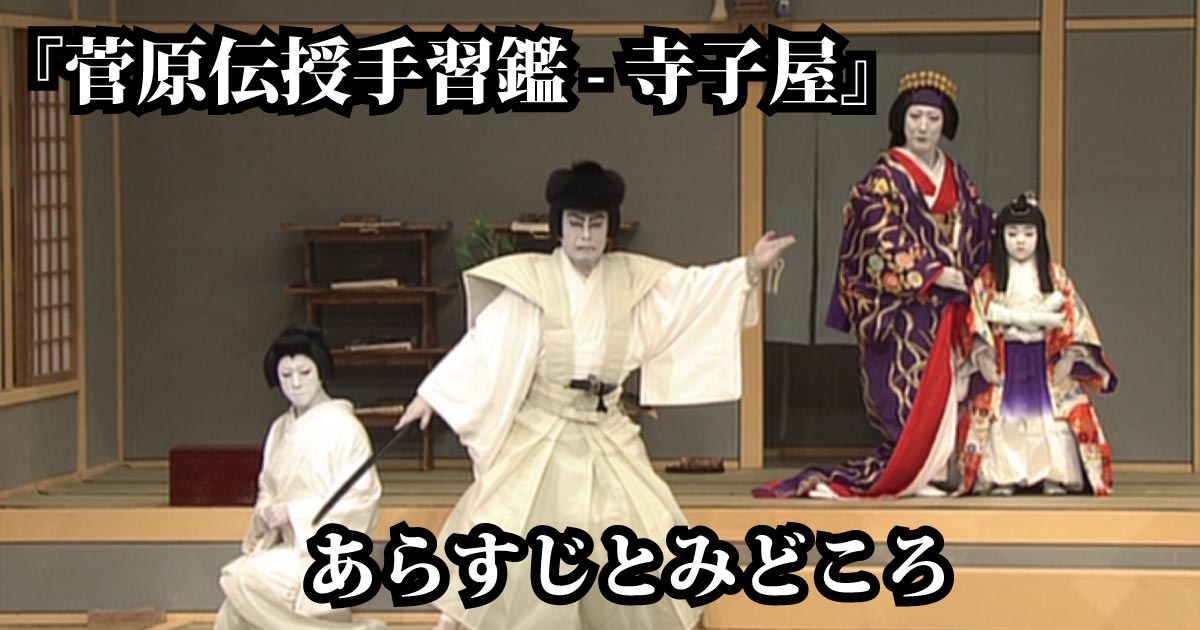
The morning program features Kejimura (“Ketamura”) with Shido and Seishiro, while the afternoon program stars Kataoka Nizaemon in Sugawara Denju Tenarai Kagami – Terakoya.
I truly want to see them both!!
Ahh… what a delightful problem to have.
So, I decided to refresh my memory with a DVD I had on hand.
This time, I watched the Terakoya (“The Village School”) scene—the final and most celebrated act of the masterpiece Sugawara Denju Tenarai Kagami.
Sugawara Denju Tenarai Kagami is a classic of the kabuki repertoire that weaves together political intrigue in the capital, the exile of Lord Sugawara, and the unwavering loyalty and parental devotion of his retainers who risk their lives to protect his household. It is a work that combines dazzling theatrical beauty with deeply moving human drama.
Because the full play runs for many hours, it is rarely performed in its entirety today. Instead, theaters usually select and present only the most highly regarded acts.
Among them, the Terakoya scene is the most frequently staged—and the most beloved—of all.
“If they were performed in full, the morning program would run about four hours, and the afternoon program just under four as well. It’d be a full day’s undertaking.”
“Terakoya is a weighty scene packed into a single, compact act, where a parent faces the ultimate choice—sacrificing their own child to save their lord’s son—and where the air grows taut at the moment the truth is revealed. Within this brief episode, the very essence of kabuki storytelling and emotional intensity is powerfully condensed.”
“Let me say it straight away! On Kabushige’s beginner-friendly scale, this one gets ★★★. It does take just a little bit of homework beforehand.”
“Synopsis of Sugawara Denju Tenarai Kagami – Terakoya
The full synopsis of Sugawara Denju Tenarai Kagami is quite long, so for those who are interested, please see the link here.
Characters
First, let’s sort out the cast of characters.
Lord Sugawara (Sugawara no Ason / Kan Shōjō):
He does not appear in this scene. He is the father of Kan Shūsai and has been exiled to a distant island through the schemes of Tokihira.
Fujiwara no Tokihira:
He does not appear in this scene. A political rival of Lord Sugawara, he drives him from power through a conspiracy.
Matsuōmaru — Matsumoto Kōshirō:
Because he knows the face of Lord Sugawara’s son, Kan Shūsai, he is ordered to carry out the head inspection.
Owing loyalty to both Sugawara and Tokihira, he secretly carries out a plan with his wife, Chiyo, to save Kan Shūsai’s life.
Chiyo — Bandō Tamasaburō:
The wife of Matsuōmaru.
Takebe Genzo — Kataoka Nizaemon:
A former retainer of Lord Sugawara and also his student of calligraphy. He was disowned for an illicit relationship with Tonami and now runs a village school in the mountains.
In the “Calligraphy Transmission” scene, he is summoned by Sugawara and receives the secret teachings of calligraphy, while secretly sheltering Kan Shūsai. Later, Tokihira orders him to present the boy’s severed head, forcing Genzo to make the agonizing decision to choose a substitute from among his pupils.
Tonami — Nakamura Kanzaburō:
Genzo’s wife. She once served as a lady-in-waiting to Sonō no Mae, but was disowned for her illicit relationship with Genzo and now runs the village school with him.
After learning of her husband’s painful decision made in the name of loyalty, the two lament together the hardship and cruelty of life in service at court.
Kan Shūsai — Matsumoto Kintarō:
The young son of Lord Sugawara and Sonō no Mae. Though still a child, he is exceptionally gifted.
He is hidden away in Seriō Village, living as if he were the child of Genzo and Tonami.
Shundō Genba — Bandō Hikozaburō:
A red-faced warrior and retainer of Tokihira.
Sonō no Mae — Nakamura Tokizō:
The lawful wife of Lord Sugawara and the mother of Kan Shūsai. She has always kept Genzo and Tonami in her thoughts, even after they were disowned for their transgression.
After Sugawara’s downfall, she lives in hiding in Kita-Saga, but is later rescued by Matsuōmaru and eventually reunited with Kan Shūsai.
Yodarekuri Yotarō — Nakamura Kōraizō:
A noticeably large “child” mixed in among the children at the school.
Terakoya — Synopsis
Set in a village school on the outskirts of the capital, in Seriō Village, this celebrated scene depicts a fierce clash between loyalty to one’s lord and the bonds between parent and child.
Genzo (Kataoka Nizaemon) appears on the hanamichi, deep in troubled thought.
He has been harshly ordered by Tokihira’s retainer, Shundō Genba, and by Matsuōmaru himself to present the severed head of Kan Shūsai.
When Genzo returns to the school, the children greet him cheerfully, but his mood remains dark. Then Tonami (Nakamura Kanzaburō) introduces a new pupil, a boy named Kotarō, who wishes to enroll. Seeing the refined look on the child’s face, Genzo’s expression suddenly softens.
At that moment, Genzo realizes that Kotarō could be used as a substitute for Kan Shūsai.
When Tonami asks why he has suddenly changed, Genzo confides that he has been ordered to hand over the head of the boy they are hiding—Kan Shūsai. His plan is to offer Kotarō’s head in his place.
If the deception is discovered, he is prepared to cut down Matsuōmaru and escape; and if even that fails, he is resolved to take his own life together with Kan Shūsai.
Matsuōmaru, the second of three brothers, knows the face of Kan Shūsai. Yet he chooses to gamble that he will not see through the ruse.
Still, the cruel reality of having to take the life of a newly enrolled, innocent child weighs heavily on both Genzo and Tonami. They lament, “How bitter a thing is service at court,” and weep over their fate.
Though it is for their lord, they must cut down a young child.
It is a heart-wrenching moment.
Soon, Shundō Genba arrives with the parents who have children at the school, come to retrieve them—so that no one else’s child will be mistakenly killed.
A little later, Matsuōmaru (Matsumoto Kōshirō) arrives in a palanquin. He appears unwell, wearing a long, untrimmed wig and a bandage around his head—signs of illness and exhaustion.
Though the scene is solemn, the oblivious Yodarekuri Yotarō steals the show with his antics, providing a moment of comic relief.
After the children are led away, Genba and Matsuōmaru step inside to conduct the head inspection.
From within, Genzo’s cry of “Ei!” is heard as he strikes down Kotarō.
Tonami staggers, and Matsuōmaru himself reels and bumps into her. He strikes a bold pose and shouts, “Insolence!”
Genzo presents the head in a box. After examining it, Matsuōmaru declares it to be the head of Kan Shūsai. Believing their task complete, they depart.
This is the most famous and gripping moment of the scene.
Just as the danger seems to have passed, Kotarō’s mother, Chiyo, arrives to take her child home. Fearing the truth will be exposed, Genzo raises his sword to kill her.
Chiyo stops the blade with her son’s book satchel.
She cries out,
“Has my child served as a worthy substitute for Kan Shūsai? Tell me—did it succeed? I want to know!”
Inside the satchel are burial robes and a banner inscribed with Namu Amida Butsu—everything prepared for a funeral.
At last, the truth is revealed: Kotarō was in fact Matsuōmaru’s own son, and the entire plan had been devised by Matsuōmaru himself to save Kan Shūsai.
When Matsuōmaru asks Genzo how Kotarō faced his death, Genzo replies that when he told the boy he was to die in place of Kan Shūsai, the child calmly offered his neck and smiled.
It is a scene no one can watch without holding back tears.
Moved by the resolve of Matsuōmaru and Chiyo, who sacrificed their own child for loyalty to their lord, Genzo, Tonami, and even the saved Kan Shūsai weep.
In the end, Kan Shūsai departs with Sonō no Mae, the wife of Lord Sugawara, to seek refuge with Kakujū, while Matsuōmaru and Chiyo carry Kotarō’s body toward Toribeno. Each goes their separate way.
The tragic collision between devotion to one’s lord and the love of a parent strikes the heart as one of the most moving scenes in all of kabuki.
The act closes with the iroha procession and a final bold pose, and the curtain falls.
Note: A “kadobi” is a fire lit at the gate to send off the spirits of the dead.
After Watching Terakoya
Standout Role
Kataoka Nizaemon
Highlights
The Head Inspection (Kubi-jikken)
Matsuōmaru’s resolve and inner conflict as he examines what may be the head of his own child, Genzo’s fear of being exposed and his readiness to strike if necessary—within the stillness of the scene, a taut tension fills the air. The emotional turmoil of each character seeps through the smallest gestures and the slightest pauses.
The Presence of Chiyo
Never stepping too far into the foreground, yet understanding everything, Chiyo’s quiet bearing only heightens the weight of Matsuōmaru’s decision.
The “Iroha Okuri”
As Kotarō’s body is sent off, a famous passage of gidayū chanting known as the “Iroha Okuri” is recited, adding a deeply moving poetic layer to the farewell.
Viewing Ratings
Overall Satisfaction: ★★★★★★★☆☆☆
Beginner-Friendliness: ★★★★☆☆☆☆☆☆
Density of Highlights: ★★★★★★★★★☆
Emotional Impact: ★★★★★★★★★☆
Rewatch Value: ★★★★★★★★★☆
Note: These ratings reflect personal taste.
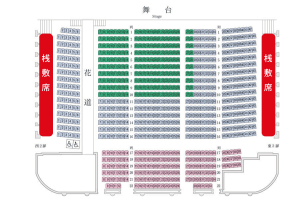
Kabushige’s Recommended Seating
For a Full View of the Stage:
Seats around the center, roughly rows 7–9, or the so-called “Tenchō Seats” (the very front row of the second floor).
Seats Near the Hanamichi:
You’ll mainly see Genzo’s entrance and the children leaving the school. These can be nice if your favorite actor is passing by, but personally, I recommend sitting closer to the center of the house.
“I came across an article in which Nizaemon spoke about his feelings for the role of Matsuōmaru, a role that has been passed down through his father and grandfather.”
コメント