
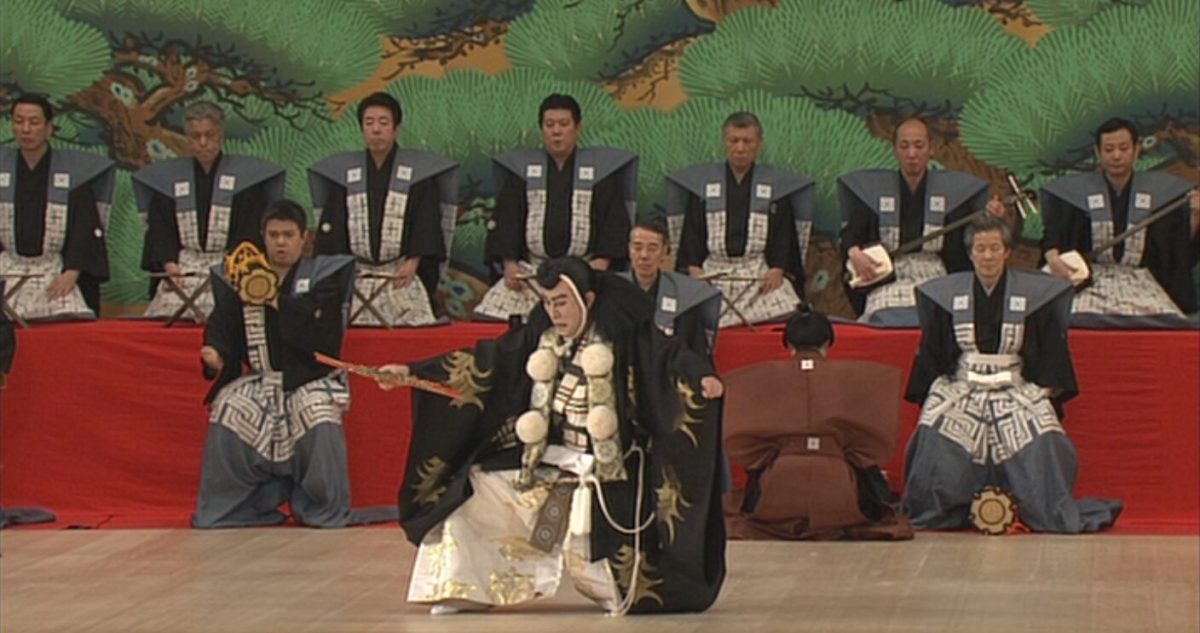
Kanjinchō” is one of the plays in the famous “Kabuki Jūhachiban” repertoire.
What is Kanjinchō from the “Kabuki Jūhachiban”? | Overview of the Play
Kanjinchō is one of the most celebrated plays counted among the “Kabuki Jūhachiban” (Eighteen Best Kabuki Plays), representing the essence of Kabuki theater.
Originally, it was performed as a specialty of the Ichikawa family, who inherited the style of the first Ichikawa Danjūrō, the founder of aragoto (rough style) acting.
However, due to a lack of strong heirs in the family, other actors gradually began performing the role of Benkei.
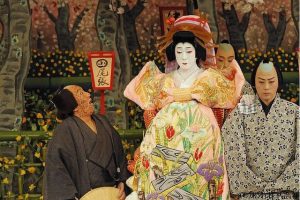
Today, Kanjinchō is considered a representative Kabuki classic, and the three main roles—Benkei, Yoshitsune, and Togashi—are traditionally performed at least once in the career of a top Kabuki actor.
The play depicts the scene in which Minamoto no Yoshitsune and his loyal retainer Benkei attempt to pass through the Ataka checkpoint on their way to the Oshu region, fleeing from the pursuit of Yoshitsune’s older brother, Minamoto no Yoritomo.
Kanjinchō is performed as a one-act play.
The story is adapted from the famous Noh play Ataka.
The stage setting imitates the Noh style with matsubame (pine-patterned backdrop), and the costumes are similarly influenced by Noh.
Kabuki retains the tense atmosphere of Noh while adding the boldness of aragoto and a deeply human drama.
Note: “Kanjinchō” refers to a scroll used to solicit donations for a temple.
Synopsis of Kanjinchō
Togashi’s Entrance
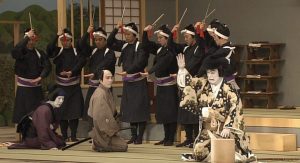
At the Ataka checkpoint on the Hokuriku road, the samurai Togashi Saemon is on high alert.
He has received orders from the Kamakura shogunate to capture Minamoto no Yoshitsune, who has fallen out of favor with his elder brother, Shogun Minamoto no Yoritomo.
Yoshitsune is said to be fleeing disguised as a yamabushi (mountain ascetic), and Togashi, with his attendants, is prepared to stop him.
Note: Yoshitsune is also referred to as Hōgandono.
The Party Arrives
Yoshitsune, a hero who played a key role in defeating the Taira clan, is now suspected of treason by his brother.
With his loyal retainer Benkei and others, he flees to seek refuge with the Fujiwara family in the Oshu region.
Benkei, a real yamabushi trained on Mount Hiei, devises a plan: the party disguises themselves as yamabushi, with Yoshitsune dressed as a strong porter carrying the luggage.
Reading the Kanjinchō
Benkei claims they are collecting donations (kanjin) to help rebuild the burned Todai-ji Temple.
Togashi, however, already suspects their disguise and strictly forbids passage to yamabushi.
To clear their names, Benkei and his men recite a formal appeal to convince Togashi. Impressed, Togashi orders Benkei to read the kanjinchō scroll.
Benkei improvises with a scroll he has on hand, reading aloud the donation request as if it were genuine.
Yamabushi Questions
Togashi, admiring Benkei’s skill, questions him about the meaning behind the yamabushi attire and the secret “nine-syllable mantra” (kuji no shingon).
Benkei explains that each item represents a Buddhist figure and demonstrates the proper use of the mantra.
Satisfied, Togashi apologizes for his suspicion and offers donations as if for the temple’s reconstruction.
The Beating (Chōchaku)
Just as the party is about to leave, Togashi is told a porter resembles Yoshitsune.
He stops them again.
To prove their loyalty and honesty, Benkei strikes Yoshitsune with his staff. Even so, Togashi remains doubtful.
Benkei then threatens, “If you still doubt, I could kill this porter right here,” showing his readiness to sacrifice himself for his lord.
Moved by Benkei’s devotion, Togashi finally allows them to pass, accepting the risk himself.
Yoshitsune and Benkei Speak
Once Togashi departs, Yoshitsune and his men praise Benkei’s quick thinking.
However, Benkei feels deep guilt for striking his lord.
Yoshitsune comforts him, sharing the hardships of their battles and praising his resourcefulness.
Benkei apologizes, tears in his eyes, but Yoshitsune accepts his loyalty and forgives the act, allowing the party to continue their journey.
Benkei’s Ennen no Mai (Dance of Eternal Years)
After passing the checkpoint, Togashi offers Benkei sake as an apology for doubting him.
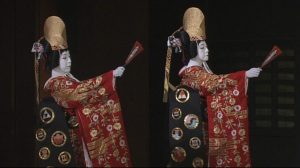
Drinking and recalling memories from his youth, Benkei performs the Ennen no Mai, a dance he learned as a child at Mount Hiei.
Realizing Togashi’s intention—allowing them to escape while enjoying the sake—Benkei drinks heartily and continues dancing, signaling his comrades to set off ahead.
Flying Six Directions (Tobi-Roppo)
Finally, Benkei, carrying a pack and staff, sets off toward Oshu.
Pausing briefly to show gratitude to Togashi and the gods, he retreats down the hanamichi with a dramatic Tobi-Roppo step, energetically pursuing his lord to continue the journey.
Main Characters of Kanjinchō
Musashibō Benkei
Benkei is Yoshitsune’s loyal retainer and a true yamabushi trained on Mount Hiei. Combining intelligence with courage, he boldly reads the Kanjinchō at the Ataka checkpoint, explaining the ways of the yamabushi and the secret “nine-syllable mantra” (kuji no shingon) to clear suspicion.
To protect his lord, he even takes on the role of the villain, striking Yoshitsune himself—an act that later moves him to tears, showing his deeply human loyalty.
In the finale, Benkei performs the Ennen no Mai dance and makes a dramatic exit down the hanamichi with a Tobi-Roppo, showcasing the boldness of aragoto style acting.
Minamoto no Yoshitsune (Hōgandono)
A hero of the Genpei War who defeated the Taira clan, Yoshitsune is now pursued by his elder brother Yoritomo, who suspects him of treason.
At the checkpoint, he disguises himself as a porter, relying on Benkei’s quick thinking to escape danger.
Yoshitsune deeply understands Benkei’s painful act of striking him, forgives the breach of etiquette, and shows both the dignity of a young general and his human kindness.
Togashi Saemon
The samurai in charge of the Ataka checkpoint in Kaga Province, Togashi is tasked with capturing Yoshitsune’s party under the shogunate’s orders.
While strictly fulfilling his duty, he is moved by Benkei’s loyalty and courage.
Ultimately, he lets the party pass, accepting the personal risk, and later offers them sake to apologize for his suspicion—depicting a man torn between duty and human compassion.
Yoshitsune’s Retainers: Kamei Rokurō, Kataoka Hachirō, Ise Saburō, and Others
These loyal followers accompany Yoshitsune on his flight, disguising themselves as yamabushi to support Benkei.
After passing the checkpoint safely, they praise Benkei’s quick thinking and dedication, and continue the journey to Oshu together with their lord.
Highlights of Kanjinchō
Reading the Kanjinchō
The iconic scene where Benkei reads aloud from a blank scroll as if it were a real Kanjinchō is the play’s centerpiece. Every element—voice, timing, posture—must come together perfectly.
This is the moment that truly tests the actor playing Benkei.
The solemnity inherited from Noh theater blends with the bold power of Kabuki, creating an intense, gripping atmosphere on stage.
Yamabushi Questions and the Nine-Syllable Mantra
When Togashi questions Benkei about his yamabushi attire and the secret kuji no shingon (nine-syllable mantra), we see Benkei’s intelligence and depth of training.
This scene highlights that he is not just a forceful aragoto warrior but a thoughtful, spiritually grounded character.
Striking Yoshitsune
One of the most dramatic moments is when Benkei strikes his lord, Yoshitsune, with his staff to prove their loyalty.
The tension between the striker and the one being struck conveys the extremes of duty and devotion, leaving the audience deeply moved.
This scene encapsulates the emotional depth of Kabuki drama.
Farewell and Forgiveness
After passing the checkpoint, Benkei apologizes for his harsh actions, revealing a human vulnerability beneath his bold aragoto persona.
Yoshitsune’s gentle forgiveness shows the profound bond between master and retainer, quietly highlighting their mutual respect and trust.
The Ennen no Mai Dance
Benkei performs the Ennen no Mai during Togashi’s sake banquet. At first, it seems like a lighthearted break, but it is actually a clever ruse to buy time for Yoshitsune and his followers to escape.
The scene demonstrates Benkei’s quick thinking and the range of his artistry, blending entertainment with cunning.
Flying Six Directions (Tobi-Roppo)
In the finale, Benkei’s energetic Tobi-Roppo exit down the hanamichi delivers the peak thrill of aragoto performance.
His movements express both the exhilaration of having protected his lord and the urgency of continuing the journey, leaving the audience with a lasting impression of heroic vigor.
Summary
The brilliance of Kanjinchō lies in its portrayal of Benkei’s multifaceted character—his intelligence, bravery, loyalty, and emotion—within the stylized beauty of Kabuki.
The play’s intense human drama unfolds entirely within the confined space of the checkpoint, which is why Kanjinchō remains one of Kabuki’s most celebrated masterpieces.
コメント