What is Kyōganoko Musume Dōjōji?
Kyōganoko Musume Dōjōji (often shortened to Musume Dōjōji) is one of the most prestigious and refined dance-dramas (mai) in Kabuki. It represents the pinnacle of onnagata (male actors specializing in female roles) artistry and nagauta (long-song) dance technique.
The play belongs to the tradition of “Dōjōji-style” performances, based on the Noh play Dōjōji and the legendary tale of Anchin and Kiyohime. Its title, Kyōganoko (“Kyoto fawn spots”), comes from the distinctive shibori-dyed fabric used in the costumes, a pattern originating in Kyoto.
Background and Formation
Over centuries, many Kabuki and dance adaptations of the Dōjōji legend were created, collectively called “Dōjōji-mono”. Each actor family developed its own style, movements, and choreography, so there was no single standardized version.
The foundation of the modern Musume Dōjōji was laid by the first Nakamura Tomijūrō, who based it on the dance Momochidori Musume Dōjōji, performed by Segawa Kikunojo I. Tomijūrō condensed and refined these elements, combining his own mastery of onnagata technique and expressive power to create the version of Musume Dōjōji performed today.
The Version Performed Today
Among the many “Dōjōji-mono” adaptations, the version with both music and choreography fully preserved to the present day is Tomijūrō’s Musume Dōjōji. In contemporary Kabuki and Japanese dance, Musume Dōjōji generally refers to this definitive form.
Derivative Works
Several derivative works were developed based on Musume Dōjōji, keeping its core structure and music while adding new variations:
- Ninin Dōjōji: Features two shirabyōshi (female-style dancers) competing in dance.
- Yakko Dōjōji: A unique version with a male lead (tachiyaku).
- Meoto Dōjōji: A duet performed by a male and a female role.
All of these retain the musical and structural foundation of Musume Dōjōji, highlighting its central importance within the Dōjōji tradition.
Plot Summary of Kyōganoko Musume Dōjōji
The Opening: The Young Monks
The stage is set at Dōjōji Temple in Kishu (present-day Wakayama Prefecture) during cherry blossom season. Young trainee monks (shoke) enter, calling to one another in a playful, casual tone:
“Have you heard? Have you heard?”
“Yes, we’ve heard!”
Today marks the ceremonial dedication of a newly rebuilt temple bell, replacing the one that had burned down long ago. However, the monks are reluctant to sit through the long and solemn chants of their master, and they quietly conspire to amuse themselves instead. One monk brings hannyatō (a euphemism for sake), while another brings tengai (referring to octopus). The monks’ humorous and worldly scheming creates a striking contrast to the sacred ceremony, setting up the stage for the later appearance of the enchanting Shirabyōshi dancer, Hanako.
The Procession: Hanako’s Arrival
Hanako, a Shirabyōshi (a female performer traditionally trained in song and dance), appears from the hanamichi (stage runway). Wearing a formal, modest attire with an eboshi cap and shimada hairstyle, she appears like an innocent young woman. She walks toward the temple, recalling her recent separation from a lover, and the tolling of the bell that divided their time. Subtle hints of resentment toward the bell foreshadow her true nature.
Dialogue with the Monks
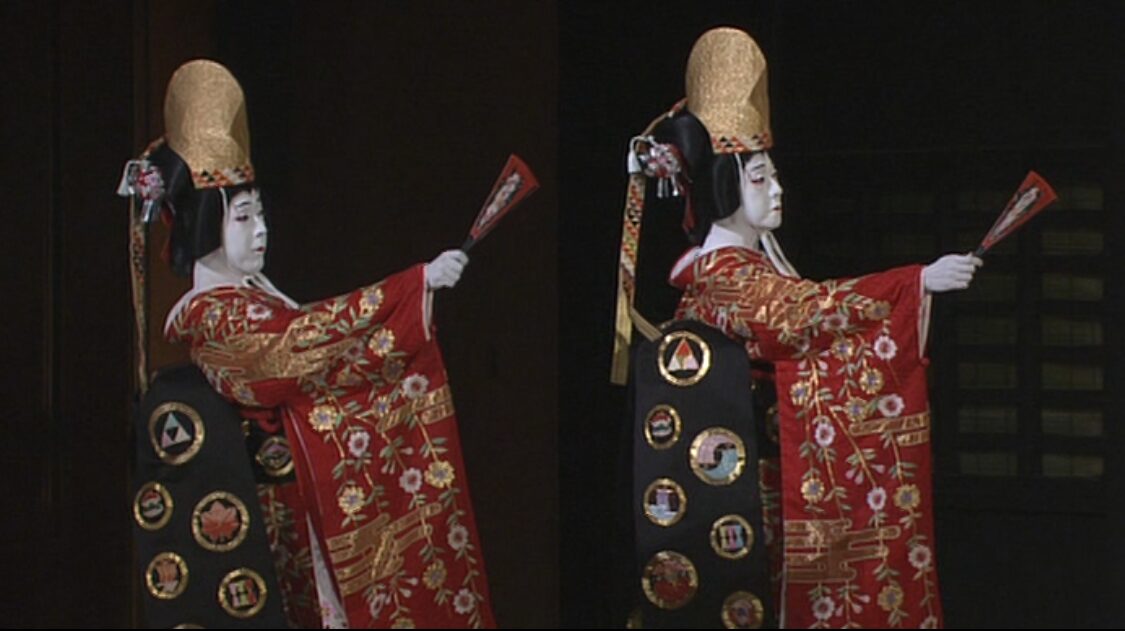
The monks, gossiping about whether she is a Shirabyōshi or a young maiden, become captivated by her beauty. Hanako requests to be allowed to worship the bell through dance, even though women are forbidden from entering. The monks, charmed, permit her entry on the condition she performs a dance. She briefly exits, changing into a vibrant red kimono, while the monks take their positions on the stage sides, preparing for her formal dance.
The Shirabyōshi Dance
In her red costume and holding a fan, Hanako performs a solemn dance inspired by Noh theater. The lyrics reference the impermanence of life (shogyō mujō) and the inexorable passage of time, yet carry a subtle, worldly irony. Her dance is both graceful and tinged with underlying tension, foreshadowing her eventual transformation.
Town Maiden Dances
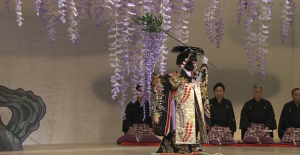
Hanako removes her eboshi, leaving the formal Noh-like dance behind. She performs a lively Kabuki-style dance reflecting the emotions of a young woman in love. During the performance, a quick costume change transforms her red kimono into a light blue one, symbolizing the shifts in her emotions. Through playful movements, she expresses flirtation, joy, and youthful excitement, delighting the audience.
Ball Play and Courtesan Districts
Hanako creates a ball from scattered cherry blossoms and performs lightly, as if a carefree girl at play. The lyrics incorporate the names of famous courtesan districts of Edo and Kamigata, celebrating love and amusement. Her dance conveys the lively, social, and romantic life of women in the pleasure quarters.
Handkerchief Dance (Kudoki)
After further costume changes, Hanako dances holding a handkerchief in the kudoki, expressing her romantic longing and delicate emotions. She gestures with joy, sorrow, jealousy, and tears, portraying the inner turbulence of a young woman in love. The audience is sometimes rewarded with a tenugui-maki (handkerchief toss) at the end of this dance.
Mountain Drum Dance (Yama-zukushi)
Hanako changes into a pale yellow costume and performs with kakko drums, singing the names of twenty-two famous mountains. She strikes the drums with precision and energy, combining rhythm with movement, as her dance becomes lively, playful, and visually dazzling.
White Costume and Bell Dance
Hanako changes into a white costume and dances with suzudaiko (small bell drums), performing a high-energy number accompanied by lively percussion. Gradually, a sense of unease emerges, foreshadowing her true, vengeful identity.
The Bell and Transformation
Drawn irresistibly to the bell, Hanako ignores the monks’ warnings and leaps toward it. The bell is raised, and beneath her costume appears a scaled, serpent-like pattern, revealing that she is possessed by the vengeful spirit of Kiyohime. Her transformation from delicate maiden to monstrous snake is a climactic moment.
The Pushback (Oshimodoshi)
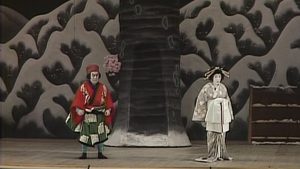
Hanako, now in her serpent form, appears on the hanamichi. Odate Samagorō confronts and subdues her in the stylized Kabuki fight known as oshimodoshi. This scene emphasizes strong aragoto (rough style) performance, showing a dramatic struggle between human control and vengeful spirit.
Final Tableau
The actors form a serpent shape on stage, with Hanako (the serpent) positioned atop the bell or platform, and Odate Samagorō performing a signature Genroku-mie pose. The spectacle concludes with visual grandeur, completing the transformation from beauty to vengeance, and ending the story with dramatic effect.
Summary and Background of Kyōganoko Musume Dōjōji and the Dōjōji Legend
Kyōganoko Musume Dōjōji (often shortened to Musume Dōjōji) is the definitive Kabuki dance drama crystallized by Nakamura Tomijūrō I. Among the many dance adaptations inspired by the Dōjōji legend, this work stands out as the uniquely complete and canonical version. Its greatest charm lies in the combination of stunning dance, the underlying passions and resentments of women, and the ultimate expression of onnagata (male actors performing female roles) artistry.
The Noh Play Dōjōji
The Noh play Dōjōji is based on the later events of the Anchin-Kiyohime legend. Rather than recounting the legend itself, it depicts the lingering resentments and unresolved emotions that continue even after the tragic events have ended. This concept later became the foundation for the more vibrant Kabuki dance drama Kyōganoko Musume Dōjōji.
The Legend of Anchin and Kiyohime
According to the legend, the young woman Kiyohime falls in love with the traveling monk Anchin when he stops at her home on his pilgrimage to Kumano. Anchin responds ambiguously, promising to return, but ultimately abandons her after completing his pilgrimage. Heartbroken, Kiyohime’s passion turns to rage and grief, and she pursues him to the Hidaka River. Her obsession transforms her into a serpent.
Anchin hides inside the bell of Dōjōji Temple for protection, but Kiyohime, now in serpent form, coils around the bell and breathes fire, destroying it. Anchin dies in the flames, leaving a tragic tale of love and betrayal that becomes the Anchin-Kiyohime legend.
Plot of the Noh Play Dōjōji
In the Noh adaptation, the tragedy has already occurred. The temple forbids bell-ringing for years due to fear of the lingering resentments. When a new bell is finally cast and its dedication ceremony held, a Shirabyōshi dancer appears and requests to perform. The monks, wary of past events, allow her to dance. During her performance, her true identity as the vengeful Kiyohime emerges, culminating in her dramatic leap into the bell, transforming into a serpent. The monks pray to calm the spirit, but the climax is visually and emotionally striking.
The Bell Entrance (Kaneiri) in Noh
The kaneiri, or “bell entrance,” is the most famous and challenging moment of Dōjōji. The performer must leap into a full-size bell descending from above—a highly dangerous and technically demanding feat. The bell, made of bamboo and wood but resembling metal, weighs tens of kilograms, and precise timing is critical. The performer must navigate with limited vision and movement, maintaining absolute focus to execute the jump safely. Only highly experienced and officially recognized Noh performers are allowed to attempt it. This scene is not merely a spectacle but a representation of the discipline, skill, and concentration required in Noh.
Summary
While the Anchin-Kiyohime legend portrays the tragic events of love and betrayal themselves, the Noh play Dōjōji emphasizes the lingering obsession and resentment that remain afterward. The events may be over, but the emotions persist. These unresolved feelings are embodied in the Shirabyōshi dancer’s performance, creating a quietly terrifying and beautiful experience—the essence of the allure of Dōjōji.
コメント