Tracing the Emotional Journey Through Featured Plays
The movie KOKUHO, based on the novel by Shuichi Yoshida, is set in the world of Kabuki.
It portrays the light and shadow of traditional performing arts—bloodlines, talent, effort, jealousy, and love—through the life of a single actor.
To understand the movie is to understand the plays performed within it.
Here is a guide to the Kabuki plays that define Kikuo’s journey.
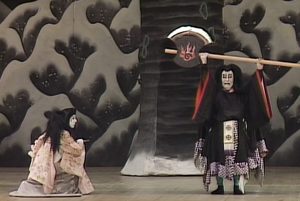
1. The Beginning of Destiny: Tsumoru Koi Yuki no Sekinoto (The Barrier Gate)
- Context in the Movie: Kikuo performs the dance of the courtesan Sumizome as a parlor piece.
His hidden potential catches the sharp eye of the master, Hanjiro. - The Play’s Highlight: The technique of “Miarawashi” (The Revelation).
The barrier keeper Sekibei is actually the villain Kuronushi, and the courtesan Sumizome is actually the spirit of a cherry tree. This “reveal” mirrors the dramatic shifts in the characters’ lives.
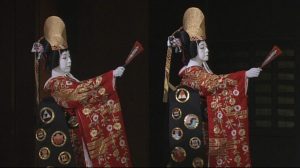
2. Witnessing Mastery: Renjishi (The Father and Son Lion Dance)
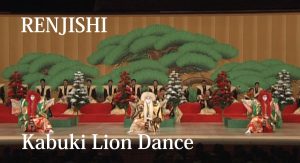
- Context in the Movie: The first professional Kabuki play Kikuo watches is Renjishi, performed by Hanjiro and his son Shunsuke.
This is the moment Kikuo is truly captivated by Kabuki. - The Play’s Highlight: The “Ke-buri” (Hair-shaking).
In the latter half, the father and son lions swing their long manes in a powerful, synchronized display.
It represents the fierce training and bond within a theatrical family.
3. Witnessing a “National Treasure”: Sagi Musume (The Heron Maiden)
- Context in the Movie: Kikuo and Shunsuke watch the “Living National Treasure” Mangiku perform Sagi Musume.
They are struck by the overwhelming gap between a master and themselves. - The Play’s Highlight: “Hikinuki” (The Quick-Change).
The costume changes instantly on stage to reflect the changing emotions of the heron spirit. It is a pinnacle of Onnagata (male actors in female roles) performance.

4. The Peak of Youth: Ninin Fuji Musume (Two Wisteria Maidens)
- Context in the Movie: Kikuo and Shunsuke perform as the “To-Han” duo. Their youth, glamour, and synchronized beauty become a sensation.
- The Play’s Highlight: The beauty of “Soroi” (Synchronization) and “Kakeai” (Dialogue/Interaction) between two dancers.
It captures the brilliant spring-time of their partnership.
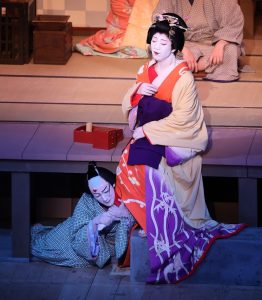
5. Talent vs. Bloodline: Sonezaki Shinju (The Love Suicides at Sonezaki)
- Context in the Movie: Following Hanjiro’s accident, a substitute must be chosen for a major performance.
This choice is not just a fill-in; it signals who will lead the next generation.
Kikuo is chosen, while Hanjiro’s biological son, Shunsuke, is not. This is the heart of the movie’s conflict. - The Play’s Highlight: A masterpiece of “Wagoto” (the soft style).
The famous line, “Tell me your readiness to die,” is a chillingly beautiful moment where Ohatsu tests Tokubei’s resolve.
6. Loss and Regeneration: Ninin Dojoji (Two Maidens at Dojoji Temple)
- Context in the Movie: After years of scandal and “touring the sticks” (provincial circuits), Kikuo is called back to the main stage by Mangiku to perform with Shunsuke once more.
However, Shunsuke’s body is failing due to diabetes, eventually leading to the loss of his leg. - The Play’s Highlight: Similar to Fuji Musume, the beauty of two dancers acting as one.
Watching the two rivals reunite on stage despite their physical and social scars is a peak emotional moment in the film.
7. The Final Scene: A Return to Sagi Musume
- Context in the Movie: The finale encapsulates everything Kikuo has endured.
His life has been a relentless, lonely pursuit of artistic perfection. - The Play’s Highlight: Standing in the snow in pure white robes (Shiromuku), Kikuo’s performance is no longer just acting.
It is the embodiment of his pain, obsession, and ultimate joy.
He has become “The Art” itself.
Conclusion: From the Screen to the Theater
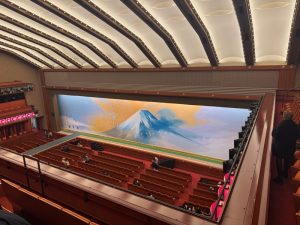
While these scenes last only a few minutes in the movie, a real Kabuki performance allows you to hear the actor’s breathing, the sound of their footsteps, and the rustle of their silk costumes.
If KOKUHO left you wanting more, that is your first step into Kabuki.
You don’t need expert knowledge; just let yourself be swept away by the beauty.
The movie is the entrance—beyond it lies a world of live performance that has been passed down for centuries.
Next time the curtain rises, go experience your own “tears and passion” at the theater.
コメント