
Kabuki, Noh, and Bunraku are often lumped together as “traditional Japanese theater,” but they’re three genuinely distinct art forms — different performers, different origins, different rhythms, and different emotional registers entirely. If you’re trying to decide which one to see in Japan, or just want to stop mixing them up, here’s a clear breakdown of what separates them.
The Short Answer
Kabuki is performed by live actors (all male, including female roles) in a bold, visually spectacular style. Noh is performed by masked actors in an extremely slow, minimalist, almost ritualistic style. Bunraku is puppet theater, with large puppets each operated by three visible puppeteers, narrated by a single chanter. All three emerged in Japan, but at different points in history, for different audiences, with different aims.
| Kabuki | Noh | Bunraku | |
| Performers | Live actors (all male) | Masked actors (traditionally all male) | Puppets, operated by visible puppeteers |
| Origin | Early 1600s, Edo period | 14th century, Muromachi period | Late 1600s, Edo period |
| Original audience | Commoners and townspeople | Samurai class and aristocracy | Commoners and townspeople |
| Pace and tone | Dynamic, bold, visually dazzling | Slow, restrained, meditative | Narrative-driven, emotionally direct |
| Music | Nagauta and other shamisen styles | Chanted utai plus a small hayashi ensemble | Gidayū-bushi narration with shamisen |
| Stage | Elaborate: revolving stage, trapdoors, hanamichi runway | Bare wooden stage, painted pine tree backdrop | Simpler stage, puppeteers visible throughout |
| Good first choice for | Newcomers wanting spectacle and accessible drama | Viewers drawn to meditative, symbolic art | Viewers who enjoy character-driven storytelling |
Kabuki: Bold, Loud, and Built for the Crowd
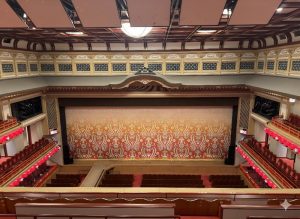
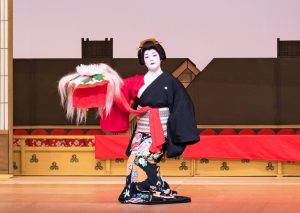
Kabuki began around 1603 with Izumo no Okuni, a shrine performer whose energetic, unconventional dance performances in Kyoto drew huge crowds of ordinary townspeople. From there, it grew into a full theatrical form defined by exaggerated movement, vivid makeup (kumadori), lavish costumes, and stage mechanisms built purely to dazzle: a runway (hanamichi) cutting through the audience, a rotating stage, and trapdoors for dramatic entrances and exits.
Unlike Noh, which was patronized by the ruling samurai class, kabuki was theater for the people — loud, emotionally direct, and unapologetically entertaining. It remains the most accessible of the three for first-time visitors today, precisely because it was designed from the start to grab and hold a general audience’s attention.
Noh: Slow, Symbolic, and Built for Contemplation
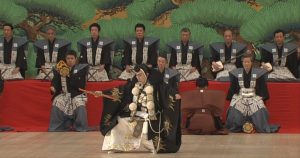
Noh is far older than kabuki, developed in the 14th century under the patronage of the samurai class and refined by the playwright Zeami into a highly stylized, symbolic art form. Where kabuki moves fast and loud, Noh moves with almost otherworldly slowness — a single gesture might unfold over a full minute, and performers wear carved wooden masks that shift expression only through the angle of the head catching the light.
Noh plays frequently deal with spirits, gods, and the boundary between the living and the dead, performed against a bare stage with nothing but a painted pine tree as a backdrop. It rewards patience and close attention rather than spectacle, and it’s the form most likely to feel genuinely unfamiliar to a first-time Western viewer — which is also exactly what makes it worth experiencing at least once.
Bunraku: Puppets With Startling Emotional Range
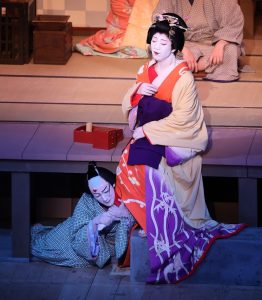
Bunraku is Japan’s traditional puppet theater, developed in the late 1600s alongside kabuki. Each major puppet — roughly two-thirds life size — is operated in full view of the audience by three puppeteers working in perfect coordination: one controlling the head and right arm, one the left arm, and one the legs. A single chanter (tayū) voices every character in the play, accompanied by shamisen, while the puppeteers themselves never speak.
It sounds like it should feel distancing, but the opposite happens: skilled puppeteers make their puppets breathe, hesitate, and grieve with startling precision, and audiences typically stop noticing the puppeteers entirely within the first few minutes. Many of Japan’s most celebrated tragic love stories — including several written by the playwright Chikamatsu Monzaemon — were originally written for bunraku before being adapted for the kabuki stage.
How the Three Forms Overlap
These aren’t three entirely separate traditions — they’ve influenced each other constantly across four centuries. A large portion of kabuki’s repertoire is directly adapted from bunraku plays, a category known as gidayū kyōgen, in which kabuki actors sometimes even mimic the deliberately puppet-like movement of bunraku performers (a technique called ningyō-buri) as a stylistic homage. Kabuki also borrowed directly from Noh: a category of kabuki plays called matsubame-mono are staged against the same pine-tree backdrop used in Noh, adapting Noh and Kyōgen source material into kabuki’s own more dynamic performance style. Kanjinchō, one of kabuki’s most beloved plays, is a prime example of this Noh-to-kabuki adaptation.
Which One Should You See First?
For most first-time visitors to Japan, kabuki is the easiest entry point — it’s visually immediate even without understanding the dialogue, many theaters offer English audio guides or subtitles, and its pacing keeps a modern audience engaged. Bunraku is a close second: the puppetry itself communicates emotion clearly across any language barrier, and performances are shorter on average than a full kabuki program. Noh is best approached once you already have some context for Japanese aesthetics, since its slow, symbolic style rewards viewers who know roughly what they’re watching for going in.
None of the three requires prior knowledge to enjoy — but knowing which kind of experience you’re walking into makes all the difference in how much you get out of it.
Frequently Asked Questions
- Which is older: Kabuki, Noh, or Bunraku?
-
Noh is by far the oldest, dating to the 14th century. Kabuki emerged around 1603, and Bunraku developed slightly later in the late 1600s — meaning kabuki and bunraku are roughly contemporaries, while Noh predates both by some 250 years.
- Do Kabuki and Bunraku share the same plays?
-
Yes, frequently. Many of kabuki’s most famous tragedies were originally written for bunraku puppet theater and later adapted for live actors — a category known as gidayū kyōgen.
- Is Noh harder to understand than Kabuki for a first-time viewer?
-
Generally, yes. Noh’s slow pacing, symbolic staging, and minimal dialogue can feel unfamiliar without some background context, while kabuki’s visual spectacle and dynamic pacing tend to be more immediately accessible to newcomers.
Summary
Kabuki, Noh, and Bunraku each capture a different facet of Japanese performing arts: kabuki’s bold spectacle, Noh’s meditative restraint, and Bunraku’s startlingly expressive puppetry. They’ve borrowed from each other for centuries, yet each remains a genuinely distinct experience worth seeing on its own terms — and for most visitors, kabuki remains the most rewarding place to start.
🎭 Want to See Kabuki Live?
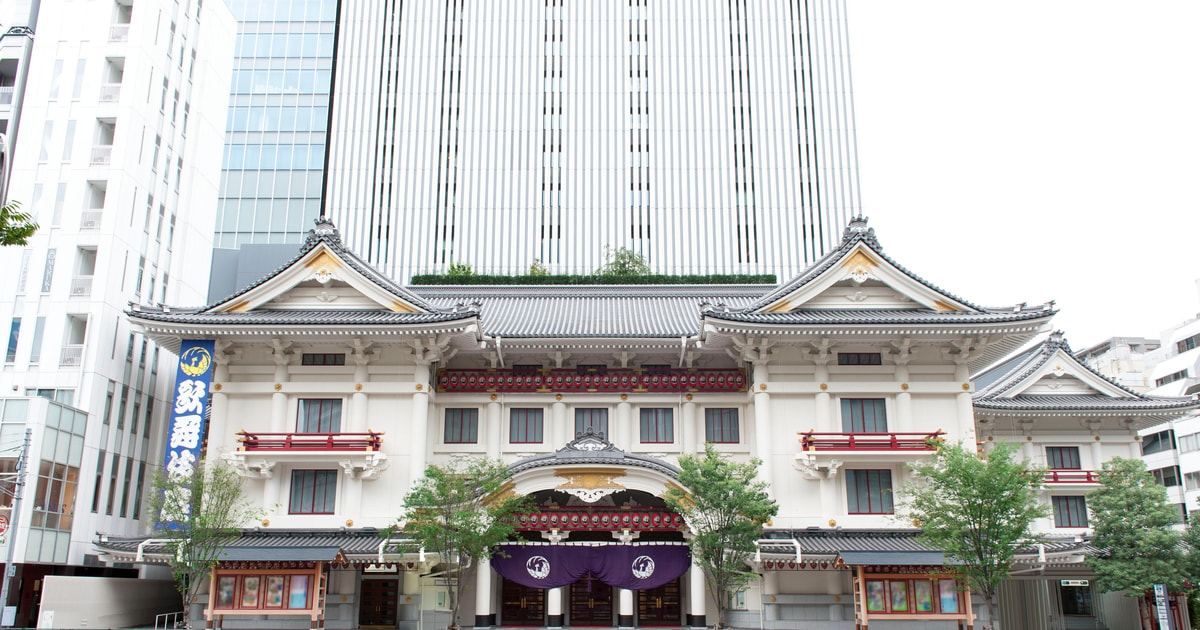
If you’re planning a trip to Tokyo, Kabuki-za is one of the most memorable ways to experience Japanese culture firsthand. GetYourGuide offers English-friendly Kabuki-za tickets and guided experiences, including options with headset translation and pre-show introductions for first-time viewers.
👉 Check Kabuki-za Tickets on GetYourGuide
This section may contain affiliate links. Booking through them costs you nothing extra and helps support this site.



コメント