Yoshitsune Senbon Zakura (“Yoshitsune and the Thousand Cherry Trees”) follows the fugitive hero Minamoto no Yoshitsune’s flight from the capital, weaving together three very different stories along the way: the secret survival of defeated Taira warriors, the quiet tragedy of ordinary townspeople, and a fox’s devotion to the parents it lost. It’s one of kabuki’s three great classics, and this guide walks through the full story scene by scene.
What Is Yoshitsune Senbon Zakura?
The play is set against the historical backdrop of the late Heian period, but takes major creative liberties with the actual history — most strikingly by introducing a fox that transforms into human form, giving the story a fantastical, highly entertaining edge on top of its historical framing. Because it’s extremely long, full performances are rare; individual scenes are typically staged on their own instead.
The Story in Brief
The play opens after the fall of the Taira clan. Suspected by his own brother, Minamoto no Yoritomo, Yoshitsune becomes a hunted man, fleeing the capital with his retainers from place to place.
Along the way, he crosses paths with an extraordinary range of people: Taira warriors believed to have died at the battle of Dan-no-ura but secretly still alive, followers devoted to Yoshitsune, and even a fox disguised as a human — each carrying their own history and hidden motives that collide with Yoshitsune’s fate. Loyalty, parental love, betrayal, gratitude, and the tragedy of the doomed all intertwine, moving from scenes of ordinary townspeople’s lives to mystical realms to the devastating final moments of defeated warriors — each scene carrying its own distinct tone, together building into one sweeping narrative.
The story unfolds across these major scenes:
- Torii-mae — Yoshitsune parts ways with his lover, Lady Shizuka, as he flees the capital; his retainer Satō Tadanobu (secretly a fox in disguise) protects her from pursuers.
- Tokaiya / Daimotsu-no-Ura — Taira no Tomomori, believed dead at Dan-no-ura, reveals his true identity and meets a devastating end after his revenge against Yoshitsune fails.
- Konomi / Kokingo’s Death — Kokingo, protecting the wife and child of Taira no Koremori, is drawn into a scheme by the small-time crook Igami no Gonta and killed by pursuers.
- Sushiya — Gonta stages an elaborate deception to protect his father and the Koremori family, leading to a tragic end.
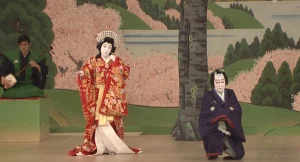
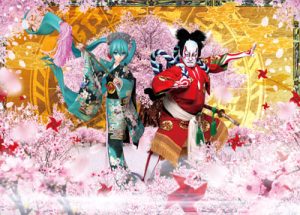
- Michiyuki Hatsune Tabi (Yoshino Yama) — a vibrant dance sequence in which Lady Shizuka and the fox-in-disguise Tadanobu travel through Mount Yoshino’s blooming cherry blossoms in search of Yoshitsune.
- Kawatsura Hōgen Yakata (Shi-no-Kiri) — Tadanobu’s true identity as the fox Genkurō is revealed, along with his devotion to the “Hatsune” hand drum made from his parents’ hides.
In short: a sweeping ensemble drama about a hunted hero and the tangled fates of everyone drawn into his flight.
What Is a “Tōshi Kyōgen,” and Why Isn’t This Play Performed in Full?
Yoshitsune Senbon Zakura was originally written as a sprawling, multi-act work. Staging a play from beginning to end is called a tōshi kyōgen, but because this particular play runs so long, full productions are rare today. Instead, it’s typically staged either by pulling out only the most popular scenes, or by combining scenes around a shared theme.
When a fuller production is staged, it typically draws from these seven scenes, selecting four to six of them: Torii-mae (the Fushimi Inari scene), Tokaiya/Daimotsu-no-Ura, the dance piece Hototogisu Hana no Sato, Konomi/Kokingo’s Death, Sushiya, Michiyuki Hatsune Tabi (Yoshino Yama), and Kawatsura Hōgen Yakata.
Alternate Names Used for Standalone Performances
Because individual scenes are so often performed on their own, they’re frequently known by shorter, more familiar names: the Fushimi Inari scene is usually just called Torii-mae; Tokaiya/Daimotsu-no-Ura is often called Ikari Tomomori (“Tomomori and the Anchor”); Michiyuki Hatsune Tabi is commonly known as Yoshino Yama; and Kawatsura Hōgen Yakata is widely referred to as Shi-no-Kiri. These are the names most often used in listings and performance schedules.
Scene-by-Scene Highlights
Torii-mae
As Yoshitsune’s party flees the capital, Lady Shizuka catches up with them. Yoshitsune gives her the treasured Hatsune hand drum as a keepsake and, steeling himself, leaves her behind. When Kamakura’s pursuers close in on her, Satō Tadanobu appears and rescues her in a striking display of swordplay. The scene’s highlight is Tadanobu’s bold aragoto-style combat, followed by the “fox roppō” exit — a dynamic, animalistic stage-exit style hinting at his true nature — set against a vivid torii-gate backdrop.
Tokaiya / Daimotsu-no-Ura (Ikari Tomomori)
Built on the audacious premise that Taira warriors believed to have died at Dan-no-ura secretly survived, this scene follows Taira no Tomomori’s doomed attempt at revenge against Yoshitsune. Tense scheming at the Tokaiya inn gives way to Tomomori revealing his true identity at Daimotsu Bay, and finally his devastating final moments, wrapped in coils of anchor rope as he sinks into the sea. Grand tragedy, parental devotion, and a warrior’s pride combine to make this one of the play’s most dramatic sequences.
Konomi / Kokingo’s Death
An essential lead-in to the Sushiya scene. Kokingo, trying to protect the wife and child of Taira no Koremori, gets caught in a scheme laid by the petty crook Igami no Gonta and is killed by pursuers. The scene shifts from a peaceful moment of gathering nuts in the countryside into an unavoidable tragedy, leaving the audience with a heavy, lingering unease that sets up the revelations to come in Sushiya.
Sushiya
One of the most beloved scenes in the entire play, centered on the endearing small-time crook Igami no Gonta and the people around him. It begins with light, comic banter before building to real heartbreak — the depth of a father-son bond gradually revealed through Gonta’s actions, leading to a genuinely moving conclusion.
Michiyuki Hatsune Tabi (Yoshino Yama)
A vivid dance piece set against Mount Yoshino’s cherry blossoms in full bloom, following Lady Shizuka and the fox-disguised Tadanobu as they travel in search of Yoshitsune. Set to the lively rhythm of kiyomoto music, the two dance in graceful unison, and a combat sequence with the “flower guards” (hanashiten) adds dynamic energy to the piece’s visual elegance — a rare scene where visuals, music, and story reach near-perfect harmony. It also quietly plants the emotional seeds — the bond between Shizuka and Tadanobu, and the origin of the Hatsune drum — that pay off in the following scene.
Kawatsura Hōgen Yakata (Shi-no-Kiri)
One of kabuki’s most celebrated scenes, revealing that Tadanobu is in fact the fox spirit Genkurō, devoted to the Hatsune drum made from the hides of his own parents. As his true identity comes to light, the scene unfolds through distinctly fox-like physicality and inventive kabuki stagecraft, blending fantasy and heartbreak into a deeply moving finale.
Hototogisu Hana no Sato (a rare dance piece)
Although the play carries Yoshitsune’s name in its title, he rarely takes center stage directly — this dance piece is a notable exception, giving him the spotlight. Reportedly reconstructed from little more than a single surviving illustrated program after nearly disappearing from the repertoire, it depicts Yoshitsune’s journey toward Kawatsura Hōgen’s residence in Yoshino. Puppeteers and shirabyōshi dancers appear before him amid blooming cherry blossoms — later revealed to be divine women serving the deity of Mount Tatsuta, who grant Yoshitsune a blessing for his journey ahead. Its blend of spring scenery, mysticism, and Yoshitsune’s own quest — plus the story of its near-loss and revival — makes it a genuinely special piece.
Which Scenes Should Beginners Start With?
For a first viewing, three scenes stand out: Sushiya, for its clear, emotionally accessible story; Kawatsura Hōgen Yakata (Shi-no-Kiri), for its inventive stagecraft and unmistakably kabuki atmosphere; and Tokaiya/Daimotsu-no-Ura (Ikari Tomomori), for its sheer dramatic scale.
Why Yoshitsune Senbon Zakura Endures
The Depth of Its Human Drama
At its core, this is a story about people left behind by history — a hunted hero, Taira warriors presumed dead, ordinary families, even a fox — each carrying their own version of caring for someone else. Parental devotion, loyalty tested against betrayal, the pride and anguish of survivors, and sacrifice for the people they love all surface in different forms across the play’s many scenes, giving audiences a rare range of emotional entry points into the story.
Sheer Entertainment Value
The play is also packed with kabuki’s most purely enjoyable elements: bold aragoto swordplay (Tadanobu at Torii-mae), spectacular combat and quick changes (Tomomori at Daimotsu-no-Ura), comic banter (Gonta at Sushiya), and vibrant dance (Michiyuki Hatsune Tabi). Despite its weighty themes, the visual pleasures never let up — making it easy for first-time viewers to stay engaged throughout.
A Fusion of the Fantastical and the Real
Historical figures share the stage with beings from another realm entirely — foxes, divine women, and spirits move naturally alongside the human cast. The fox Genkurō, devoted to the drum made from his parents’ hides, is the clearest example, while the dance piece Hototogisu Hana no Sato adds a further layer of myth. These moments where reality and the mystical blur together give the play a depth and poetry all its own, elevating it beyond a straightforward historical drama into something closer to legend.
How to Enjoy It as a First-Time Viewer
There’s no need to absorb the entire plot on a first watch. Simply picking one famous scene and getting a rough sense of its story is more than enough to enjoy it. Since the tone shifts so dramatically from scene to scene, it’s worth starting with whichever one appeals to you most, and exploring the rest from there.
Frequently Asked Questions
- Can I watch the entire play from start to finish?
-
Rarely — the play is extremely long, so full productions (tōshi kyōgen) are uncommon today. Most performances select four to six scenes out of the seven that make up the complete work.
- Why does Yoshitsune barely appear in his own title role?
-
The play is really an ensemble drama about the people caught up in Yoshitsune’s flight rather than a biography of Yoshitsune himself — which is why the rare scene where he does take center stage, Hototogisu Hana no Sato, stands out as unusual.
- What’s the connection between the fox and the Hatsune drum?
-
The fox spirit Genkurō disguises himself as the retainer Satō Tadanobu specifically to stay close to the Hatsune drum, which was made from the hides of his own parents — his devotion to the drum is the emotional core of the Kawatsura Hōgen Yakata scene.
Summary
Yoshitsune Senbon Zakura endures because it works on three levels at once: a deeply human drama, a showcase of kabuki’s purest entertainment value, and a story where myth and history blur together. Pick any one scene to start — a devastating warrior’s end, a small-time crook’s hidden devotion, or a fox’s love for its lost parents — and you’ll find a complete emotional world waiting inside it.
Related Reading
🎭 Want to See Kabuki Live?
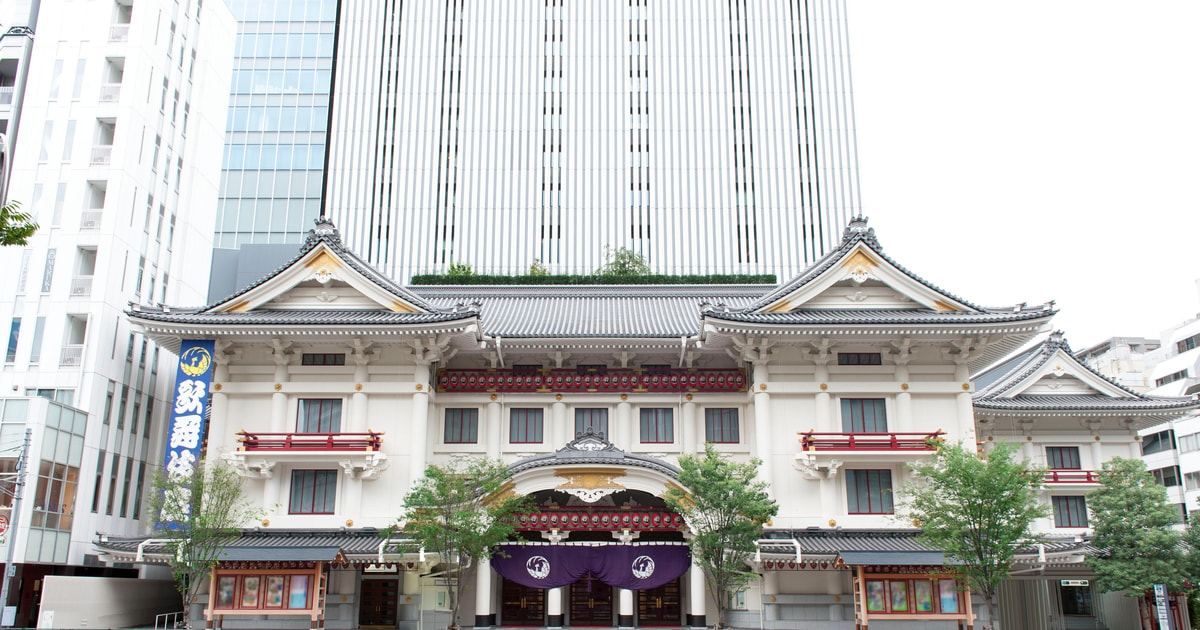
If you’re planning a trip to Tokyo, Kabuki-za is one of the most memorable ways to experience Japanese culture firsthand. GetYourGuide offers English-friendly Kabuki-za tickets and guided experiences, including options with headset translation and pre-show introductions for first-time viewers.
👉 Check Kabuki-za Tickets on GetYourGuide
This section may contain affiliate links. Booking through them costs you nothing extra and helps support this site.


コメント
コメント一覧 (1件)
[…] あわせて読みたい Yoshitsune Senbon Zakura Explained|Complete Story Guide to Kabuki’s Great Ensemble Epic A complete scene-by-scene guide to Yoshitsune Senbon Zakura, one of kabuki’s three great classics — fugitive warrio […]