Shinjū Tsukiyo Hoshinoya (心中月夜星野屋) takes on the subject of a double suicide pact between two lovers — but rather than ending in tragedy, it turns into a razor-sharp game of mutual deception. Originally a beloved rakugo comic-storytelling piece, its kabuki adaptation adds much deeper characterization and dramatic staging, giving it a completely different flavor from the source material.
This guide covers the kabuki-version synopsis, how it differs from the original rakugo, the characters, and the highlights.
Synopsis (Kabuki Version)
Otaka, a former geisha, now makes her living teaching shamisen. Teruzō, the owner of a produce wholesale shop, is deeply involved with her — but after a disastrous run of bad investments, he’s forced to close his business, and comes to tell Otaka he wants to end things, offering her 20 ryō as a parting gift.
Otaka refuses the money. Instead, she presses him with a different question entirely: “Why haven’t you asked me to die with you?” Moved by her words, Teruzō agrees — that very night, at the sound of the ninth bell, the two will meet at Azuma Bridge to end their lives together.
The Azuma Bridge Scene (Climax)
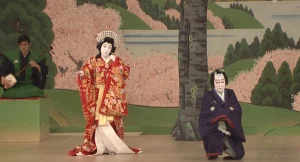
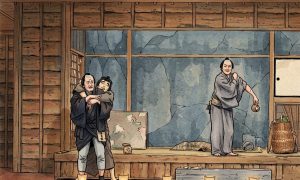
Under the moonlight, the two stand together on the bridge. But Otaka keeps stalling, making excuse after excuse, never quite ready to jump. Growing impatient, Teruzō finally pulls her toward the edge — when Otaka’s mother, Okuma, suddenly appears and a scuffle breaks out. In the end, only Teruzō falls into the river.
Back at the Music Studio (The Reversal)
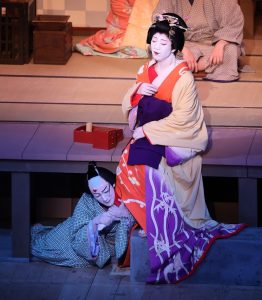
Otaka and Okuma return home, only to be visited by Izumiya Tōsuke, the man who originally introduced the couple. He warns them that Teruzō’s ghost has appeared, vowing to curse Otaka to death out of resentment. Terrified, Otaka is advised by Tōsuke that her only way to survive is to cut off her hair and become a nun. After much hesitation, she resolves to sacrifice her prized black hair.
Just then, Teruzō’s ghost appears before her — but in the very next instant, everything flips. The entire ghost scare was staged by Teruzō and Tōsuke all along, a test designed to reveal Otaka’s true feelings.
The Final Twist
Otaka seems to have been thoroughly outmaneuvered — but she has one more trick up her sleeve. The hair she cut off turns out to have been a hairpiece all along; her real hair is completely untouched. What follows is an escalating, increasingly absurd back-and-forth over money and deception between Otaka’s family and Teruzō’s side — a genuine battle of wits between two equally cunning parties. A story that began as tragedy ends instead on a note of irony and laughter.
How the Kabuki Version Differs From the Rakugo Original
This piece is based on the rakugo story “Hoshinoya.” The rakugo version shares the same basic structure — the shop owner proposes the suicide pact, the woman never intends to go through with it and only the man jumps, followed by a ghost scare and a battle of deception — but the kabuki adaptation strengthens things considerably:
Deeper Characterization
Where the rakugo version prioritizes comic pacing, the kabuki version takes real care to develop Otaka’s cunning, Teruzō’s naivety, and Okuma’s practical cleverness — giving the story genuine weight as a human drama.
Visually Staged Beauty
Scenes that rakugo handles purely through narration are fully staged in kabuki. The moonlit Azuma Bridge scene in particular stands out as a genuine set piece, built through lighting, movement, and pacing into a moment of real tension and beauty.
A Careful Balance of Comedy and Fear
Rather than simple comedy, the piece blends the weighty theme of double suicide, the genuine fright of a ghost scare, and the absurdity of mutual deception into one carefully balanced whole.
Characters
Otaka
A former geisha now working as a shamisen teacher. She appears warm and emotionally invested at first glance, but is in fact remarkably shrewd and practical — the character who genuinely controls the story.
Teruzō
Owner of the produce shop “Hoshinoya.” Cornered by his failed business, he turns to Otaka, but carries a certain naivety that ultimately leaves him outmaneuvered.
Okuma
Otaka’s mother — practical, calculating, and the one feeding her daughter ideas throughout. The story’s true mastermind behind the scenes.
Izumiya Tōsuke
Teruzō’s accomplice, who orchestrates the ghost scare and serves as the architect of the whole scheme.
Highlights
A Double-Suicide Story That’s Actually Funny
Most shinjū (double-suicide) plays are unambiguous tragedies. This one is different — its charm comes precisely from the gap between “a woman with no intention of dying” and “a man who takes it completely seriously.”
Layers of Mutual Deception
Otaka and her mother versus Teruzō — and then a further twist undercutting that — keeps the audience genuinely unsure who’s actually outsmarting whom.
A Satisfying Final Reversal
The truth behind the ghost, the hairpiece trick, and the real state of the money all come out in a fast, satisfying cascade of reveals at the very end.
Summary
Shinjū Tsukiyo Hoshinoya fuses a heavy theme, romantic gamesmanship, and the pleasure of mutual deception into one distinctive piece. What looks like tragedy turns into comedy by the end — a structure that owes everything to its rakugo roots. It may be the kabuki play that best captures human cunning and charm in equal measure.
Frequently Asked Questions
- Does anyone actually die in Shinjū Tsukiyo Hoshinoya?
-
No — despite the “shinjū” (double suicide) in the title, the story turns into a comic battle of wits rather than an actual tragedy. Teruzō falls into the river, but the “ghost” and its aftermath turn out to be an elaborate ruse.
- Is this based on a rakugo story?
-
Yes — it’s adapted from the rakugo piece “Hoshinoya,” though the kabuki version adds significantly deeper characterization and full stage direction not present in the original comic storytelling format.
- Is this a good pick if I want something other than a straight tragedy?
-
Yes — it’s one of the more comedic entries in kabuki, blending a serious premise with genuine wit and a satisfying series of twists at the end.
Related Reading
🎭 Want to See Kabuki Live?
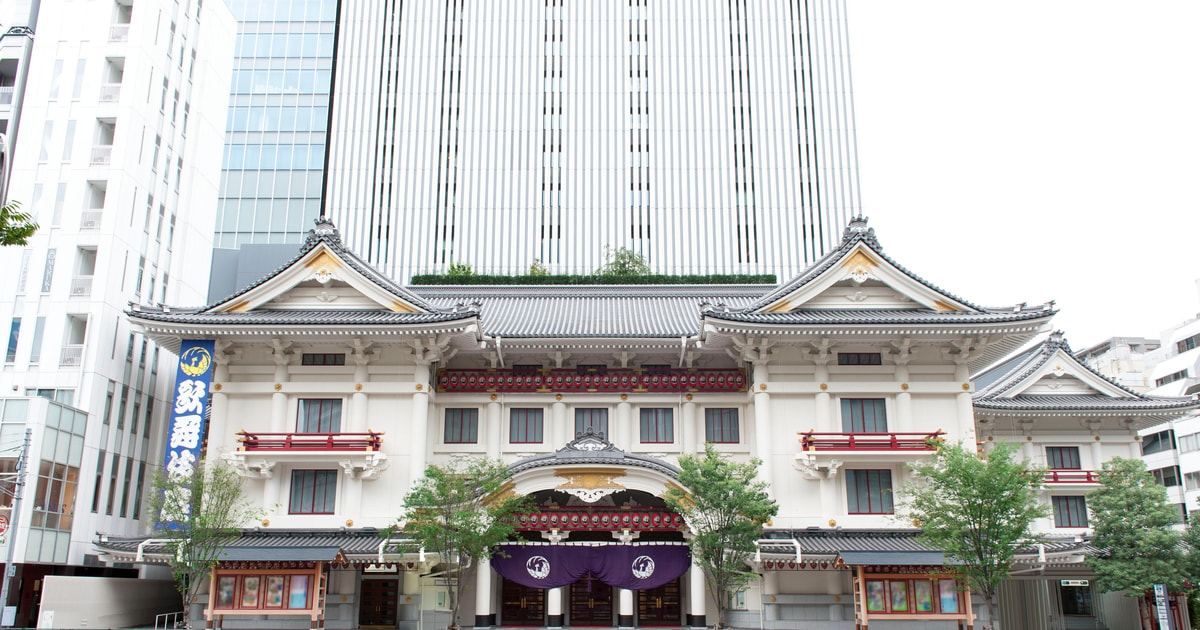
If you’re planning a trip to Tokyo, Kabuki-za is one of the most memorable ways to experience Japanese culture firsthand. GetYourGuide offers English-friendly Kabuki-za tickets and guided experiences, including options with headset translation and pre-show introductions for first-time viewers.
👉 Check Kabuki-za Tickets on GetYourGuide
This section may contain affiliate links. Booking through them costs you nothing extra and helps support this site.
コメント
コメント一覧 (1件)
[…] one of Chikamatsu’s most beloved Kamigata sewamono scenes. あわせて読みたい Shinjū Tsukiyo Hoshinoya: A Double-Suicide Story That Turns Into a Comic Battle of Wits This rakugo-derived kabuki play starts as a suicide pact between two lovers and ends as a […]