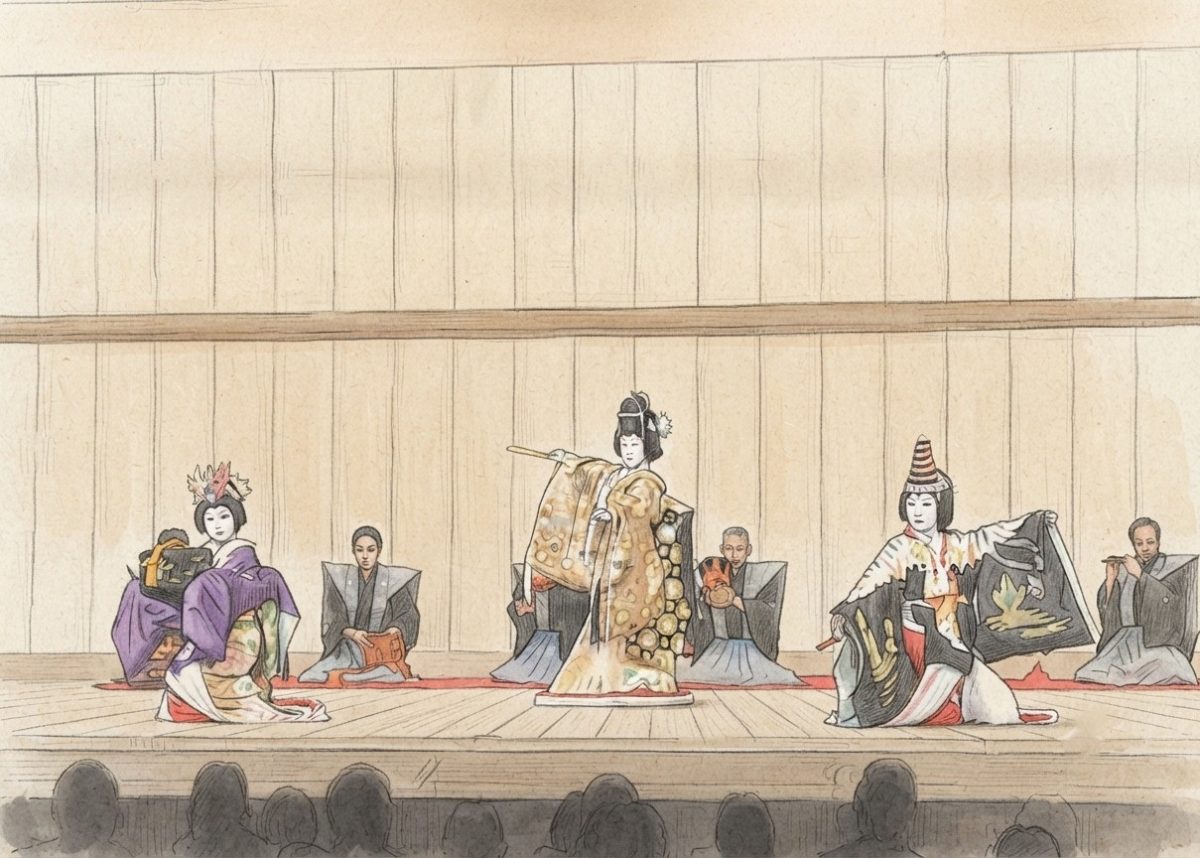
Hinazuru Sanbasō (“The Bridal Crane Sanbasō”) is one of the oldest surviving nagauta pieces in the sanbasō family of ceremonial dances — and the gentlest. Where its better-known relative Kotobuki Shiki Sanbasō stomps and rattles bells with masculine force, Hinazuru Sanbasō trades that power for soft, feminine grace, opening the 2026 Shūzan-sai program at the Kabukiza with quiet elegance rather than a bang.
What Is Hinazuru Sanbasō?
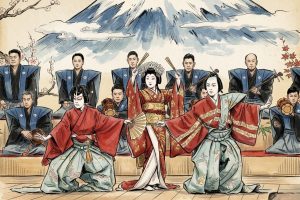
Sanbasō is a broad family of celebratory dances rooted in Shiki Sanbasō, the Noh ritual piece performed to pray for peace and a bountiful harvest. Three figures move through the dance in sequence — Okina, Senzai, and Sanbasō — and nearly every version keeps that same basic skeleton. What changes from one “___ Sanbasō” to the next is the choreography, the music, and the mood built around it.
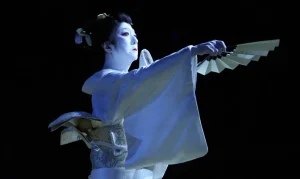
Hinazuru Sanbasō is believed to have been composed around 1755, making it one of the oldest nagauta sanbasō pieces still performed today. Its lyrics draw heavily on the Noh chant “Okina,” and its choreography reworks the fast, comic energy typical of sanbasō dances into something markedly softer and more refined — a distinctly feminine take on a form usually built around strength.
Origins: From Harvest Prayer to Kabuki Stage
Sanbasō traces back further than Noh, to sarugaku-era village rituals in which farmers holding bells danced to pray for a good harvest. Traces of that origin survive in the lyrics even today — phrases evoking sowing seeds and pine trees on a shoreline are folk-agricultural imagery, carried forward from the dance’s roots as a rural prayer ritual.
Kabuki inherited the form from Noh’s “Okina,” but shifted the spotlight: where Noh centers the sacred, dignified Okina, kabuki drew attention to the third role, Sanbasō, danced by a kyōgen performer, and developed it into a fast, lively, crowd-pleasing showpiece in its own right. Each staging tradition gave its version a distinct name — hence the many “___ Sanbasō” pieces that exist today. Hinazuru Sanbasō took that same rustic prayer dance and refined it into an elegant nagauta showpiece, carried by the full ensemble of shamisen, vocals, and hayashi instruments (flute and drums) characteristic of the genre.
Sanbasō’s Many Variations
Understanding where Hinazuru Sanbasō sits requires knowing its siblings:
Kotobuki Shiki Sanbasō — the most orthodox and formal version, marked by powerful foot-stamping and a bell dance. Performed at New Year’s, kaomise season openings, and shūmei (name-succession) celebrations.
Ayatsuri Sanbasō — staged around the conceit that Sanbasō has become a puppet, danced with the jerky, mechanical movement of a marionette for comic effect.
Shiki Sanbasō (Kiyomoto) — a kiyomoto-genre take distinguished by casting an onnagata as Senzai, folding in its own note of elegance.
Kuruwa Sanbasō — set in the pleasure quarters, with a courtesan taking the role of Okina and an attendant and a jester filling in for Senzai and Sanbasō, played more for playful theatricality than ceremony.
Set against this list, Hinazuru Sanbasō occupies a niche none of the others fill: preserving the form’s old-fashioned formality while foregrounding a distinctly feminine grace.
Hinazuru Sanbasō vs. Kotobuki Shiki Sanbasō: What’s the Difference?
The two are easily confused since they share a name and a basic structure, but their character couldn’t be more different.
| Kotobuki Shiki Sanbasō | Hinazuru Sanbasō | |
|---|---|---|
| Mood | Powerful, masculine | Graceful, feminine |
| Signature moment | Bold foot-stamping and a bell dance | Soft, refined movement |
| Typically staged at | New Year’s, kaomise, shūmei celebrations | Formal programs like Shūzan-sai |
Where Kotobuki Shiki Sanbasō is danced with vigorous, masculine energy built around its stamping footwork and bell, Hinazuru Sanbasō is prized instead for its softness and refinement — making it a particular favorite among female kabuki fans. Two dances sharing a name and a lineage, delivering strikingly different experiences, is exactly the kind of contrast that makes kabuki dance rewarding to compare piece by piece.
Structure of the Dance
Like most sanbasō pieces, Hinazuru Sanbasō has no plot to follow — it unfolds in two broad sections instead.
Part One: Okina and Senzai (Utaigakari)
The piece opens with text drawn from the Noh chant “Okina.” Senzai dances first to purify the stage, after which Okina dances solemnly, praying for peace under heaven. This section closes on the line “kyō no gokitō nari” (“this is today’s prayer”).
Part Two: Sanbasō’s Dance (Kyōgengakari)
A shift in the hayashi calls — “ōsae, ōsae” — turns the piece over to Sanbasō’s lively dance. Unlike the forceful stamping of Kotobuki Shiki Sanbasō, Sanbasō here moves lightly while still carrying an air of dignity, true to the piece’s gentler character.
Reading the Lyrics
Several unfamiliar terms recur in the text, each worth knowing:
Karasu-tobi (“crow’s flight”) — a sideways leaping movement performed by Sanbasō in the black formal robe (daimon), regarded as one of the dance’s most striking visual moments.
Aokigahara — in this lyric, not the forest at the foot of Mt. Fuji, but a place name in Hyūga Province (present-day Miyazaki Prefecture), tied by tradition to the legendary origin of the deity Sumiyoshi Myōjin.
Shisha (“four shrines”) — appearing as “shisha no gozen” and “shisha no onda,” referring to the deities enshrined at Sumiyoshi, to whom the dance’s prayers are repeatedly addressed.
Knowing this vocabulary rewards a closer listen, especially in the piece’s later passage: “makoto ni samazama no mai no kyoku, sasu ude ni wa akuma wo harai, osamuru te ni wa juhuku wo idaki” — a line describing Sanbasō warding off evil with an outstretched arm and gathering good fortune as the arm draws back in, the dance’s central gesture of exorcism and blessing.
Characters
Okina — the dignified, sacred figure at the dance’s center, who prays solemnly for peace under heaven.
Senzai — dances ahead of Okina to purify the stage, embodying youthful freshness.
Sanbasō — prays for a bountiful harvest. Where Kotobuki Shiki Sanbasō‘s Sanbasō is bold and dynamic, this version moves with softness and grace.
Highlights
A Feminine Take on a Masculine Form
Most sanbasō pieces lean into bold, masculine energy, which makes Hinazuru Sanbasō‘s soft, dignified grace stand out. It’s the clearest possible way to see how much range a single dance framework can hold.
A Dignified Opener for a Formal Program
There’s no story here, but the piece’s prayer for peace and a good harvest carries a stately, festive weight — exactly the tone suited to opening a prestigious run like Shūzan-sai.
Short and Welcoming for First-Timers
With no plot to track, Hinazuru Sanbasō is easy to settle into even for a first-time viewer — a good warm-up piece to open an evening’s program before the story-driven works that follow.
Tips for First-Time Viewers
Listen for the Nagauta Melody
Hinazuru Sanbasō is composed in nagauta, the shamisen-based musical genre developed specifically to accompany kabuki dance, blending vocals, shamisen, and hayashi instruments into a single unified sound. With no story to follow, paying attention to how the melody and rhythm shift between the solemn opening section and the livelier close is the clearest way to feel the piece’s two-part structure.
Watch the Expression and Costume
Without a plot to track, the performers’ expressions, posture, and costuming carry the piece. Opera glasses are especially useful from seats further from the stage, letting you catch the tension in Okina’s expression and the precision of Sanbasō’s footwork up close.
Pair It with What Follows
Hinazuru Sanbasō is a short opener. Watching it alongside a plot-heavy piece staged later in the same program throws the contrast between “ceremonial dance” and “dramatic narrative” into sharp relief — a good way to appreciate kabuki’s range across a single evening.
2026 Shūzan-sai Kugatsu Kabuki: Performance Details
Hinazuru Sanbasō opens the evening program of Shūzan-sai Kugatsu Kabuki 2026 (September 2–26, Kabukiza).
Cast
| Role | Performer |
|---|---|
| Okina | Nakamura Kaishun |
| Senzai | Nakamura Jakuemon |
| Sanbasō | Nakamura Manju |
The evening program continues after Hinazuru Sanbasō with Numazu, Kyō Ningyō, and Ichijō Ōkura Monogatari.
Why This Piece Fits Shūzan-sai
Shūzan-sai is an annual run honoring the first Nakamura Kichiemon, one of the defining actors of postwar kabuki, launched in 2006 under his successor, the second Kichiemon. 2026 marks the 140th anniversary of the first Kichiemon’s birth, giving the year’s program an extra note of formality and heritage.
Opening such a commemorative run with a piece built around prayer and dignity rather than plot — exactly what Hinazuru Sanbasō offers — reflects the character of Shūzan-sai itself.
Who Should Watch This
New to kabuki and want to ease in with something short — with no plot to follow and a compact runtime, sanbasō pieces are a gentle introduction to kabuki’s formal, stylized side.
Already seen Kotobuki Shiki Sanbasō and want to compare — discovering how differently the “same” dance can land depending on staging is one of kabuki’s quiet pleasures.
Looking for a dignified, ceremonial opener — the piece’s poise and formality suit the tone of a prestigious run like Shūzan-sai perfectly.
Frequently Asked Questions
- Does Hinazuru Sanbasō have a story?
-
No. Like other sanbasō pieces, it’s a ceremonial dance without a plot — Okina, Senzai, and Sanbasō dance in sequence, praying for peace and a good harvest. It’s meant to be experienced as atmosphere rather than followed as narrative.
- What’s the difference between Hinazuru Sanbasō and Kotobuki Shiki Sanbasō?
-
Both derive from the Noh piece “Okina,” but Kotobuki Shiki Sanbasō is powerful and masculine, built around forceful foot-stamping, while Hinazuru Sanbasō is soft and feminine in character.
- How long does it run?
-
It’s one of the shorter sanbasō pieces, staged as the opening work of the evening program. For an exact runtime, check the official program listing on Kabuki Bito for the specific performance dates.
- Is it a good choice for a kabuki beginner?
-
Yes. There’s no dialogue or plot to follow, just music, movement, and atmosphere, which makes it an easy, low-pressure way to start an evening at the theater.
- What should I look for in the costuming?
-
Sanbasō traditionally wears a black daimon robe and dances with bells in hand. In Hinazuru Sanbasō specifically, watch for suppleness of movement over raw power — that’s the clearest visual marker of how it differs from Kotobuki Shiki Sanbasō.
- Where can I buy tickets?
-
Tickets for Shūzan-sai Kugatsu Kabuki are available through the official Kabukiza website and the Kabuki Bito ticket information page.
Summary
Hinazuru Sanbasō is one of nagauta’s oldest sanbasō pieces, composed around 1755 — and its defining trait is restraint. Where its sibling Kotobuki Shiki Sanbasō commands the stage with power, this piece opens with softness and grace instead, letting Okina, Senzai, and Sanbasō carry a prayer for peace and abundance through poise rather than force.
Staged in 2026 as the opening work of Shūzan-sai’s evening program, it’s a short, plot-free piece well suited to easing into an evening of kabuki — and, watched alongside its more forceful namesake, a genuinely rewarding lesson in just how much range a single dance form can hold.
🎭 Want to See Kabuki Live?
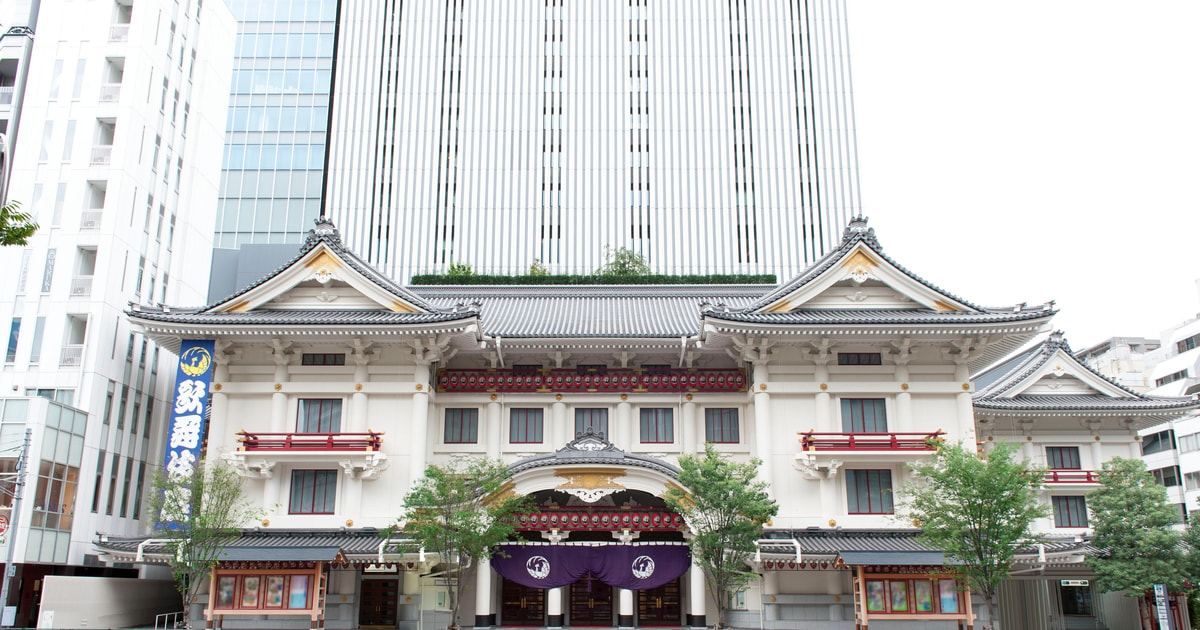
If you’re planning a trip to Tokyo, Kabuki-za is one of the most memorable ways to experience Japanese culture firsthand. GetYourGuide offers English-friendly Kabuki-za tickets and guided experiences, including options with headset translation and pre-show introductions for first-time viewers.
👉 Check Kabuki-za Tickets on GetYourGuide
This section may contain affiliate links. Booking through them costs you nothing extra and helps support this site.
コメント
コメント一覧 (1件)
[…] あわせて読みたい Hinazuru Sanbasō Explained: Kabuki’s Gentle, Feminine Sanbasō Hinazuru Sanbasō is one of the oldest nagauta sanbasō dances, prized for its soft, feminine grace in contrast to the powerful Kotobuki Shiki Sanbas […]