One of kabuki’s most beloved scenes, commonly known as Shi-no-Kiri, is formally titled “Kawatsura Hōgen Yakata” — the fourth-act finale of Yoshitsune Senbon Zakura. Its true lead isn’t Minamoto no Yoshitsune at all, but a fox disguised as his loyal retainer, whose 400-year devotion to a drum made from his own parents’ hides brings audiences to tears. It’s also a showcase of some of kabuki’s most dazzling stagecraft, packed with instantaneous costume changes and acrobatic, fox-like physicality.
Synopsis
Two Tadanobus, and a Fox Revealed
The setting is the residence of Kawatsura Hōgen in Yoshino, Yamato Province, where Yoshitsune is hiding from Yoritomo’s pursuers. His retainer Satō Tadanobu arrives — but when asked about Lady Shizuka, whom Yoshitsune had entrusted to his protection, Tadanobu has no memory of any such thing.
Then the real Shizuka arrives, along with the “other Tadanobu” who has been escorting her the whole journey — a Tadanobu who, she explains, would always appear whenever she struck the Hatsune drum. Ordered by Yoshitsune to get to the bottom of it, Shizuka strikes the drum again, and Tadanobu reappears — but his movements are unmistakably not those of an ordinary man.
Four Hundred Years of Solitude and Longing for a Parent
Finally revealing his true nature, Tadanobu confesses that he isn’t human at all — he’s the fox-child whose parents’ hides became the drum known as Hatsune. “The hide of this drum,” he says, “is the hide of my own parents.” For 400 years, the fox had longed for his parents from afar. Only once the drum, once kept in the imperial court, passed into Yoshitsune’s hands did he finally find a chance to stay close to them. “It’s been barely a year since last spring,” he weeps. “How could I possibly part from them now?” Everyone present is moved by the sight of a creature crying out in pure devotion to its lost parents.
Yoshitsune’s Empathy, and the Drum Entrusted
Listening quietly nearby, Yoshitsune is deeply moved. Having lost his own father shortly after birth, and now a fugitive estranged even from the brother he once trusted as a father figure, Yoshitsune finds his own rootless, fractured family bonds mirrored in the fox’s pure, boundless devotion to his parents across the boundary of species.
As a reward for having faithfully protected Shizuka, Yoshitsune formally grants the Hatsune drum to the fox — and with it, his own childhood name, Genkurō. From that day on, the fox carries the name Genkurō-gitsune.
The Legend of the Hatsune Drum: A Bond Spanning Four Centuries
The drum at the center of the story carries an almost unbearably poignant legend behind it.
Hide with a thousand years of spiritual power — the drum is made from the hides of a male and female fox who lived for a thousand years in Yamato Province during the reign of Emperor Kanmu, gaining supernatural power over that span.
A sacred instrument for rain-calling rituals — crafted for a ritual to summon rain and save the nation, the drum’s power was considered so great that it was kept as a treasured secret within the imperial court for generations. It was this very ritual that separated the fox parents from their child for four hundred years.
Main Characters: Devotion Contrasted with Loyalty
Genkurō-gitsune (the fox disguised as Tadanobu) — the scene’s true protagonist, a fox devoted entirely to the memory of his parents. The contrast between his light, animalistic movement and his anguished cries of longing gives the role its power.
Minamoto no Hōgan Yoshitsune — the tragic young nobleman, who sees his own circumstances reflected in the fox’s devotion and grants him the drum out of genuine compassion.
Lady Shizuka — Yoshitsune’s beloved companion, who summons the fox by striking the drum and plays a key role in uncovering his true identity.
Kawatsura Hōgen and Iso no Zenji — the couple sheltering Yoshitsune, prepared even to end their own lives to protect him, embodying a distinctly human form of loyalty that stands in deliberate contrast to the fox’s devotion.
Highlights: Spectacular Stagecraft Meets Genuine Emotion
Astonishing Quick Changes and Acrobatics
The fox disguised as Tadanobu moves visibly differently from an ordinary samurai — appearing suddenly through a transom gap, vanishing instantly at a staircase landing. These keren stage tricks are a genuine spectacle, demanding split-second timing and technical precision.
Kitsune Kotoba (Fox Speech and Gesture)
Curled fingers forming the distinctive “fox hands,” along with a clipped, lilting speech pattern — the endearing, almost desperate effort of an animal trying its best to pass as human is what captures the audience’s heart.
The Fox’s Exit
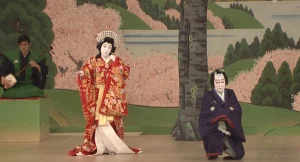
In the final moments, overjoyed at having received the drum, the fox uses his supernatural power to fend off a night raid targeting Yoshitsune. Then, cradling the drum, he leaps away through a flurry of falling cherry blossoms — one of kabuki’s most beautiful and exhilarating closing images.
Frequently Asked Questions
- The play is named after Yoshitsune, so why isn’t he the main character here?
-
While Yoshitsune is the central figure of the play as a whole, the true protagonist of this particular scene is the fox, Genkurō. Yoshitsune instead serves as a witness and quiet parallel figure — listening to the fox’s devotion and responding with compassion, in a way that ultimately highlights his own solitude as someone estranged from his own family.
- What does “Shi-no-Kiri” mean?
-
Yoshitsune Senbon Zakura is a five-act play, and Kawatsura Hōgen Yakata is the final scene (“kiri”) of the fourth act (“shi”) — hence its common nickname, “Shi-no-Kiri.” Kabuki often refers to its most celebrated scenes by nicknames like this, even in standalone performances.
- Why does the fox appear whenever the Hatsune drum is struck?
-
Because the drum’s hide is made from his own parents. He hears its sound as his parents’ voice calling to him — for a fox who spent four centuries longing for them, the drum’s tone was his only remaining connection to his family.
Summary
Shi-no-Kiri endures not simply as dazzling fantasy, but as a story built on the ache of longing for family — the fox’s pure devotion after four centuries apart from his parents, and Yoshitsune’s own quiet loneliness mirrored in it, all wrapped in some of kabuki’s most spectacular stagecraft. As the fox leaps away through falling cherry blossoms, drum held close, it’s a closing image that has moved audiences, newcomers and lifelong fans alike, for generations.
Related Reading
🎭 Want to See Kabuki Live?
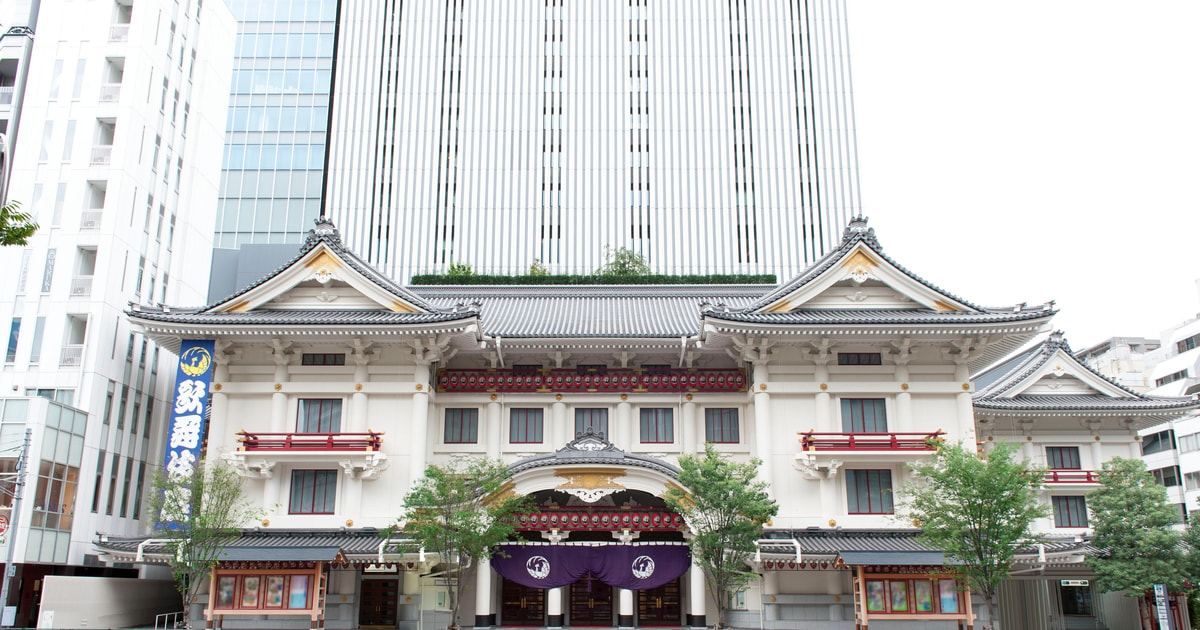
If you’re planning a trip to Tokyo, Kabuki-za is one of the most memorable ways to experience Japanese culture firsthand. GetYourGuide offers English-friendly Kabuki-za tickets and guided experiences, including options with headset translation and pre-show introductions for first-time viewers.
👉 Check Kabuki-za Tickets on GetYourGuide
This section may contain affiliate links. Booking through them costs you nothing extra and helps support this site.


コメント