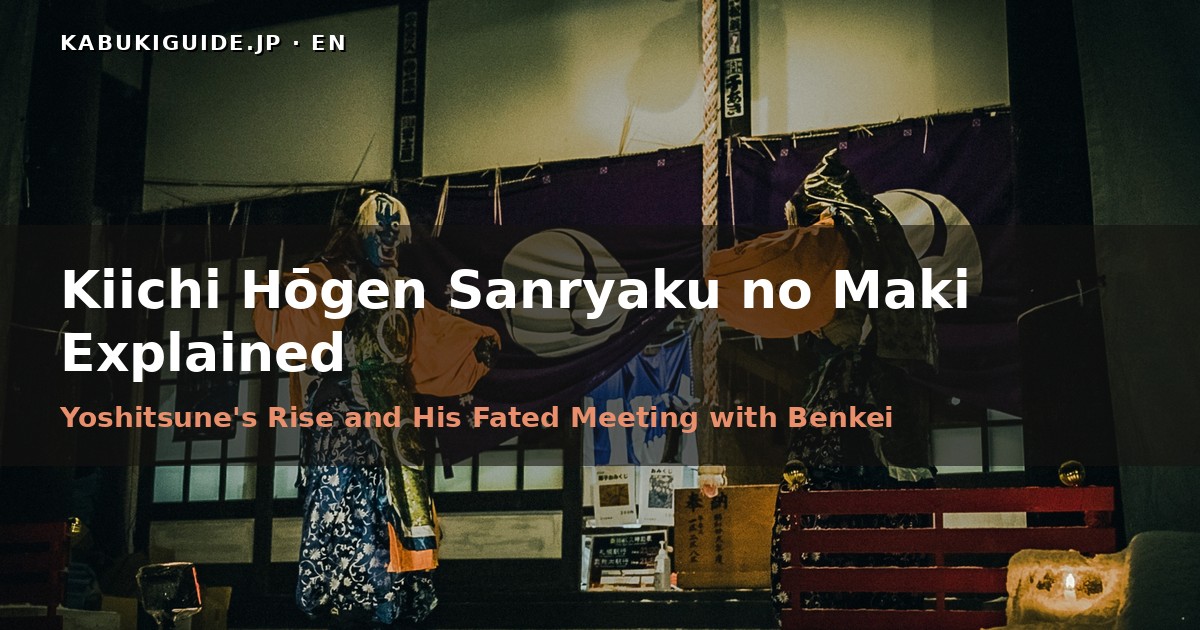
Kiichi Hōgen Sanryaku no Maki (鬼一法眼三略巻) traces the young Minamoto no Yoshitsune’s transformation from a hidden fugitive’s son into the hero who would one day command Musashibō Benkei — culminating in one of kabuki’s most famous first meetings. First staged in 1731 as a puppet-theater (jōruri) work, it’s a five-act epic, though today only three of its scenes remain in regular rotation.
What Kind of Play Is This?
Written by Wada Bunkōdō and Hasegawa Senshi, the play draws on the historical war chronicle Gikeiki to dramatize Yoshitsune’s path toward reclaiming his family’s fortunes. Of its five acts, three have survived as beloved standalone scenes: Kikubatake, Ichijō Ōkura Monogatari, and Gojō no Hashi. In practice, Kikubatake is usually what’s meant when people refer to “Kiichi Hōgen Sanryaku no Maki” today, with the other two scenes typically performed independently.
Typical Running Times
- Kikubatake — roughly 1 hour
- Ichijō Ōkura Monogatari — roughly 1 to 1.5 hours
- Gojō no Hashi — roughly 30 minutes to just under an hour
(Times vary somewhat depending on casting and whether the scene is staged as pure drama or dance.)
The Setup
After his father Minamoto no Yoshitomo’s death, the young Ushiwakamaru (later Yoshitsune) grows up in hiding under Taira rule, harboring dreams of restoring the Minamoto clan. To do that, he needs a legendary military treatise — the “Rikutō Sanryaku,” known as the Tiger Scroll — held by the scholar-warrior Kiichi Hōgen. Disguising his identity, he infiltrates Kiichi’s household as a servant, and between romance and calculated deception, works to obtain the scroll. From there, the story moves through Ichijō Ōkura’s tale of hidden loyalty, and finally to Yoshitsune’s fated encounter with Benkei at Gojō Bridge.
Act Three: Kikubatake
Ushiwakamaru, having grown up training in swordsmanship on Mount Kurama, learns the “tengu” who trained him was secretly Kiichi Hōgen all along. Though Kiichi serves the Taira, he secretly holds onto the Tiger Scroll per his late father’s wish — to be handed over only once a Minamoto heir proves himself worthy of leadership.
At sixteen, Yoshitsune travels to the capital with his retainer Onisanta, and the two infiltrate the Kiichi household as servants under the names Toravaka and Chienai, hoping to obtain the scroll. Kiichi senses their true identities but chooses to watch and wait rather than confront them.
Complicating matters, Kiichi’s daughter Minazuru-hime falls in love with Toravaka — unaware of his real identity — right as Taira no Kiyomori issues an order demanding Kiichi hand over the scroll immediately. Caught between the ambitions of a Minamoto restoration, Kiichi’s hidden loyalty, and a young woman’s genuine feelings, the tension of Act Three unfolds.
The scene turns on a three-way psychological standoff where almost nobody says what they really mean: Yoshitsune and Onisanta maintain their disguise even as Kiichi quietly sees through it, while Minazuru-hime’s sincere affection adds a note of real pathos to all the scheming around her.
Act Four: Ichijō Ōkura Monogatari
Act Four centers on a different figure entirely: the court noble Ichijō Ōkura Nagashige. Though descended from Minamoto lineage in an age of total Taira dominance, he survives by playing the fool — drinking heavily, feigning ignorance of politics, and appearing to everyone around him as a harmless, unreliable aristocrat.
Behind the act, though, lies fierce loyalty to the Minamoto cause and the composure to wait patiently for the right moment. The push-and-pull between his public buffoonery and his private resolve is what makes this act so compelling — and so demanding for the actor performing it.
As Taira pressure intensifies, Ōkura finally drops the mask, revealing his true self to the audience in a moment widely regarded as one of the most impressive dramatic showcases in all of kabuki.
Act Five: Gojō no Hashi
The story closes with its most famous scene: the fated meeting between Yoshitsune and the warrior-monk Musashibō Benkei on Kyoto’s Gojō Bridge.
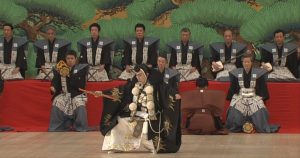
Benkei, having vowed to collect a thousand swords through combat, is testing his skill on the bridge when the still-young Ushiwakamaru appears. Small but remarkably agile, Yoshitsune nimbly dodges Benkei’s powerful strikes and ultimately defeats him — the scene’s highlight being less a clash of raw strength than a striking contrast between Benkei’s brute force and Yoshitsune’s dance-like, graceful evasion.
Humbled and impressed by his opponent’s skill, Benkei pledges lifelong loyalty to Yoshitsune on the spot — the beginning of one of Japanese legend’s most enduring lord-and-retainer bonds, and a genuinely exhilarating close to the story.
Main Characters
The Minamoto Side
- Minamoto no Yoshitsune (Ushiwakamaru / Toravaka) — Yoshitomo’s son, trained in swordsmanship at Kurama, who infiltrates the Kiichi household in search of strategic knowledge and later gains Benkei as his retainer
- Onisanta (Chienai) — Kiichi’s younger brother, who serves Yoshitsune loyally and infiltrates the household alongside him, marked by his sharp wit and level-headed judgment
- Ichijō Ōkura Nagashige — a court noble of Minamoto descent who feigns foolishness to survive under Taira rule while secretly holding firm loyalty to the Minamoto cause
The Kiichi Household
- Kiichi Hōgen — a master strategist serving the Taira who secretly hopes for a Minamoto restoration, and the keeper of the Tiger Scroll
- Minazuru-hime — Kiichi’s daughter, who falls for Toravaka and brings a note of lyrical romance to the story
- Onijirō — Kiichi’s other younger brother, entrusted to Kumano alongside Onisanta
The Taira Side
- Taira no Kiyomori — head of the Taira clan, who orders Kiichi to surrender the Tiger Scroll
- Taira no Shigemori — Kiyomori’s eldest son, who has his own scenes involving Minazuru-hime
At Gojō Bridge
- Musashibō Benkei — a fierce warrior-monk who challenges Yoshitsune at Gojō Bridge, loses, and becomes his most devoted retainer
Highlights
A Psychological Chess Match (Kikubatake)
The core appeal of Act Three is that nearly everyone is hiding their true feelings — Yoshitsune and Onisanta maintain a false identity while Kiichi quietly plays along, all while Minazuru-hime’s genuine love adds real emotional stakes to the deception.
Loyalty Disguised as Foolishness (Ichijō Ōkura Monogatari)
Act Four’s slow reveal of Ōkura’s true resolve beneath his comic foolishness makes for a genuinely dramatic structure, and a serious test of an actor’s range.
Power Versus Grace (Gojō no Hashi)
The final duel between Benkei’s brute strength and Yoshitsune’s dancer-like agility is visually thrilling, marking the birth of one of Japanese legend’s most iconic partnerships.
Frequently Asked Questions
- Can all five acts of the play be seen today?
-
Not typically — only three scenes (Kikubatake, Ichijō Ōkura Monogatari, and Gojō no Hashi) survive in regular performance, usually staged independently rather than as a full five-act production.
- What is the “Tiger Scroll” the story revolves around?
-
It refers to the “Rikutō Sanryaku,” a legendary military strategy text that Kiichi Hōgen has sworn to protect until a worthy Minamoto heir emerges — Yoshitsune’s pursuit of this scroll drives the entire plot.
- Is this the same story where Yoshitsune and Benkei first meet?
-
Yes — that meeting is dramatized in the final act, Gojō no Hashi, one of the most famous scenes in the entire Yoshitsune legend and a popular standalone piece in its own right.
Summary
Kiichi Hōgen Sanryaku no Maki tells the origin story of a legend — how Yoshitsune gained the knowledge, the allies, and finally the greatest retainer of his life. Each surviving act stands on its own as a complete drama, yet together they trace a clear arc: a hero gaining wisdom, gaining companions, and gaining the strength that would define the rest of his story.
🎭 Want to See Kabuki Live?
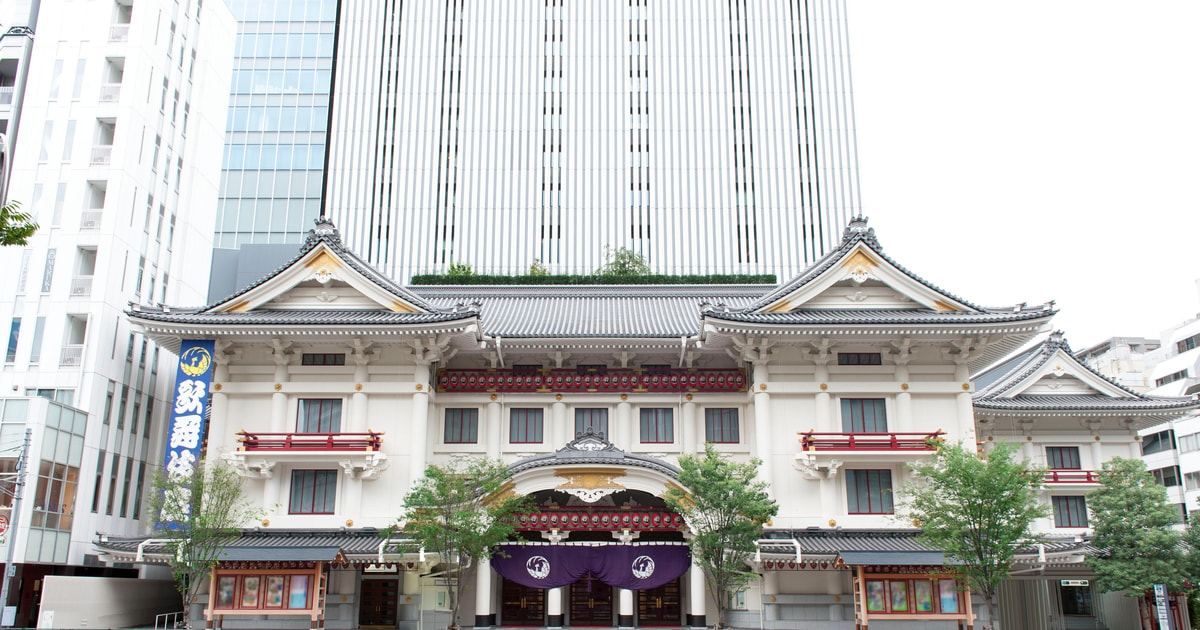
If you’re planning a trip to Tokyo, Kabuki-za is one of the most memorable ways to experience Japanese culture firsthand. GetYourGuide offers English-friendly Kabuki-za tickets and guided experiences, including options with headset translation and pre-show introductions for first-time viewers.
👉 Check Kabuki-za Tickets on GetYourGuide
This section may contain affiliate links. Booking through them costs you nothing extra and helps support this site.



コメント