This article is based on an actual visit to Shinbashi Enbujo in July 2026.
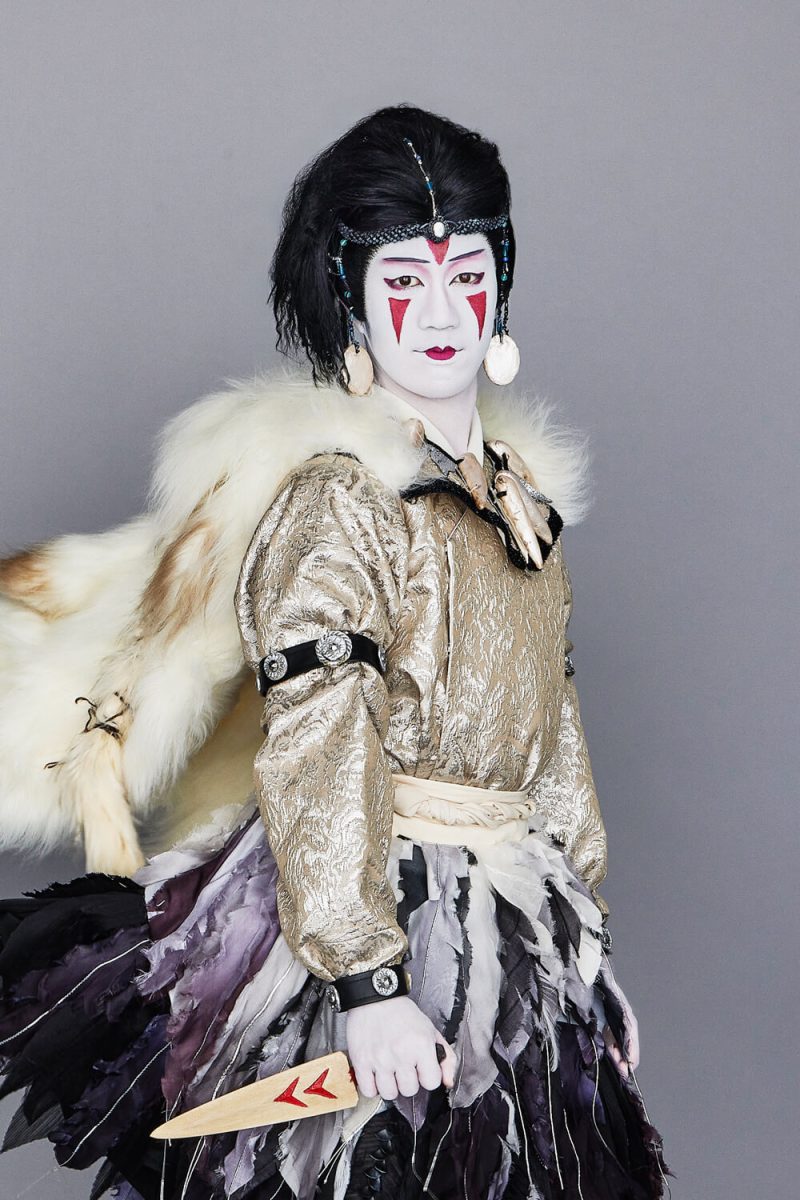
Studio Ghibli’s beloved film Princess Mononoke received its first-ever Super Kabuki staging at Shinbashi Enbujo in July 2026, with Ichikawa Danko as Ashitaka and Nakamura Kazutaro as San. Having seen the production firsthand, this review walks through the story, the staging choices that stood out, and practical viewing tips — including how the show looks from a second-floor seat.
Some staging details and plot points are discussed below — if you’d rather go in completely fresh, read with caution past the synopsis section.
What Is Super Kabuki Princess Mononoke?
This new Super Kabuki production adapts Hayao Miyazaki’s landmark animated film for the kabuki stage. With its sweeping themes of conflict between humanity and nature, life and death, and the possibility of coexistence, there was considerable anticipation around how such a story would translate into Super Kabuki form.
Super Kabuki is a modern performance style pioneered by Ichikawa En’ō, known for bold theatrical techniques like wire-flying stunts (chūnori), instantaneous costume changes, and dynamic staged combat.
The Cast
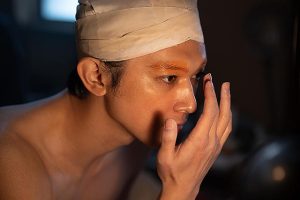
Ashitaka — Ichikawa Danko. Danko has spoken about finding real inspiration in the film’s theme song after the passing of his grandfather, Ichikawa En’ō, and has described feeling a sense of destiny in taking on this role, along with his wish to approach the production “with eyes unclouded” — a nod to one of the film’s signature lines.
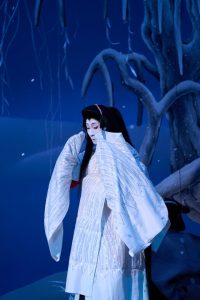
San — Nakamura Kazutaro. Kazutaro has noted that Princess Mononoke already carries a distinctly kabuki-like feel in its memorable lines, and has expressed hope that the production proves itself a genuinely worthwhile fit for the Super Kabuki format — bringing real physicality to the demanding role of a human girl raised by wolves in the forest.
Lady Eboshi — Nakamura Tokizō. Leading the ironworks settlement of Tatara-ba, Eboshi is a morally complex figure who resists easy categorization as hero or villain — how that nuance comes through on the kabuki stage is one of the production’s most interesting questions.
Okkoto-nushi — Ichikawa Chūsha. The great boar god Okkoto-nushi presents a genuinely compelling casting challenge: how do you portray a non-human deity through kabuki performance?
Synopsis
In an age when the land was still covered in deep forest and ancient gods walked among beasts and humans who once shared a common tongue, people gradually cleared the wilderness to build villages and nations, forging iron and waging war. The story is set in the Muromachi period, in a remote village of the Emishi people, once defeated in battle against the Yamato. When a demon god attacks the village, a young man named Ashitaka fells the creature to protect his people — but is cursed on his right arm as a result, a wound that will eventually take his life.
The village elder, examining a lead pellet found within the demon god’s body, tells Ashitaka that something troubling is unfolding far to the west, and that he might find a way to break the curse if he can see the truth with unclouded eyes. Ashitaka sets out west with his mount, Yakul.
Along the way, he learns from the monk Jiko-bō of a forest ruled by the Great Forest Spirit (Shishigami), forbidden to humans. At the forest’s edge lies Tatara-ba, an ironworking settlement led by Lady Eboshi. Within the forest, the wolf god Moro and her adopted human daughter San — the “Princess Mononoke” of the title — are locked in fierce conflict with the humans encroaching on their home.
Witnessing the struggle from both sides, Ashitaka comes to understand that neither side is simply right or wrong. Eboshi has built a haven for the sick and displaced even as she works to clear the forest; San is willing to give her life to stop her. Caught between them while trying to end the fighting, Ashitaka himself falls to a gunshot wound, only to be saved by the Great Forest Spirit — an event that deepens his bond with San.
Meanwhile, the boar god Okkoto-nushi rallies his kind for a final stand against humanity, while Jiko-bō and Eboshi’s faction move to hunt down the Great Forest Spirit itself, and a samurai warlord schemes to seize Tatara-ba for himself. As gods, forest, and humanity collide in a conflict spiraling toward catastrophe, Ashitaka holds fast to his belief that humans and the forest can find a way to live together — refusing to hate either side, and working to see a path forward with unclouded eyes. It’s a story told on a grand scale, built around the timeless question of how humanity and nature might coexist.
Highlights: How Kabuki Brought This World to Life
The Kodama Steal the Show
The tree spirits known as kodama are an early scene-stealer. Played by six child performers in costume, they’re larger than expected — genuinely funny in scale — each wearing a single note of an angklung (a bamboo percussion instrument) around their neck, live-performing that distinctive rattling sound with every head-tilt. Their poses are endearing enough that the audience audibly laughed every time they appeared, providing a welcome dose of comic relief throughout.
A Soundscape Built From Film Score and Shinobue
The production largely uses the film’s original soundtrack, layered with live traditional instrumentation — most notably the shinobue flute, whose distinctly Japanese tone blends surprisingly well with the film’s established sound. In the scenes set within the Great Forest Spirit’s domain, the constant chime of wind bells and small bells builds a genuinely mystical atmosphere through sound alone, performed live from the stage-right musicians’ area throughout.
Striking Visual Solutions for Wolves, Demon Gods, and Boar Deities
How to stage the film’s animals and gods was one of the biggest questions going in — and the answer turned out to be full theatrical personification. The demon god’s design carries real menace and visual impact. The two wolf gods, played by human performers, are strikingly beautiful in pure white costume, spinning and lunging at the humans in a way that feels like classic kabuki formal beauty made manifest. Moro and Okkoto-nushi both appear in lavish costumes that match their film designs closely, and the ape-like shishigami-adjacent creatures (the “shōjō”) are rendered almost exactly as they appear on screen, right down to their vocal character — a genuinely delightful surprise.
The Great Forest Spirit and the Night Walker
The Great Forest Spirit itself also appears through full personification — a commanding, golden figure that reads unmistakably as a king among gods. Its transformation into the towering Night Walker skips the intermediate stages of the transformation, instead concealing the figure behind foliage before revealing its elongated neck, then concealing it again before the full, gigantic form emerges — a staged, step-by-step reveal. The film’s inky black liquid effect is omitted entirely.
In the climax, the Great Forest Spirit’s restoration is conveyed through wire-flying (chūnori), the signature Super Kabuki technique — a genuinely inspired solution, translating the film’s imagery into kabuki’s own theatrical language. Leaves rain down over the stage in a suitably beautiful closing image. The curtain call, with every character — allies and adversaries alike — lined up together in good spirits, felt like a fitting, warm echo of the story’s own theme of coexistence.
San’s Combat Sequences Are Not to Be Missed
San’s fight scenes include genuine acrobatic flips, a striking display of physical ability. The first meeting between San and Ashitaka is staged much like the film — San drawing poison from Moro’s wound by mouth — though without blood makeup around her lips, likely a practical choice given how often the scene repeats across the run.
Why Stage This as Super Kabuki?
As Danko has noted, Super Kabuki was created by Ichikawa En’ō with an eye toward kabuki’s future. Staging Princess Mononoke within that framework carries real significance — the question of whether an entirely new story, rather than a classical one, can still become a genuine part of kabuki’s forward path is itself a large part of what makes this production compelling.
Seat Selection: A View From the Second-Floor West Wing
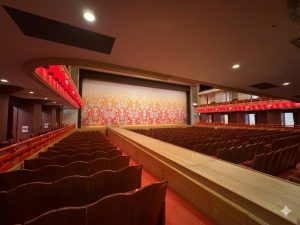
This viewing was from the west wing of the second floor — a useful reference point for planning your own visit.
- Best seats for the wire-flying sequence are on the second floor. The signature chūnori moment came through very clearly, and the falling leaves in the finale looked especially beautiful from the left side of the second floor.
- The hanamichi runway is largely out of view. Ashitaka’s hair, visible atop Yakul, was about all that could be made out — most of what happens on the runway itself is essentially invisible from this angle. If the hanamichi staging matters to you, a first-floor seat is the better choice.
- The shōjō creatures’ appearance was still clearly visible from the far left of the second floor.
Overall Impressions
What stood out most in person was a sense of scale that simply doesn’t come through on screen — particularly during the Night Walker sequence, when the entire theater fell silent, fully absorbed in the world of the story. Danko’s Ashitaka struck a genuinely effective balance between strength and sensitivity, staying true to the film’s spirit while still working as a fully realized kabuki performance.
Frequently Asked Questions
- Do I need to have seen the film to enjoy this production?
-
No — the story is presented clearly enough on stage to be enjoyable even for first-time viewers unfamiliar with the film.
- Is this a good show to bring children to?
-
Many of the staging effects are quite striking, and children of elementary-school age and up will likely find plenty to enjoy.
- How long is the performance?
-
Act One runs about 90 minutes, followed by a 30-minute intermission, then Act Two runs about 100 minutes — a total running time of roughly 3 hours 40 minutes, including the intermission.
- Does the production include signature Super Kabuki staging techniques?
-
Yes — the production makes use of wire-flying stunts (chūnori) and dynamic use of the hanamichi runway, both hallmarks of the Super Kabuki style.
Performance Information
Run: July 3 – August 23, 2026. Matinee performances begin at 11:00 AM, evening performances at 4:00 PM (check official listings for dark days).
Venue: Shinbashi Enbujo, Tokyo
| Seat Type | Price (tax included) |
| First Class | ¥17,000 |
| Second Class A | ¥10,000 |
| Second Class B | ¥6,500 |
| Third Floor A | ¥6,500 |
| Third Floor B | ¥3,000 |
| Box Seats (Sajiki) | ¥18,000 |
Summary
Super Kabuki’s Princess Mononoke brings Ghibli’s world to life through unmistakably kabuki tools — full theatrical personification of its animals and gods, wire-flying spectacle, and live traditional instrumentation. Rather than simply recreating the film, it succeeds by becoming something genuinely its own: kabuki’s own version of Princess Mononoke. It’s a production worth recommending with real confidence to Ghibli fans and kabuki newcomers alike — just choose your seat with the staging you care most about in mind: second floor for the wire-flying spectacle, first floor for the hanamichi runway.
🎭 Want to See Kabuki Live?
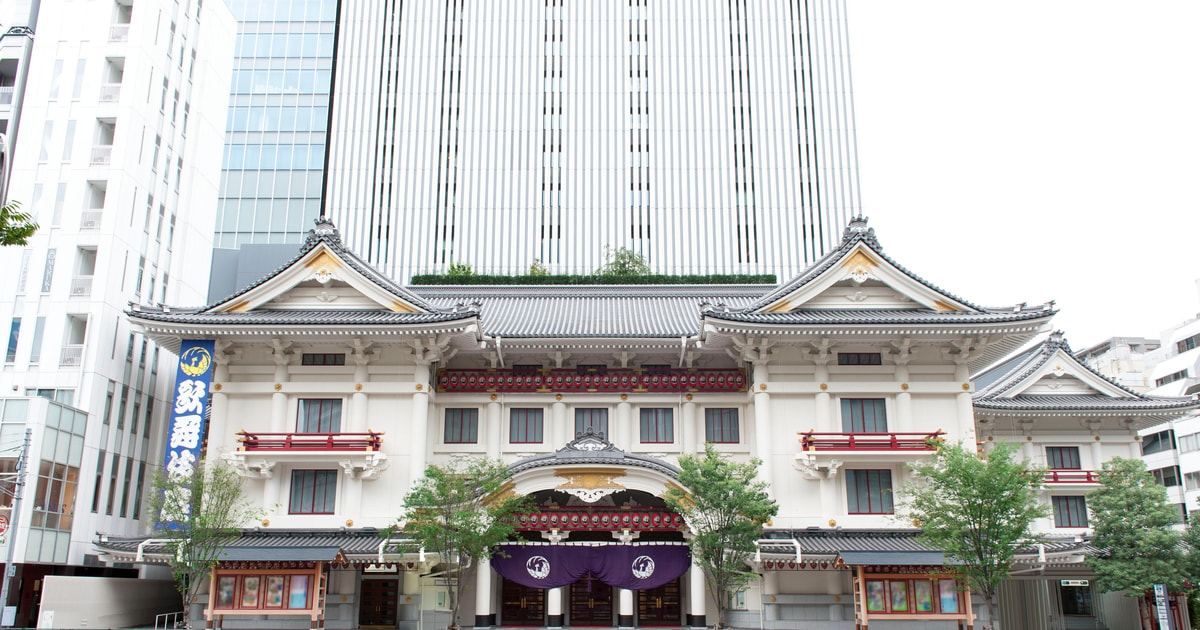
If you’re planning a trip to Tokyo, Kabuki-za is one of the most memorable ways to experience Japanese culture firsthand. GetYourGuide offers English-friendly Kabuki-za tickets and guided experiences, including options with headset translation and pre-show introductions for first-time viewers.
👉 Check Kabuki-za Tickets on GetYourGuide
This section may contain affiliate links. Booking through them costs you nothing extra and helps support this site.



コメント
コメント一覧 (1件)
[…] あわせて読みたい Super Kabuki Princess Mononoke Review|Story, Highlights, and What It Looks Like From the Balcony A firsthand review of Super Kabuki’s Princess Mononoke at Shinbashi Enbujo: staging highlights, cast, and what the […]