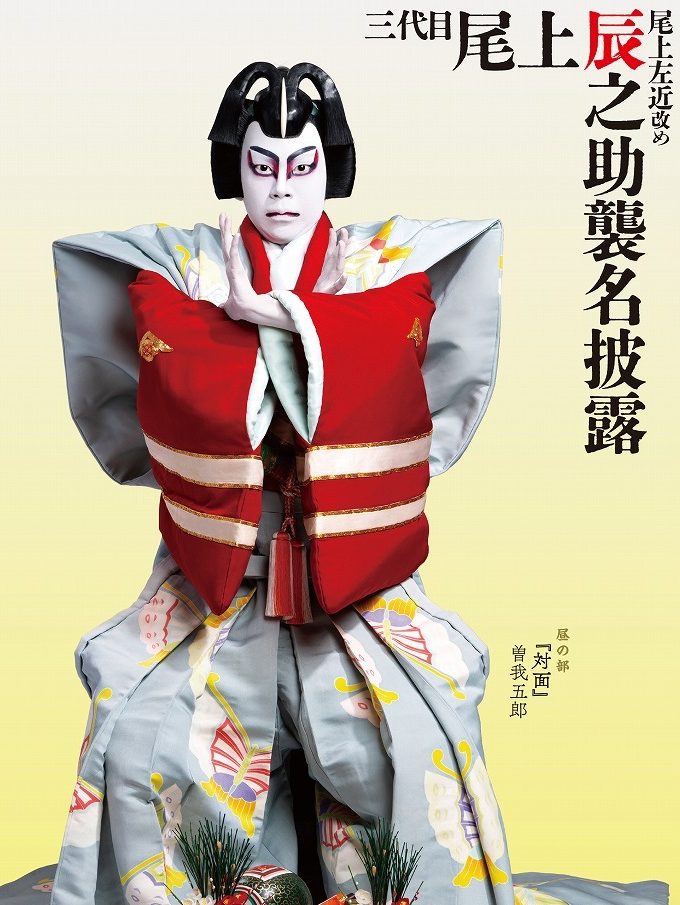
In May 2026, the actor previously known as Onoe Sakon took on the name Onoe Tatsunosuke at Kabukiza’s “Dan-Kiku Festival” May Grand Kabuki. “Tatsunosuke” is no ordinary stage name — it’s a name carried before him by both his grandfather and his father, one of special significance within the Shōroku acting lineage. This article walks through the family tree behind the name, his career to date, his artistic range, and the highlights of the 2026 name-succession celebration.
Family Tree: A Name Carried by Grandfather and Father Before Him
Within the Onoe family, Tatsunosuke belongs to the Shōroku lineage. The family tree behind the newly succeeded third-generation Tatsunosuke (formerly Onoe Sakon) runs as follows:
- Great-grandfather: Onoe Shōroku II
- Grandfather: Onoe Shōroku III (first-generation Tatsunosuke)
- Father: Onoe Shōroku IV (second-generation Tatsunosuke)
- Himself: Onoe Sakon → (2026) Onoe Tatsunosuke III
Within this family, “Tatsunosuke” is traditionally the name carried during a performer’s younger years, later passed on to the larger, more senior name “Shōroku.” His grandfather, Shōroku III, carried the name first as the original Tatsunosuke; his father, Shōroku IV, carried it next as the second Tatsunosuke — each bearing the name during their own younger years.
He has described the name’s meaning to him personally: “Tatsunosuke is the name my grandfather first carried, which my father then carried as a young man and protected with everything he had. It’s an extremely important name, one I truly love, both for our family and for me personally.”
The Kioichō branch of the family has long treasured a lineage of aragoto and kizewamono (realistic contemporary drama) passed down from Onoe Kikugorō VI, with weight and intensity of performance forming one central pillar of the family’s artistic style.
His Career as Onoe Sakon
He performed under the name Onoe Sakon since his childhood stage debut, building a genuinely long performance history from an early age. At age nine, he named the role of Marubashi Chūya — a role with strong aragoto leanings — as one he hoped to play someday, reflecting a clear alignment with the family’s traditional style even at that stage.
A Turning Point: Fuji Musume
From there, his path took an interesting turn. After appearing in the onnagata dance piece Fuji Musume and receiving direct instruction from Bandō Tamasaburō, he began taking on onnagata roles as well. What makes this notable is the combination: coming from a lineage of male-role (tachiyaku) specialists, and taking up onnagata roles on top of that. Since kabuki roles are typically quite clearly divided by type, this represents a genuine branching point in his career.
Choosing to Do Both
Today, he maintains a style built on his family’s tachiyaku tradition while also performing onnagata roles — his physique and natural softness of gesture allowing him to move into onnagata performance without strain. He has named Onoe Kikugorō VII, celebrated for excelling in both tachiyaku and onnagata roles, as his personal aspiration — pursuing not a choice between the two, but both at once.
Cho-Kabuki Appearances
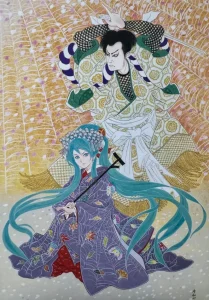
Beyond classical works, he has also taken on newer productions. In Cho-Kabuki, he appeared as Hatsune-hime in Sekai no Hana Musubu Kotonoha, performing as a young cast member in a work blending live theater with digital and video staging — productions that draw a notably broad audience, introducing his name to viewers well beyond traditional kabuki circles.
The 2026 Name-Succession Celebration
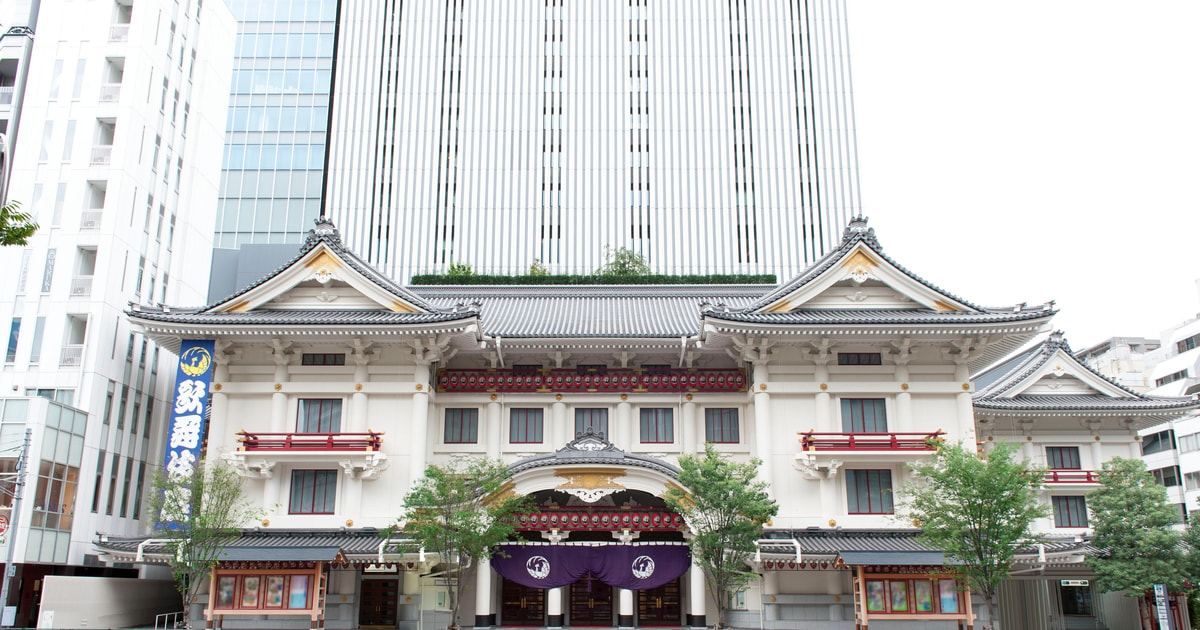
The name-succession celebration took place May 3–27, 2026, as part of “Dan-Kiku Festival” May Grand Kabuki at Kabukiza. The Dan-Kiku Festival is an annual May production at Kabukiza tied to the Naritaya (Ichikawa Danjūrō) and Otowaya (Onoe Kikugorō) lineages, and name-succession celebrations held within it typically include formal on-stage speeches (kōjō) and special casting not seen in ordinary performances.
The Succession Plays: Kotobuki Soga no Taimen and Kikubatake
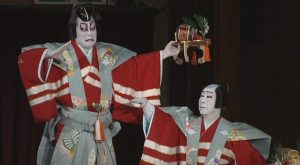
Two classic works were announced as the succession-celebration plays: the role of Soga Gorō in Kotobuki Soga no Taimen — a role both his grandfather and father performed at their own Tatsunosuke succession ceremonies — and the role of the servant Toravaka (in truth Minamoto no Ushiwakamaru) in Kiichi Hōgen Sanryaku no Maki‘s “Kikubatake” scene.
He commented on the choice: “I felt a strong desire to take this name with this particular play, and I feel the weight of that role. I’ve studied it thoroughly with my father, and I intend to perform it with everything I have.” Kotobuki Soga no Taimen in particular gave him the chance to share the stage with Onoe Kikugorō VII — the very performer he names as his personal artistic goal.

A Rare Alignment: The “Sannosuke” Trio
This particular succession is also notable for completing a well-known kabuki grouping known as Sannosuke — a nickname traditionally given to a trio of promising young stars whose names each end in “-nosuke.” With the birth of Onoe Tatsunosuke, the “Reiwa-era Sannosuke” trio was completed: Ichikawa Shinnosuke, Onoe Kikunosuke, and Onoe Tatsunosuke. Though each comes from a different family and artistic tradition, the three are increasingly recognized as a generational cohort carrying their names forward together.

Frequently Asked Questions
- What generation of “Tatsunosuke” is this?
-
The third. His grandfather, Onoe Shōroku III, carried the name first, and his father, Onoe Shōroku IV, carried it second — Onoe Sakon succeeded to the name as the third generation in May 2026.
- What’s the difference between “Tatsunosuke” and “Shōroku”?
-
Both belong to the same family lineage, but “Tatsunosuke” is traditionally carried during a performer’s younger years, later succeeded by the larger, senior name “Shōroku” — a path both his grandfather and father followed before him.
- Does he perform only male roles, or onnagata too?
-
Both — while his family specializes in tachiyaku (male) roles, he began studying onnagata performance after training under Bandō Tamasaburō in Fuji Musume, and continues to perform both role types today.
Summary
An actor who spent his early career as Onoe Sakon has taken up “Onoe Tatsunosuke” — a name carried before him by his grandfather (Shōroku III) and father (Shōroku IV), and one of deep significance to the Shōroku lineage. Coming from a family of tachiyaku specialists while also pursuing onnagata roles, and appearing in both classical works and new productions like Cho-Kabuki, his current position reflects an artist working across traditions rather than settling into just one. The Dan-Kiku Festival celebration marked a moment where that whole trajectory came into clear focus — a name worth knowing the next time you see it on a kabuki program.
🎭 Want to See Kabuki Live?
If you’re planning a trip to Tokyo, Kabuki-za is one of the most memorable ways to experience Japanese culture firsthand. GetYourGuide offers English-friendly Kabuki-za tickets and guided experiences, including options with headset translation and pre-show introductions for first-time viewers.
👉 Check Kabuki-za Tickets on GetYourGuide
This section may contain affiliate links. Booking through them costs you nothing extra and helps support this site.






コメント
コメント一覧 (3件)
[…] あわせて読みたい Onoe Tatsunosuke III Explained|Family Tree, Career, and the 2026 Name Succession A name carried by grandfather and father before him: the family tree, career, and 2026 name succession behind kabuki’s newest Onoe […]
[…] あわせて読みたい Onoe Tatsunosuke III Explained|Family Tree, Career, and the 2026 Name Succession A name carried by grandfather and father before him: the family tree, career, and 2026 name succession behind kabuki’s newest Onoe […]
[…] あわせて読みたい Onoe Tatsunosuke III Explained|Family Tree, Career, and the 2026 Name Succession A name carried by grandfather and father before him: the family tree, career, and 2026 name succession behind kabuki’s newest Onoe […]