In kabuki, there’s a term: Sannosuke. It refers to a trio of promising young stars whose names all end in “-nosuke” — a kind of unofficial star-unit nickname. Born in the Shōwa era, revived in Heisei, and now carried into Reiwa, the same nickname has resurfaced across three separate generations — a genuinely rare occurrence in kabuki history.
The Original Sannosuke (Shōwa Era)
It all began in May 1965. Onoe Kikunosuke IV and Onoe Tatsunosuke (the first of that name) took their names in the same ceremony, joined by Ichikawa Shinnosuke VI, who had already been carrying that name since the previous year. The nickname “Sannosuke” arose naturally from there.
These three weren’t grouped together simply because their names sounded alike. All three were born in the 1940s, genuinely close friends off stage, and their families shared deep ties as well — Shinnosuke and Tatsunosuke were even cousins.
And above all, their individual stage presences divided cleanly into distinct types. Shinnosuke brought striking flair to bold aragoto and leading-man roles. Kikunosuke captivated audiences with refined, elegant onnagata performance. Tatsunosuke brought a rugged charisma to contemporary drama and dance. With three genuinely different types standing together, the stage gained real dimension, and the group dynamic itself became a draw in its own right.
A magazine of the time summed it up neatly: “Kikunosuke for popularity, Tatsunosuke for masculinity, Shinnosuke for good looks” — and that clear division of roles was exactly what fueled the Sannosuke boom.
A Kyoto Back-Alley Legend
The Shōwa Sannosuke left behind plenty of stories befitting genuine young stars of the era.
One famous anecdote is set in Kyoto: as the three walked down a back alley, Kikunosuke supposedly started a confrontation, Tatsunosuke landed a blow and ran off, and Shinnosuke — the only one left standing there — ended up getting hit back. True or not, the story has stuck around as a perfect encapsulation of each of their personalities.
The Fervor That Helped Save Shōwa-Era Kabuki
One event cemented the Sannosuke’s popularity for good. In November 1965, Ichikawa Danjūrō XI, Shinnosuke’s father, passed away suddenly. Kikunosuke and Tatsunosuke stepped up to support Shinnosuke, who had lost his backing at a young age.
That bond left a strong impression on audiences, and the “bond between the three of them” translated directly into popularity. Their fan base shifted too — young women, in particular, began coming to the theater alongside kabuki’s more traditional audience.
At a time when kabuki’s decline was a real topic of conversation, this boom was a genuine tailwind for the art form. Eventually, each of the three succeeded to major names of their own, and the “Sannosuke” grouping naturally dissolved. Then, in 1987, Tatsunosuke passed away suddenly at age 40, and the trio came to be remembered as something closer to legend.
The Heisei Sannosuke (The New Sannosuke)
Even as eras changed, the story didn’t end there. The sons of the Shōwa Sannosuke went on to recreate the same configuration.
Ichikawa Shinnosuke VII, Onoe Kikunosuke V, and Onoe Tatsunosuke II began drawing attention around 1996.
The moment that sealed it was Kabukiza’s 2000 production of The Tale of Genji. Shinnosuke played Hikaru Genji, Kikunosuke played Lady Murasaki, and Tatsunosuke played Tō no Chūjō — casting that echoed the Shōwa Sannosuke closely enough to generate real buzz all over again.
This “revival” moment, however, didn’t last especially long. Each of the three went on to succeed to their next major names, and the Sannosuke grouping once again completed its role. Even so, the connection never fully broke — at Danjūrō XIII’s 2022 name-succession celebration, the three stood on the same stage once more, underscoring just how deep that bond still ran.
And Now, the Reiwa Sannosuke
And now, a third chapter of this story is beginning.
Ichikawa Shinnosuke VIII, Onoe Kikunosuke VI, and Onoe Sakon make up this next generation.
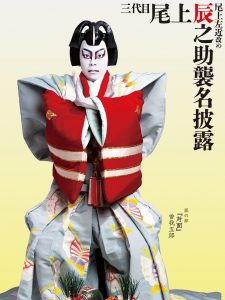
The key turning point came in May 2026, when Onoe Sakon succeeded to the name Onoe Tatsunosuke III — completing the conditions for a new “Sannosuke.”
A pattern that has run from Shōwa through Heisei into Reiwa has now reconnected into a single unbroken thread once again.

Frequently Asked Questions
- Is “Sannosuke” an official kabuki title?
-
No — it’s an informal nickname that emerges naturally whenever three promising young actors, whose names all end in “-nosuke,” rise to prominence together at the same time.
- How many times has a “Sannosuke” trio formed?
-
Three times so far — the original Shōwa-era trio starting in 1965, a Heisei-era revival starting around 1996, and the current Reiwa-era trio, completed in May 2026.
- Are the different generations of Sannosuke related to each other?
-
Yes — the Heisei Sannosuke were the sons of the original Shōwa trio, following in their fathers’ footsteps within the same three acting families.
Summary
“Sannosuke” is no coincidence. When bloodline, name, generation, and genuine star quality align all at once, three individual performers naturally come to be seen as a unit — in other words, it’s the story of kabuki’s own tradition of succession, made visible. That’s exactly why the name keeps resurfacing across eras instead of fading away, taking on fresh meaning each time a new generation carries it forward. Watching how the Reiwa Sannosuke’s own relationship unfolds on stage may turn out to be one of the more compelling threads in kabuki’s years ahead.
Related Reading

🎭 Want to See Kabuki Live?
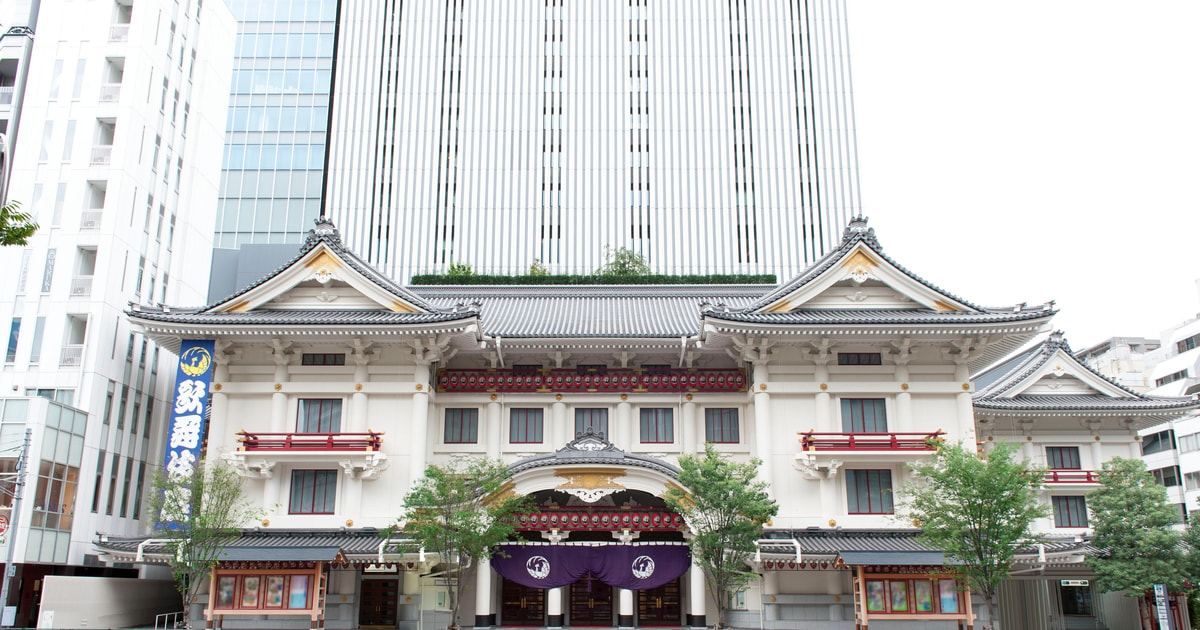
If you’re planning a trip to Tokyo, Kabuki-za is one of the most memorable ways to experience Japanese culture firsthand. GetYourGuide offers English-friendly Kabuki-za tickets and guided experiences, including options with headset translation and pre-show introductions for first-time viewers.
👉 Check Kabuki-za Tickets on GetYourGuide
This section may contain affiliate links. Booking through them costs you nothing extra and helps support this site.



コメント