“What’s Kikubatake actually about?” “Is it beginner-friendly?” “What am I supposed to be watching for?” — this guide answers all three, with a simple synopsis, the key highlights, and what to know before the curtain rises.
What Is Kikubatake?
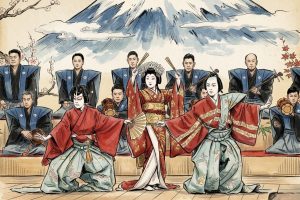
Kikubatake (菊畑, “The Chrysanthemum Garden”) is the third act of Kiichi Hōgen Sanryaku no Maki, a five-act jidai-jōruri (historical puppet-theater play) co-written by Bunkōdō and Hasegawa Senshi, later adapted into kabuki.
The first two acts cover the birth and childhood of Onikawakamaru — the boy who would grow up to become the warrior-monk Musashibō Benkei — told through a series of bold, larger-than-life episodes. By the time the story reaches Kikubatake, it shifts into a different register entirely: a beautifully staged scene woven from loyalty, scheming, and romance, set against a garden in full chrysanthemum bloom, all building quietly toward the future of the young Minamoto no Yoshitsune.
A typical performance runs around one hour, though this varies depending on whether it’s staged as part of a full run or as a standalone dance-adjacent piece.
Synopsis
Kikubatake unfolds in the garden of Kiichi Hōgen, a renowned military strategist, in full chrysanthemum bloom. Young Ushiwakamaru (the future Minamoto no Yoshitsune) is trying to obtain a secret manual of military strategy: the Sanryaku no Maki.
Kiichi Hōgen — formerly a retainer of the Minamoto clan, now nominally serving the rival Taira — is unwittingly harboring his own younger brother, Onisanta, who has taken a servant’s identity as “Chienai” to investigate his brother’s true loyalties and steal the treasured scroll.
Meanwhile, Ushiwakamaru himself is hiding in plain sight as a servant named Torazō, quietly waiting for his opportunity to move against the Taira. Kiichi’s daughter, Princess Minazuru, falls for “Torazō” without knowing his true identity — and the moment she learns who he really is, and what he intends to do, becomes one of the scene’s most affecting turns. Her conflict between love and loyalty to her family is one of the play’s central emotional threads.
Characters
Yoshioka Kiichi Hōgen
A master strategist and head of the Yoshioka family, which served the Minamoto clan for generations. Bound by his late father’s dying wish to pass the secret military manual to a worthy heir of Minamoto blood, he outwardly serves the Taira while secretly hoping for the Minamoto clan’s restoration.
Torazō, Actually Ushiwakamaru (the Future Minamoto no Yoshitsune)
The eighth son of Minamoto no Yoshitomo. Trained in swordsmanship on Mt. Kurama by a great tengu who was secretly Kiichi Hōgen himself, he now seeks the “tiger scroll” of the Sanryaku no Maki to restore his clan, infiltrating the Yoshioka household as a servant alongside Onisanta. Princess Minazuru falls for him without knowing his true identity.
Chienai, Actually Onisanta
Kiichi’s youngest brother, raised in secrecy deep in the mountains of Kumano — so thoroughly separated from his family that he doesn’t even recognize his own elder brother by sight. He serves under the alias Chienai to determine whether Kiichi truly sides with the Minamoto cause, combining loyalty with careful caution.
Princess Minazuru
Kiichi’s daughter, skilled enough in swordsmanship to have defeated her father’s own student in a tournament before Taira no Kiyomori. She discovers, almost by accident, that “Torazō” is actually Ushiwakamaru — and chooses to remain devoted to him even after learning the truth. Her struggle between love and family loyalty is a major highlight of the scene.
Highlights
The Tense Standoff Between Kiichi and Ushiwakamaru
The central confrontation revolves around the “tiger scroll” of the military classic Rikutō Sanryaku. Kiichi must decide whether this young man can truly be entrusted with the future of the Minamoto clan, while Ushiwakamaru must prove his resolve and ambition. It’s a quiet psychological duel rather than a physical one — and it’s the scene’s biggest highlight. Ushiwakamaru’s actions here also connect directly to the later, more famous play Kanjinchō.
A Web of Hidden Identities
Torazō is secretly Ushiwakamaru; Chienai is secretly Onisanta — a whole cast operating under assumed names. The tension of not knowing who’s truly an ally and who’s an enemy keeps the story tightly wound, and the moments where identities are finally revealed are major dramatic payoffs.
Jōruri’s Weight Meets Kabuki’s Spectacle
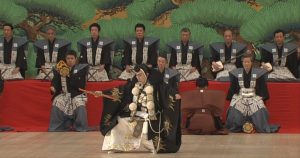
Adapted from a jōruri puppet play, the kabuki version adds mie poses, stylized combat, and lavish costuming on top of the story’s original gravity — a fusion of substantial drama and visual splendor.
Why Kikubatake Works Well for Beginners
Kikubatake stands out among kabuki plays for being:
- Relatively simple in its core story
- Easy to follow in terms of character relationships
- Visually rich enough to hold attention throughout
These qualities make it an approachable choice even for a first-time kabuki audience.
Frequently Asked Questions
- What is the “tiger scroll” everyone is after in Kikubatake?
-
It’s a secret manual within Rikutō Sanryaku, a classic text on military strategy, passed down within the Yoshioka family with instructions to give it only to a worthy heir of Minamoto blood.
- Is Kikubatake connected to any other famous kabuki plays?
-
Yes — Ushiwakamaru’s actions here set up his growth into Minamoto no Yoshitsune, the central figure of the later, widely performed play Kanjinchō.
- Is Kikubatake good for a first-time kabuki viewer?
-
Yes — its relatively straightforward story, clear character relationships, and visually rich staging make it one of the more approachable historical dramas in the kabuki repertoire.
Summary
Kikubatake blends hidden identities, a battle of wits over a legendary manual, and a young princess’s conflicted heart into one tightly constructed scene — a strong entry point into kabuki’s historical dramas, and a direct stepping stone toward the story that eventually becomes Kanjinchō.
🎭 Want to See Kabuki Live?
If you’re planning a trip to Tokyo, Kabuki-za is one of the most memorable ways to experience Japanese culture firsthand. GetYourGuide offers English-friendly Kabuki-za tickets and guided experiences, including options with headset translation and pre-show introductions for first-time viewers.
👉 Check Kabuki-za Tickets on GetYourGuide

This section may contain affiliate links. Booking through them costs you nothing extra and helps support this site.
Related Reading




コメント