

Kabuki wasn’t always an all-male art form. For its first few decades, women performed kabuki too — some of them founded it. The reason men eventually took over every role, including the female ones, has less to do with artistic preference and more to do with a string of government bans rooted in anxiety about public morality.
It Started With a Woman
Kabuki’s origin story centers on Izumo no Okuni, a shrine performer who began staging bold, unconventional dance performances in Kyoto around 1603. Okuni’s troupe included women, and their performances — energetic, a little provocative, thoroughly entertaining — became a sensation. This earliest phase is sometimes called onna kabuki (“women’s kabuki”), and it was, by most accounts, a genuinely mixed and open art form in its first years.
The First Ban: Onna Kabuki (1629)
Okuni’s success spawned countless imitators, and troupes of women performers — some connected to the pleasure districts — spread rapidly across Japan. The shogunate grew concerned that these performances were functioning as thinly veiled solicitation, and in 1629, it banned women from performing kabuki altogether. It’s worth noting the ban targeted a perceived social problem, not the art form’s female performers specifically for lacking skill — but the practical result was the same either way: women were now shut out of the kabuki stage.
The Second Ban: Wakashu Kabuki (1652)
Kabuki didn’t skip a beat — young men and adolescent boys stepped into the vacated roles, in a phase known as wakashu kabuki (“young men’s kabuki”). But the same concerns resurfaced almost immediately, this time centered on the young performers themselves, and the shogunate banned wakashu kabuki too, just 23 years after the first ban.
Yarō Kabuki and the Birth of Onnagata
With both women and youths barred from the stage, kabuki was left with only adult men — a phase called yarō kabuki (“men’s kabuki”), and the shogunate imposed a further requirement: male performers had to shave the front of their heads in the adult male style of the time, specifically to make them look less conventionally attractive and further discourage the same concerns that had led to the previous two bans.
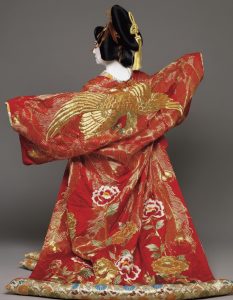
It’s from this restrictive moment that onnagata — men specializing permanently in female roles — truly took shape as a serious art form. Faced with an impossible brief (perform convincing femininity while visibly, unmistakably male, hairline included), performers didn’t try to literally impersonate women. Instead, they began developing an entirely abstracted, stylized language of femininity: precise posture, a lowered center of gravity, controlled gaze, and refined gesture designed to evoke the essence of womanhood rather than mimic its surface. That distinction — expressing an idea of femininity through codified technique, rather than simply “playing dress-up” — is exactly what elevated onnagata from a workaround into one of kabuki’s most respected specialties.
Why the Tradition Never Reverted
By the time the strictest of these restrictions eased, onnagata had already become a deeply developed art form in its own right, with its own training lineage, its own techniques, and its own celebrated masters. There was no practical reason to “revert” to mixed casting — onnagata performance had become one of kabuki’s core attractions rather than a stopgap measure, and the acting families that had built their reputations on it had every incentive to keep training sons to carry it forward. Four centuries later, that unbroken line of transmission is exactly why onnagata remains central to kabuki today, taught and refined generation after generation rather than treated as a historical relic.
Frequently Asked Questions
- Did women originally perform in kabuki?
-
Yes — kabuki was founded around 1603 by Izumo no Okuni, a female performer, and women were part of the art form’s earliest years before being banned from the stage in 1629.
- Why were women banned from kabuki?
-
The shogunate grew concerned that performances by women, some connected to the pleasure districts, were being used for solicitation, and banned women from the kabuki stage in 1629 on public morality grounds.
- Was the ban on women the only reason onnagata developed?
-
It was the starting point, but not the whole story. A second ban on young male performers in 1652 pushed kabuki toward adult male actors specifically, which is when onnagata developed into the highly codified, abstracted art form it remains today.
Summary
Onnagata exists because of two consecutive government bans, not artistic preference — first on women, then on young male performers, leaving adult men as the only option left standing. What could have been a simple workaround instead became one of kabuki’s most refined art forms, built on the idea that femininity could be expressed through codified technique rather than literal imitation — a tradition unbroken for nearly 400 years.
Related Reading


🎭 Want to See Kabuki Live?
If you’re planning a trip to Tokyo, Kabuki-za is one of the most memorable ways to experience Japanese culture firsthand. GetYourGuide offers English-friendly Kabuki-za tickets and guided experiences, including options with headset translation and pre-show introductions for first-time viewers.
👉 Check Kabuki-za Tickets on GetYourGuide

This section may contain affiliate links. Booking through them costs you nothing extra and helps support this site.





コメント
コメント一覧 (1件)
[…] あわせて読みたい Why Do Men Play Women’s Roles in Kabuki? The History of Onnagata Kabuki wasn’t always all-male. Two government bans, first on women and then on young male performers, are the real reason onnagata developed i […]