
A kabuki actor’s wig and costume aren’t simply dressing — they’re precision-built tools, custom-fitted to an individual performer and engineered to survive vigorous combat, sudden reveals, and hours under stage lighting. Behind every dazzling silhouette on stage is a surprisingly technical, deeply specialized craft tradition.
Wigs: Custom-Built for Every Actor
Kabuki wigs (kazura) are made from real human hair, individually knotted strand by strand onto a metal base plate custom-shaped to fit that specific actor’s head. This isn’t an off-the-shelf accessory — it’s built to stay perfectly secure through dramatic mie poses, energetic dance sequences, and full-contact stage combat, without shifting or slipping under pressure.
A wig that shifts mid-pose would undercut the whole effect of a mie, the frozen, intense pose actors strike at a scene’s dramatic peak.
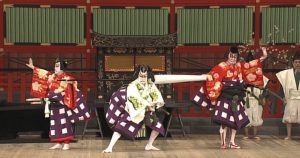
There are hundreds of distinct wig styles across kabuki’s repertoire, each tied to a specific role type — a samurai’s topknot style, a courtesan’s elaborate styling, an onnagata’s softly rounded silhouette, and countless further variations signal a character’s status and role before they’ve said a single line. Specialized backstage hairdressers, known as tokoyama, are responsible for styling and resetting these wigs before nearly every performance, since the wear of a single show can throw off the exact silhouette required.
Costumes: Wearable Art With Real Physical Weight
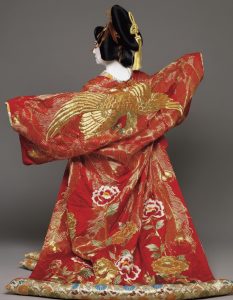
Kabuki costumes (ishō) are often genuinely museum-quality objects — elaborately embroidered silk, sometimes taking master craftspeople months to complete a single piece. They’re far from purely decorative, either: bold aragoto costumes in particular can weigh a substantial amount, adding real physical difficulty to already demanding, dynamic movement. Performing a full combat sequence or an extended dance in one of these costumes is a genuine feat of stamina as much as artistry.
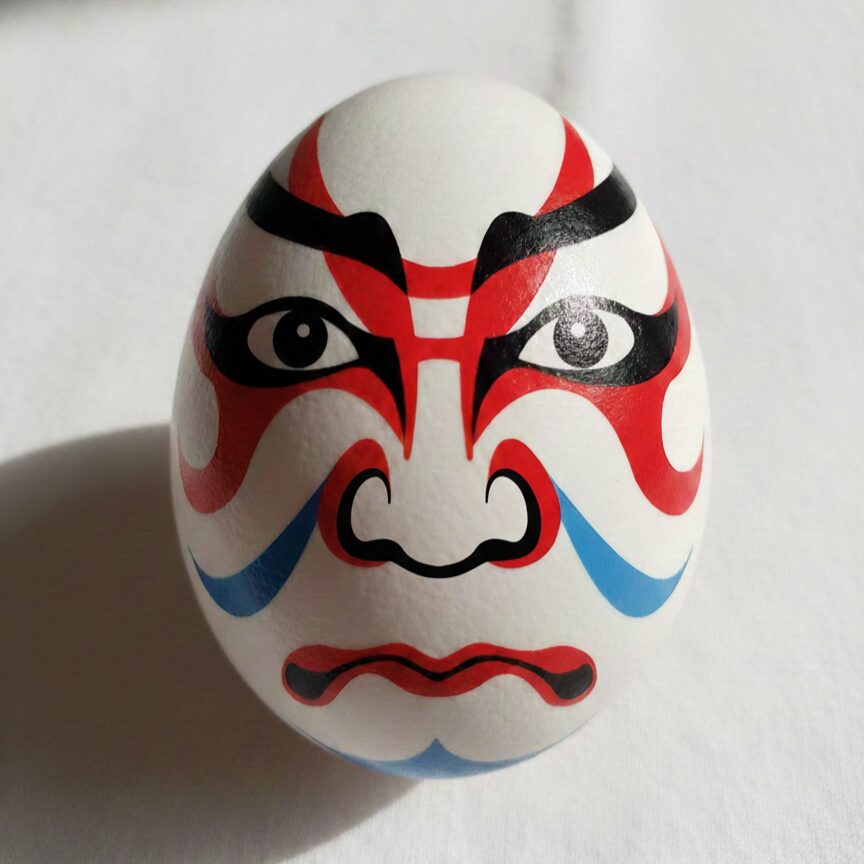
Color and pattern function almost as their own language, much like kumadori makeup — specific colors, motifs, and fabric choices signal a character’s status, personality, and role type at a glance, giving an experienced kabuki audience information about a character before they even speak.
The Engineering Behind Instant Costume Changes
Some of kabuki’s most crowd-pleasing moments come from instantaneous costume transformations, made possible by ingenious tailoring techniques built directly into the garment. In hikinuki, an outer layer of costume is deliberately basted together with loose thread; at a precise cue, an assistant pulls the thread free, and the entire outer layer falls away in an instant, revealing a completely different costume underneath — no exit from the stage required. A related technique, bukkaeri, uses the same basted-thread principle on just the upper half of the costume: at the cue, the threads are pulled and the outer upper garment falls away and hangs from the waist, revealing a completely different costume (or the character’s true form) underneath. Both techniques demand tight coordination between actor and stage assistant, and both are engineered directly into how the costume is constructed from the very start.
Wig Styles Vary by Role in Striking Detail
The differences between wig styles go well beyond simple hairstyle — the exact silhouette, height, and styling of a wig is calibrated to a character’s specific status and personality. A dignified samurai’s wig sits differently than a comic servant’s, and an aragoto hero’s wig style is built to project outsized power, sometimes incorporating dramatically exaggerated shapes that would look absurd on an ordinary person but read as larger-than-life on stage. Onnagata wigs, meanwhile, are styled to soften and idealize, working in tandem with an onnagata’s posture and gesture to build the same abstracted vision of femininity discussed elsewhere on this site. A trained eye can often identify a character’s role type from wig silhouette alone, before the actor has even turned to face the audience.
Passed Down, Piece by Piece
Costumes and their construction techniques are frequently maintained by specialized theatrical costume houses with deep, generations-long expertise in kabuki’s specific needs — pieces are repaired, restyled, and sometimes handed down for reuse across productions, treated as genuinely valuable craft objects rather than disposable set dressing.
Frequently Asked Questions
- Are kabuki wigs made from real hair?
-
Yes — kabuki wigs are made from real human hair, individually knotted onto a metal base plate custom-fitted to each actor’s own head shape.
- How does an actor change costume so quickly on stage?
-
Through techniques like hikinuki and bukkaeri, where a costume is deliberately constructed to fall away or flip open at a precise cue, revealing a new look instantly without the actor leaving the stage.
- Who styles a kabuki actor’s wig before a performance?
-
Specialized backstage hairdressers called tokoyama style and reset kabuki wigs before nearly every performance, since normal wear during a show can shift the exact silhouette required for a given role.
Summary
A kabuki actor’s wig and costume are as much precision engineering as they are art — custom-built human-hair wigs, museum-quality embroidered silk, and costumes designed to transform in an instant through techniques refined over centuries. The next time an actor’s entire look changes in the blink of an eye, there’s a genuinely ingenious piece of craftsmanship behind that single dramatic moment.
🎭 Want to See Kabuki Live?
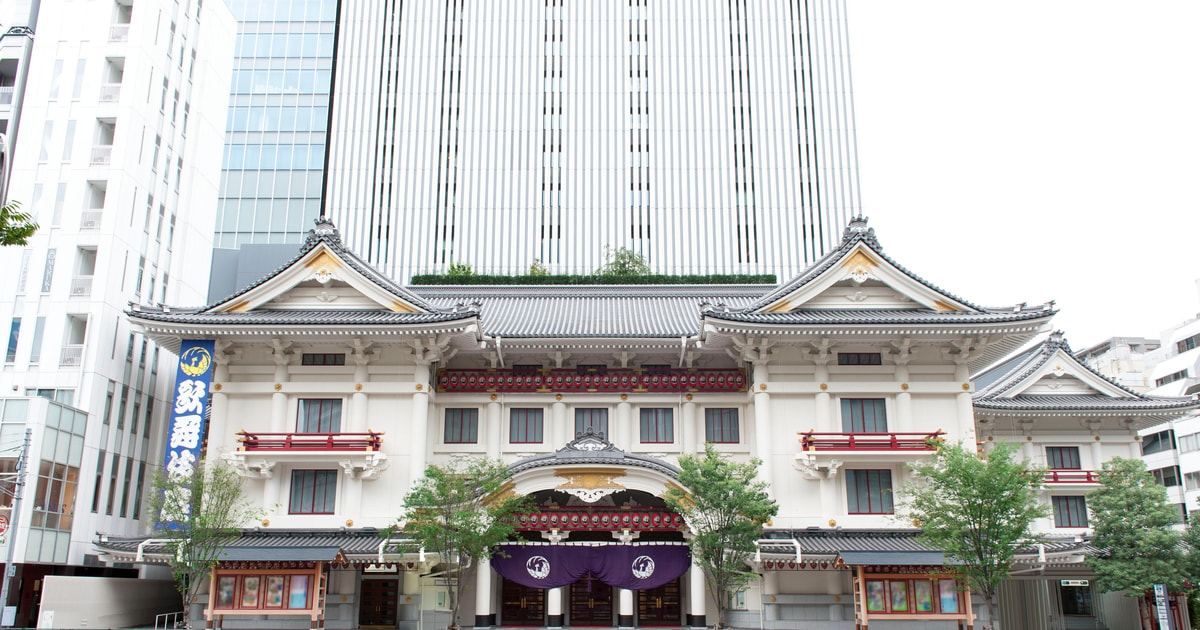
If you’re planning a trip to Tokyo, Kabuki-za is one of the most memorable ways to experience Japanese culture firsthand. GetYourGuide offers English-friendly Kabuki-za tickets and guided experiences, including options with headset translation and pre-show introductions for first-time viewers.
👉 Check Kabuki-za Tickets on GetYourGuide
This section may contain affiliate links. Booking through them costs you nothing extra and helps support this site.


コメント
コメント一覧 (2件)
[…] あわせて読みたい Kabuki Wigs and Costumes: The Craftsmanship Behind the Spectacle Kabuki wigs are custom-built from real human hair, and costumes are engineered to transform instantly on stage. Here’s the craftsmanship behind kabu […]
[…] あわせて読みたい Kabuki Wigs and Costumes: The Craftsmanship Behind the Spectacle Kabuki wigs are custom-built from real human hair, and costumes are engineered to transform instantly on stage. Here’s the craftsmanship behind kab […]