

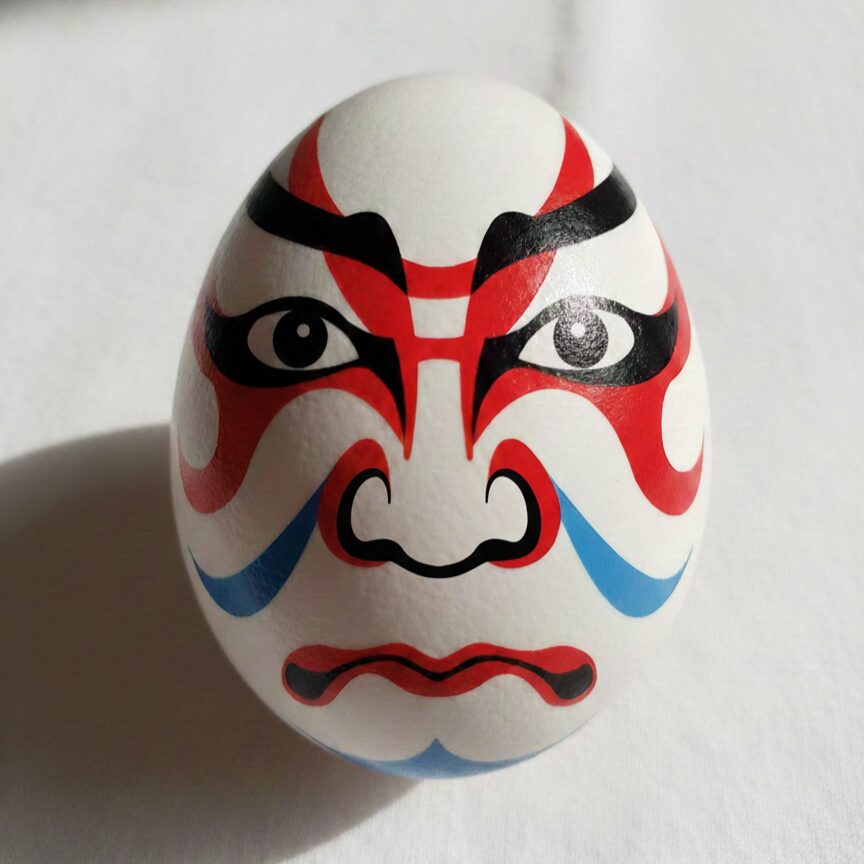
Kumadori’s bold red and blue lines might look like they’re painted on with a brush and a steady hand, but the real technique is stranger and more intimate than that — a surprising amount of it is done with bare fingertips, by the actor themselves, in a ritual repeated before nearly every aragoto performance.
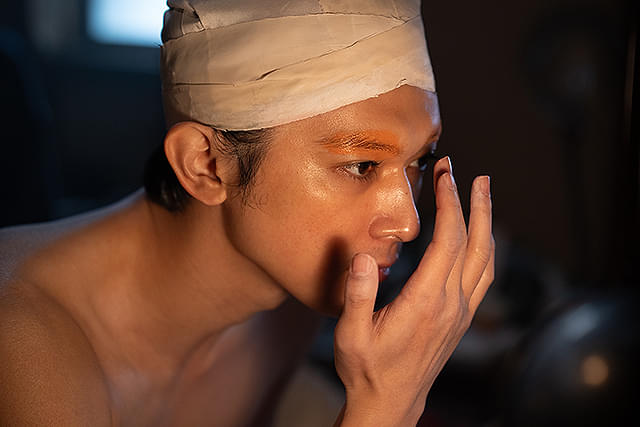
Actors Apply Their Own Makeup
Unlike most Western theatrical traditions, where a dedicated makeup artist handles an actor’s face, kabuki performers apply their own kumadori themselves, seated at their own mirror in the dressing room. It’s a skill learned early, as part of an actor’s broader training, and it means every performer builds a genuinely personal, practiced relationship with their own face and the specific pattern tied to their role.
Step One: The Base Layer
Before any color goes on, the face is prepared with a base layer — depending on the specific role, this might be a plain skin-toned foundation or the same white base (oshiroi) used across kabuki more broadly. This base creates a clean, even surface for the bold colors to follow, and it’s the same starting point used across most kabuki role types before any role-specific styling begins.
Step Two: Drawing the Lines
The defining lines of a kumadori pattern are drawn next, tracing the specific pattern tied to a given role — patterns that are themselves passed down within acting families, sometimes with small variations specific to a particular actor’s lineage or personal interpretation. This stage requires real precision: the lines follow the natural contours of the actor’s own face, meaning the same “type” of kumadori looks at least slightly different on every performer who wears it.
Step Three: The Fingertip Blend
Here’s the detail that surprises most people: much of kumadori’s signature effect comes from blending pigment outward from those lines using bare fingers, rather than a brush. This fingertip blending is what creates kumadori’s distinctive soft gradient — sharp where the line begins, fading outward into the surrounding skin — giving the pattern a sense of motion and intensity rather than a flat, painted-on look. It’s a tactile, almost sculptural process, closer to shaping the color across the face than simply drawing it on.

How Long Does It Take?
Depending on the complexity of the specific pattern and the role, a full kumadori application can take anywhere from around thirty minutes to well over an hour. For a major aragoto role, this isn’t a rushed pre-show formality — it’s treated as a meaningful part of an actor’s own preparation, a quiet, focused ritual of becoming the character before ever stepping on stage.
What the Pigments Are Made Of
Traditional kumadori pigments draw on materials with deep roots in Japanese cosmetic and artistic tradition, including beni, a red pigment historically derived from safflower petals, mixed into an oil- or wax-based medium that helps the color hold and blend smoothly across the skin. This same oil-based composition is also why removing kumadori at the end of a performance requires a proper oil-based cleanser rather than simple soap and water.
Kumadori Isn’t Used in Every Role
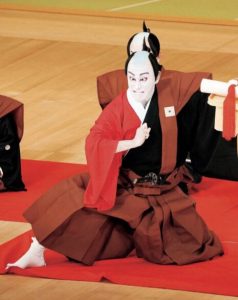
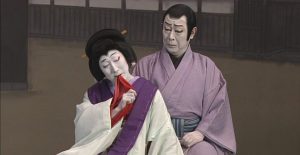
It’s worth remembering that this entire elaborate process is reserved specifically for aragoto-style roles and a handful of other characters requiring exaggerated visual symbolism — heroes, villains, and supernatural figures whose nature benefits from bold, legible face makeup. Refined wagoto roles, everyday townspeople, and most onnagata roles use far more subtle, naturalistic makeup instead, meaning the hour-long kumadori ritual described here is a special occasion within an actor’s broader career, not a routine part of every single performance.
Why Self-Application Matters
The fact that actors paint their own kumadori isn’t incidental — it reinforces the idea that the pattern isn’t simply a costume element handed to a performer, but something they actively construct and inhabit themselves, role after role, performance after performance. By the time the final line is blended into place, the actor hasn’t just been made up for the part; they’ve spent the better part of an hour physically building toward it.
Frequently Asked Questions
- Do kabuki actors apply their own makeup?
-
Yes — unlike much of Western theater, kabuki performers apply their own kumadori themselves, a skill learned as part of their broader training from a young age.
- Is kumadori painted on with a brush?
-
The initial lines are drawn precisely, but much of the pattern’s signature soft gradient effect comes from blending the pigment outward with bare fingertips rather than a brush.
- How long does it take to apply kumadori before a performance?
-
Roughly thirty minutes to over an hour, depending on the complexity of the specific pattern and role.
Summary
Kumadori’s bold visual impact comes from a surprisingly intimate, hands-on process — actors applying their own pattern, blending pigment outward with bare fingertips, refining a family-specific design across a ritual that can take the better part of an hour. It’s less a cosmetic step than a genuine act of physical preparation, and knowing what’s actually happening behind that dramatic face paint adds a whole new layer of appreciation the next time you see it on stage.
🎭 Want to See Kabuki Live?
If you’re planning a trip to Tokyo, Kabuki-za is one of the most memorable ways to experience Japanese culture firsthand. GetYourGuide offers English-friendly Kabuki-za tickets and guided experiences, including options with headset translation and pre-show introductions for first-time viewers.
👉 Check Kabuki-za Tickets on GetYourGuide

This section may contain affiliate links. Booking through them costs you nothing extra and helps support this site.








コメント