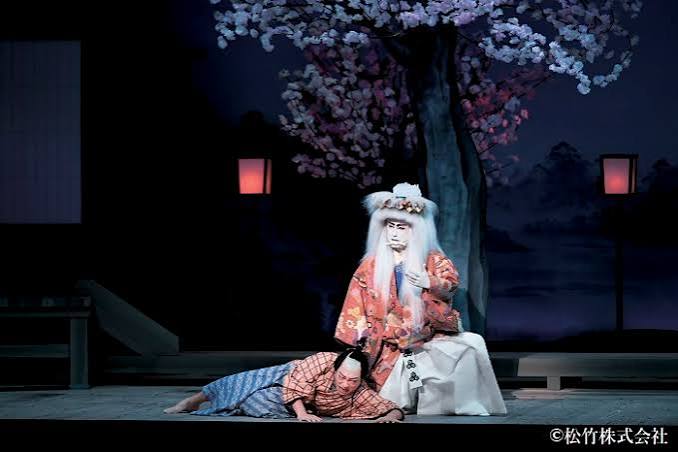
Ohamagoten Tsunatoyo-kyō (御浜御殿綱豊卿) is a scene from the celebrated shin-kabuki (new kabuki) masterpiece Genroku Chūshingura, built entirely around a tense verbal confrontation between Tokugawa Tsunatoyo (the future sixth shogun, Ienobu) and Akō rōnin Tominomori Sukeemon.
The setting is Ohama Palace, one year after the corridor attack at Edo Castle that set the entire Chūshingura story in motion. Sukeemon is determined to avenge his lord; Tsunatoyo is torn between the shogunate’s rule of law and the samurai code of loyalty. Their confrontation raises a question the play never fully resolves: what does true loyalty actually mean, and is revenge ever truly justice?
Unlike most Chūshingura-related plays, this scene has no swordplay to speak of — it’s a substantial, dialogue-driven work carried entirely by words and psychological tension.
Synopsis
At Ohama Palace, a lavish garden party is underway. Lord Tsunatoyo, of the Tatebayashi domain, outwardly shows no interest in politics — but privately, he’s deeply troubled by the question of restoring the Asano family’s fortunes and the looming revenge plot of the Akō rōnin.
Into this scene slips Tominomori Sukeemon, one of the Akō rōnin, who has infiltrated the palace to gather intelligence on the whereabouts of Kira Kōzuke-no-suke, the enemy his former lord’s group is sworn to kill.
Tsunatoyo eventually grants Sukeemon an audience, and the two engage in a fierce debate over the ethics of revenge. Loyalty to one’s fallen lord, or the rule of the shogunate — neither side will yield, and the tension between them builds toward a breaking point.
That night, mistaking his target in the dark, Sukeemon lunges with a spear at a figure he believes to be Kira — only to discover it’s Tsunatoyo himself. Tsunatoyo strikes Sukeemon down and rebukes him sharply: an act like this, he says, cannot be called the vengeance of a righteous man. In that moment, the story rises above a simple revenge plot and becomes something larger — a drama interrogating the very meaning of righteousness.
Characters
Tokugawa Tsunatoyo
The future sixth shogun, Tokugawa Ienobu. As Lord of Tatebayashi residing at Ohama Palace, he sympathizes with the Akō rōnin’s cause while remaining torn by his responsibility to the shogunate’s order. The play uses him to embody the wisdom and restraint expected of a true ruler.
Tominomori Sukeemon
One of the Akō rōnin, who infiltrates Ohama Palace to track the whereabouts of Kira Kōzuke-no-suke, the man his former lord Asano Naganori was forced to confront. As a samurai devoted entirely to loyalty, he serves as the play’s second lead, locked in fierce debate with Tsunatoyo.
Arai Hakuseki
Tsunatoyo’s scholarly advisor. He doesn’t drive the plot directly, but his presence helps surface Tsunatoyo’s inner conflict and philosophy.
Kira Kōzuke-no-suke
The man the Akō rōnin are sworn to kill. He never appears directly, but his presence looms over the entire story, generating the tension that drives it.
Highlights
A Devastating War of Words
The single greatest highlight of this play is the verbal exchange between Tsunatoyo and Sukeemon — an intensity that feels like two men dueling with words instead of swords. Watching two deeply held convictions collide is exactly what shin-kabuki does best.
The Measure of Tsunatoyo as a Ruler
Tsunatoyo is never written as a simple authority figure. He sympathizes with the rōnin while never losing sight of the nation’s order — and that scale of vision, that sense of a genuinely large-minded person, is the heart of the play.
The Spear Scene
After a story built entirely on dialogue, the tension snaps taut in the final act. The moment Sukeemon realizes the man he’s lunged at with a spear, mistaking him for Kira, is actually Tsunatoyo himself, is a genuinely stunning turn — this is a quiet play, but its closing tension hits remarkably hard.
What Tsunatoyo Means by “Righteousness”
The true core of this play lies in the philosophy Tsunatoyo lays out to Sukeemon near the end. He argues that what matters isn’t the act of revenge itself, but the motivation from which righteousness arises in the first place. In essence: justice isn’t measured by outcome, but by the spirit behind the action that led to it.
With that framing, Tsunatoyo challenges Sukeemon on several fronts — the contradiction of hoping to restore the Asano family while pursuing a vendetta, the danger of revenge pursued by any means necessary, and the possibility that Ōishi Kuranosuke (the rōnin’s leader) may still be weighing his own answer to this question.
What’s depicted here isn’t simply a conflict between a lord and a rōnin — it’s a genuine meditation on what righteousness actually means. That depth is exactly why this scene endures as more than just another Chūshingura episode.
A Different Angle on the Chūshingura Story
While most Chūshingura works build toward the climactic raid on Kira’s mansion, Ohamagoten Tsunatoyo-kyō is unusual in approaching the story from the side of someone questioning that raid before it happens. Is revenge truly justice? Can order and loyalty coexist? The play digs into these questions entirely through the dialogue between Tsunatoyo and Sukeemon — making it as much a drama of ideas as it is a Chūshingura tale.
Is This a Good Fit for Beginners?
This isn’t a flashy aragoto spectacle, but it’s an excellent choice if you:
- Already enjoy the broader Chūshingura story
- Appreciate substantial, dialogue-driven drama
- Like historical drama
- Enjoy a battle of wits between two strong characters
It’s also a great way to discover that kabuki’s dialogue-driven plays can be every bit as gripping as its more visually spectacular ones.
Frequently Asked Questions
- What kind of play is Ohamagoten Tsunatoyo-kyō?
-
It’s a scene from the shin-kabuki masterpiece Genroku Chūshingura, built around a tense debate between Tokugawa Tsunatoyo and the Akō rōnin Tominomori Sukeemon over the ethics of revenge.
- What are the highlights of this play?
-
The tense verbal duel between Tsunatoyo and Sukeemon, the depth of Tsunatoyo’s character as a ruler, and the dramatic spear scene in the final act.
- Is this part of the Chūshingura story?
-
Yes — it’s a scene from Genroku Chūshingura, approaching the familiar Chūshingura story from an unusual angle: the perspective of someone questioning the revenge plot rather than carrying it out.
Summary
Ohamagoten Tsunatoyo-kyō isn’t a play about carrying out revenge — it’s a play about interrogating what revenge even means. The tense debate between Tsunatoyo and Sukeemon, the dramatic spear scene, and Tsunatoyo’s closing philosophy — that righteousness lies in intention, not outcome — combine to ask what true loyalty really requires of a samurai. That’s exactly why this piece endures as a Chūshingura story that’s also, genuinely, a drama of ideas.
🎭 Want to See Kabuki Live?
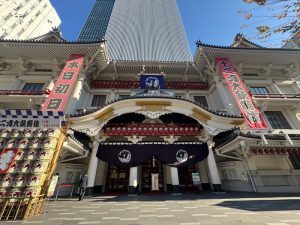
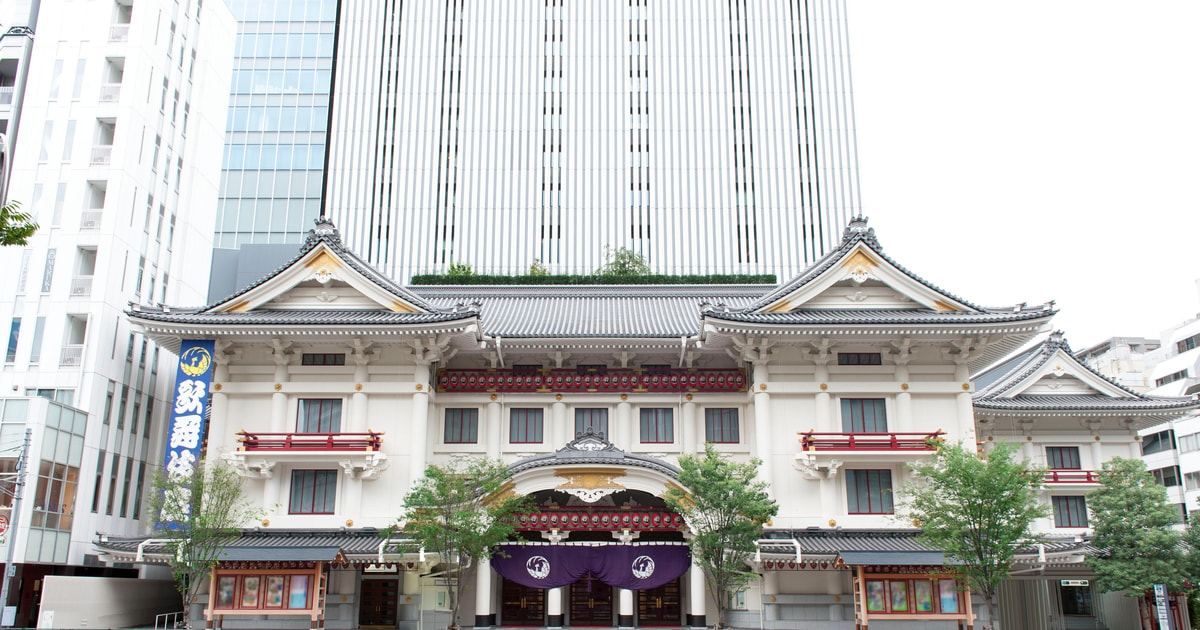
If you’re planning a trip to Tokyo, Kabuki-za is one of the most memorable ways to experience Japanese culture firsthand. GetYourGuide offers English-friendly Kabuki-za tickets and guided experiences, including options with headset translation and pre-show introductions for first-time viewers.
👉 Check Kabuki-za Tickets on GetYourGuide
This section may contain affiliate links. Booking through them costs you nothing extra and helps support this site.
コメント
コメント一覧 (1件)
[…] あわせて読みたい Ohamagoten Tsunatoyo-kyō: Synopsis and Highlights of This Genroku Chūshingura Scene A scene from Genroku Chūshingura built on a tense debate between Tokugawa Tsunatoyo and an Akō rōnin over the true meaning of loya […]