
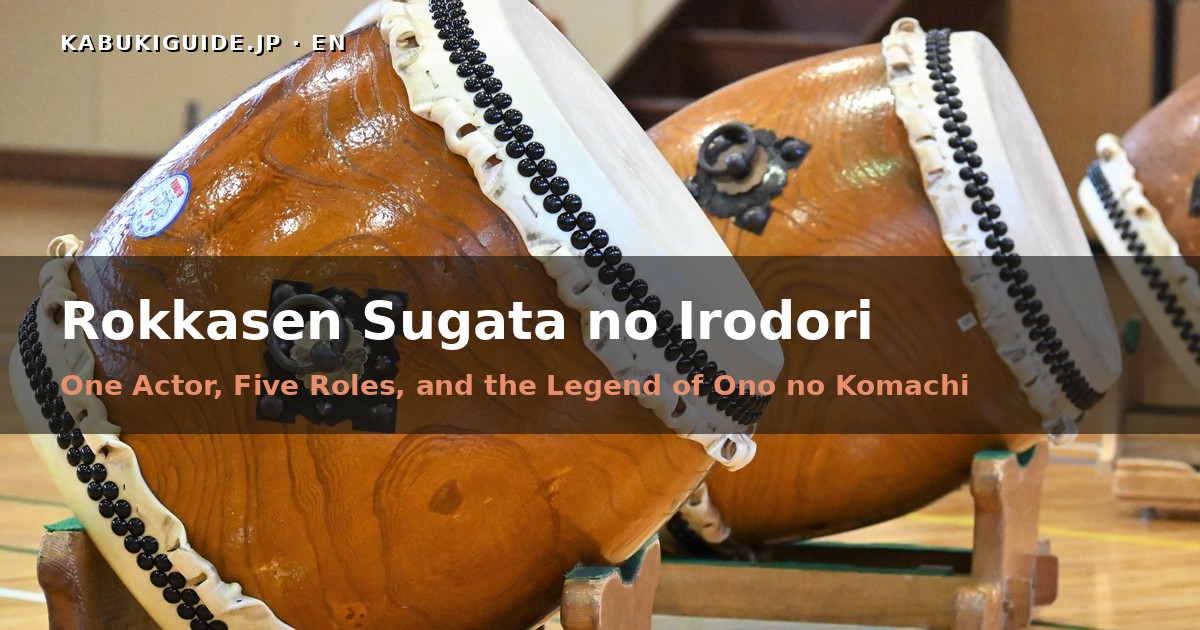
Rokkasen Sugata no Irodori (六歌仙容彩) is a celebrated kabuki henge-buyō (“transformation dance”) built around the Rokkasen — the six legendary poets of the Heian era. A single actor moves through five completely different characters across shifting styles of music (gidayū, nagauta, and kiyomoto), all circling around the beauty and heartbreak surrounding the poet Ono no Komachi.
Set against the elegant backdrop of imperial court culture, the piece is threaded through with the wit, visual puns, and humor distinctive to Edo-period kabuki.
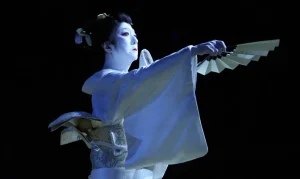
At the center of the story is Ono no Komachi, celebrated as one of history’s great beauties. Five of the six legendary poets fall for her — and not one of them succeeds. The piece builds to a dramatic close when the sixth, Ōtomo no Kuronushi, is revealed to be plotting treason.
Main Characters
Ono no Komachi
The center of the story — a poet renowned as an unrivaled beauty. Five different men fall for her, and she accepts none of them. She’s portrayed with real elegance, but also a distinct sense of loneliness beneath the beauty. (She doesn’t appear in the “Kisen” segment; the teahouse woman Okaji stands in for her there.)
Sōjō Henjō
Formerly a nobleman (Yoshimine no Munesada) before becoming a monk. Portrayed with real dignity and intelligence, he sincerely confesses his love to Komachi, only to be gently turned away. He carries the quiet, dignified opening register of the piece.
Bunya no Yasuhide
A witty, playful courtier who tries to win Komachi over with clever wordplay and lighthearted movement. Even in defeat, he stays bright and comic, providing much of the piece’s humor and rhythm.
Ariwara no Narihira
The most famous of the Rokkasen for his good looks. Elegant and sensual, he forms a visually stunning pairing with Komachi, though his sincere courtship, too, goes unanswered.
Kisen Hōshi
A worldlier, more down-to-earth aesthete. The setting shifts entirely to the streets of Gion, where he performs a lively dance opposite the teahouse woman Okaji — a role embodying distinctly Edo-flavored wit and humor, a deliberate step away from the courtly world of the rest of the piece.
Okaji of Gion
A teahouse woman who appears in the “Kisen” segment, standing in for Komachi as an approachable, down-to-earth figure — and a key part of what lightens the mood of the piece overall.
Ōtomo no Kuronushi
The pivotal figure of the finale. Introduced as a poet, he’s ultimately revealed as a traitor plotting to seize power. His scheme to frame Komachi collapses when he’s exposed, leading into a dramatic stylized combat scene to close the piece.
Synopsis
Henjō
Sōjō Henjō visits Komachi’s elegantly curtained chamber, blocked at first by her attendants. When Komachi finally appears, Henjō confesses his feelings, only to be gracefully deflected. He departs with quiet dignity and a lingering sense of melancholy — a fitting, subdued opening to the piece.
Bunya
The mood shifts entirely as Bunya no Yasuhide enters to the bright rhythms of kiyomoto music. Playful and comic, he tries witty words and dance to reach Komachi, trading humorous banter with her attendants — but never actually gets to see her, and dashes off in good-natured defeat. A scene where lightness and the comedy of failed romance sit side by side.
Narihira
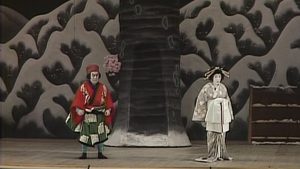
The curtain rises on a striking image: Komachi in a formal twelve-layered robe beside Narihira, bow in hand — a pairing celebrated as the ultimate beautiful man and woman. Narihira dances an elegant “fan” sequence expressing his love, but Komachi brushes him off and leaves, and he exits with quiet longing. One of the piece’s most visually refined, wistfully beautiful scenes.
Kisen
The setting shifts dramatically to a springtime scene in Gion. Kisen Hōshi appears, gourd in hand, beneath blooming cherry blossoms, trading playful banter with the teahouse woman Okaji. Komachi doesn’t appear here at all — instead, Edo-style wit substitutes Okaji in her place. Lively group dances follow, making this the most down-to-earth, cheerful segment of the whole piece, including a moment where Kisen dresses as a woman to the audience’s delight.
Kuronushi
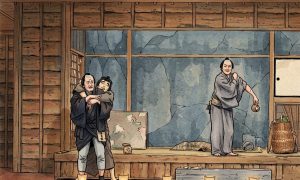
The finale unfolds in a palace garden. Kuronushi attempts to frame Komachi by stealing one of her poems, but when Komachi washes a copy of the Man’yōshū in water, the forged writing dissolves, exposing his scheme. Cornered, Kuronushi reveals his true nature as a traitor plotting to seize power, and the piece erupts into stylized combat, closing on a bold mie pose — a genuinely dramatic finish for what began as pure dance.
Highlights
One Actor, Five Completely Different Roles
The single biggest draw of this piece is watching one performer transform into Henjō, Bunya, Narihira, Kisen, and Kuronushi in succession — each with entirely different costume, expression, movement, and dance quality, almost as if a different actor appeared each time.
A Showcase of Musical Variety
Nagauta, kiyomoto, and gidayū each take the lead in different segments, changing the entire rhythm and atmosphere of the piece from scene to scene — something to enjoy with your ears as much as your eyes.
Edo Wit in “Kisen”
After the refined court world of the earlier scenes, the shift to Gion’s cheerful springtime atmosphere is a genuine tonal surprise. The exchange with Okaji and the lively group dance are pure crowd-pleasing fun — a great example of the “breaking the formality” spirit distinctive to Edo kabuki.
From Elegant Dance to Dramatic Finale
The mood flips entirely in the “Kuronushi” segment, turning from romantic dance into a story of conspiracy and combat, closing on a powerful mie pose.
Best Experienced as a Full Sequence
Watching all five segments together reveals the elegant brevity of “Narihira” in a new light. On its own, it can feel almost too short — but within the full sequence, that brevity works perfectly. Think of the vivid “Bunya” segment as a main course, “Narihira” as a palate-cleansing sorbet, flowing into the lively “Kisen,” all bookended by “Henjō” and “Kuronushi.” Seen as a whole, the piece’s structural craftsmanship becomes genuinely apparent.
Frequently Asked Questions
- Does the same actor really play all five roles?
-
Yes — that transformation is the entire premise of the piece as a “henge-buyō” (transformation dance), with the performer changing costume, movement, and character completely between segments.
- Do any of the men succeed in winning Komachi’s love?
-
No — all five suitors are turned away in one form or another, which is central to the piece’s bittersweet, melancholic thread running underneath its lighter moments.
- Why does the tone shift so dramatically in the final segment?
-
The “Kuronushi” segment reveals a hidden plot to frame Komachi and seize power, turning the piece from romantic dance into dramatic combat — a deliberate structural payoff after four segments of courtship and comedy.
Summary
Rokkasen Sugata no Irodori is a showcase of pure performance range: one actor moving through elegance, comedy, romance, and villainy across five roles, tied together by the beauty and quiet loneliness of Ono no Komachi. Watched in full, its shifting rhythms and tones reveal a piece built with real structural care — as satisfying to the ear as it is to the eye.
Related Reading
🎭 Want to See Kabuki Live?
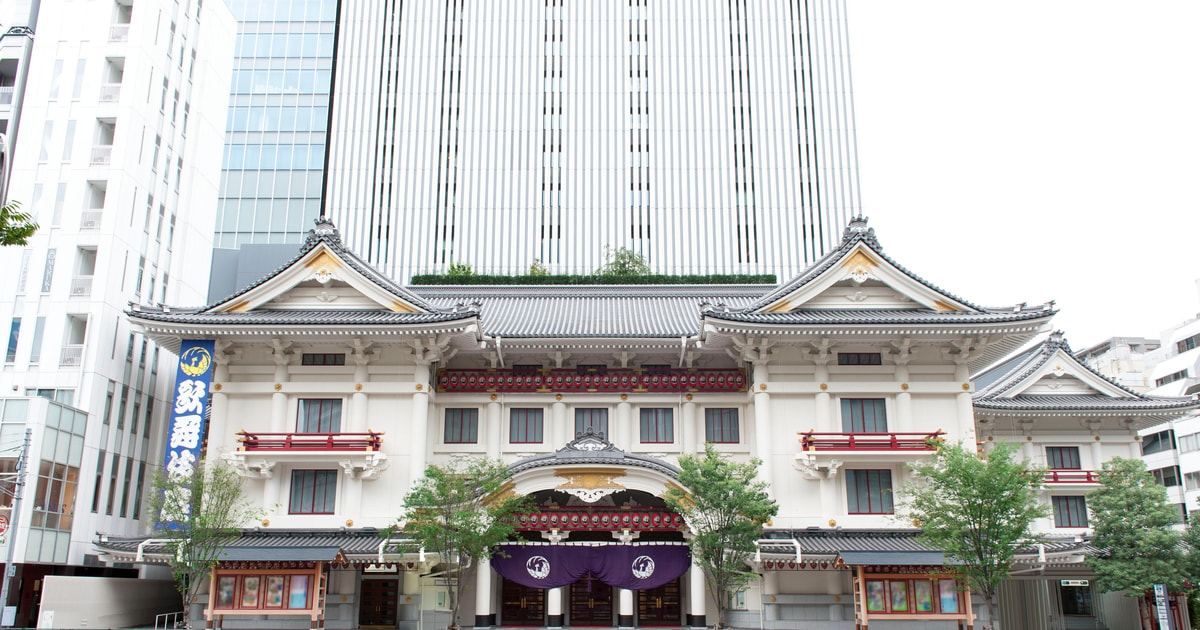
If you’re planning a trip to Tokyo, Kabuki-za is one of the most memorable ways to experience Japanese culture firsthand. GetYourGuide offers English-friendly Kabuki-za tickets and guided experiences, including options with headset translation and pre-show introductions for first-time viewers.
👉 Check Kabuki-za Tickets on GetYourGuide
This section may contain affiliate links. Booking through them costs you nothing extra and helps support this site.



コメント