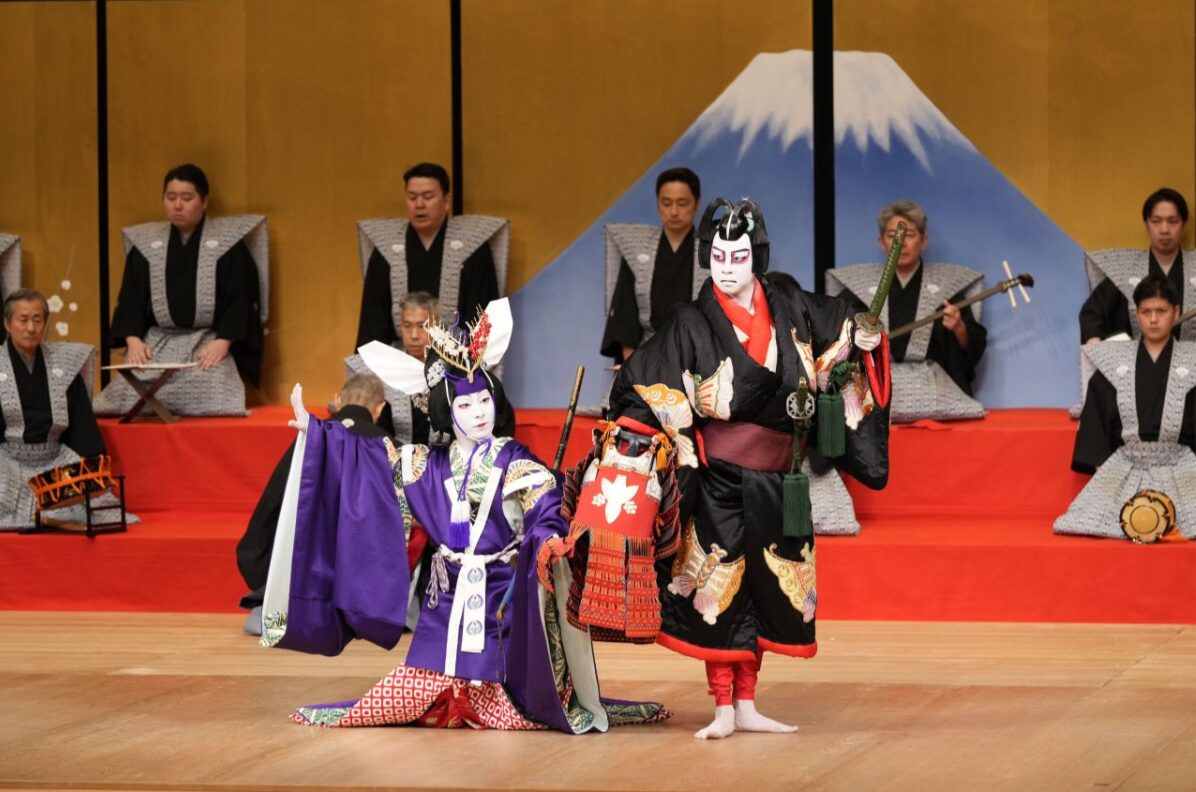
Shōfudatsuki Kongen Kusazuri (正札附根元草摺), more commonly known by its nickname Kusazuribiki (“The Armor-Skirt Pull”), is a classic dance piece within the Soga-monogatari cycle, and a signature example of the “pulling” (hikigoto) style of celebratory dance believed to draw good fortune.
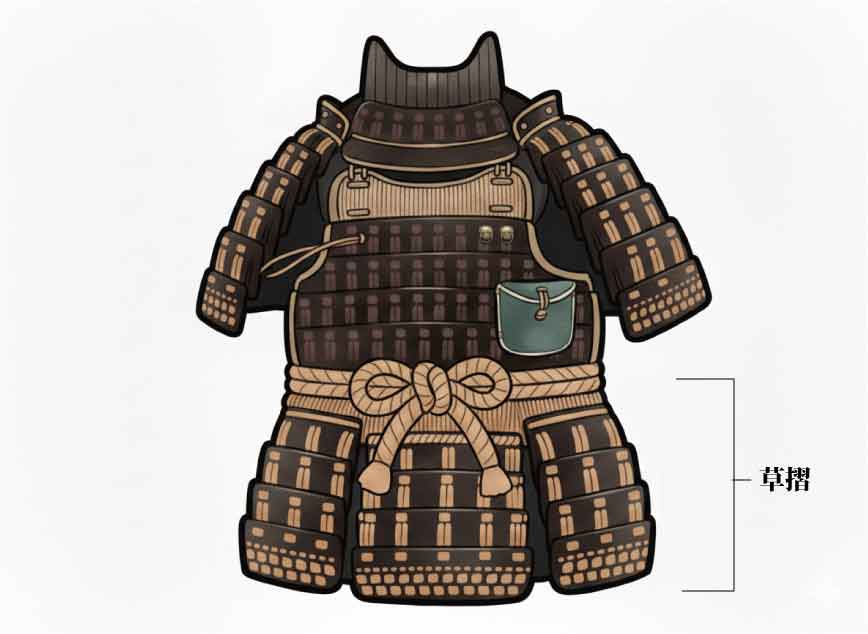
A kusazuri refers to the skirt-like section of samurai armor that hangs from the waist, designed to swing and shift freely so it doesn’t hinder movement on horseback while still protecting the lower body — and pulling on it is exactly what drives this piece’s central action.
What Does the Title Mean?
Broken down piece by piece, the title carries a specific meaning:
- Shōfudatsuki — “officially certified” or “authentic”
- Kongen — “the true origin” or “the root of the story”
- Kusazuri — the armor-skirt pulling scene itself
In other words, the title essentially announces: “this is the authentic, original version of the famous kusazuri-pulling scene from the Soga story” — a title that functions almost like a seal of authenticity.
Synopsis
Version 1: Opposite Kobayashi no Asahina
Soga Gorō, tucking his armor under his arm, tries to rush off to kill his father’s enemy, Kudō Suketsune. Blocking his path is the immensely strong warrior Kobayashi no Asahina, who insists “the time isn’t right yet” and grabs hold of the trailing kusazuri of Gorō’s armor. The two engage in a full-strength tug-of-war, each refusing to yield.
At points, Asahina shifts into an almost feminine manner as he continues blocking Gorō’s way. After a lively, spirited exchange along the hanamichi, Gorō keeps trying to push forward while Asahina keeps holding him back — the scene closes on the bold, full-bodied tug-of-war that defines aragoto style.
Version 2: Opposite Maizuru, Asahina’s Sister
The same setup plays out, but this time it’s Asahina’s sister, Maizuru, who blocks Gorō’s path, similarly insisting the time isn’t right and grabbing the kusazuri for the same tug-of-war. But as the struggle continues, Maizuru shifts tactics — rather than relying purely on strength, she appeals to Gorō with tender, romantic feeling and a graceful femininity to hold him back.
After a lighter, more elegant paired dance along the hanamichi, Gorō again tries to push forward toward his revenge, with Maizuru holding him back. The contrast between the bold young warrior and the elegant onnagata role gives this version of the dance its distinctly classical, expansive Soga-story charm.
Asahina vs. Maizuru: What’s the Difference?
In the Asahina version, the story centers entirely on a clash of raw strength between two powerful warriors. Asahina, dressed in rough, unrefined style with distinctive saru-guma kumadori makeup and a full beard, engages Gorō in a straightforward contest of brute force over the kusazuri. What makes this version especially entertaining is the moment this powerfully built, rough-looking character suddenly slips into an almost delicate, feminine display of longing — a striking contrast that gives the role its unique comic charm.
In the Maizuru version, Maizuru is portrayed as a genuinely skilled woman warrior — her contest of strength with Gorō is no mere performance. When she realizes strength alone won’t hold him back, she shifts into a more delicate display of romantic feeling and femininity to make her case instead. That fluid movement between physical contest and graceful, emotionally expressive dance is what makes the Maizuru version distinctive.
Main Characters
Soga Gorō
The younger of the two Soga brothers — fierce and hot-blooded, driven by an unshakable resolve to avenge his father’s death at the hands of Kudō Suketsune.
Kobayashi no Asahina
A famously mighty warrior who blocks Gorō’s path, grabbing the kusazuri of his armor to hold him back. His distinctive saru-guma kumadori gives him an almost clownish, comic quality.
Maizuru, Asahina’s Sister
A woman warrior who blocks Gorō’s path in place of her brother, grabbing the kusazuri to hold him back. She combines martial skill with a graceful femininity, creating a vivid contrast between elegance and tension in the tug-of-war scene.
Highlights
The Asahina Version
The charm here is watching the powerfully built Asahina slip into moments of delicate, almost coquettish femininity — a distinctive quality found only in this version of the piece.
The Maizuru Version
The appeal lies in how fluidly the piece moves between a genuine physical contest and rich, emotionally expressive dance — a balance unique to the Maizuru variant. In modern productions, the Maizuru version is performed more often, though the core tug-of-war remains the highlight either way.
The Good Fortune of a “Pulling” Dance
Hikigoto (“pulling events”) are a category of dance built around a tug-of-war over an object, traditionally believed to draw good fortune to those who perform or watch them. As one of the representative works in this tradition, Kusazuribiki carries a distinctly auspicious character.

Frequently Asked Questions
- What is a “kusazuri,” and why does the tug-of-war revolve around it?
-
A kusazuri is the skirt-like section of samurai armor hanging from the waist. It’s designed to swing freely, which makes it a natural, dynamic prop for a tug-of-war scene between two characters — hence the piece’s nickname, Kusazuribiki (“The Armor-Skirt Pull”).
- What’s the difference between the Asahina and Maizuru versions?
-
The Asahina version centers on a straightforward clash of strength between two warriors, with comic contrast when the rough Asahina turns briefly delicate. The Maizuru version features a woman warrior who shifts from physical contest to graceful, emotionally expressive dance to hold Gorō back.
- What is a “hikigoto” dance?
-
Hikigoto (“pulling events”) are a category of celebratory kabuki dance built around a tug-of-war over an object, traditionally believed to bring good fortune — Kusazuribiki is one of its representative pieces.
Summary
Kusazuribiki distills the Soga revenge story into a single, tightly focused image: a tug-of-war over an armor skirt, charged with both raw physical intensity and, depending on the version, real comic or romantic nuance. As one of kabuki’s classic “pulling” dances, it carries an auspicious, celebratory quality that has kept it in the repertoire for generations.
Related Reading
🎭 Want to See Kabuki Live?
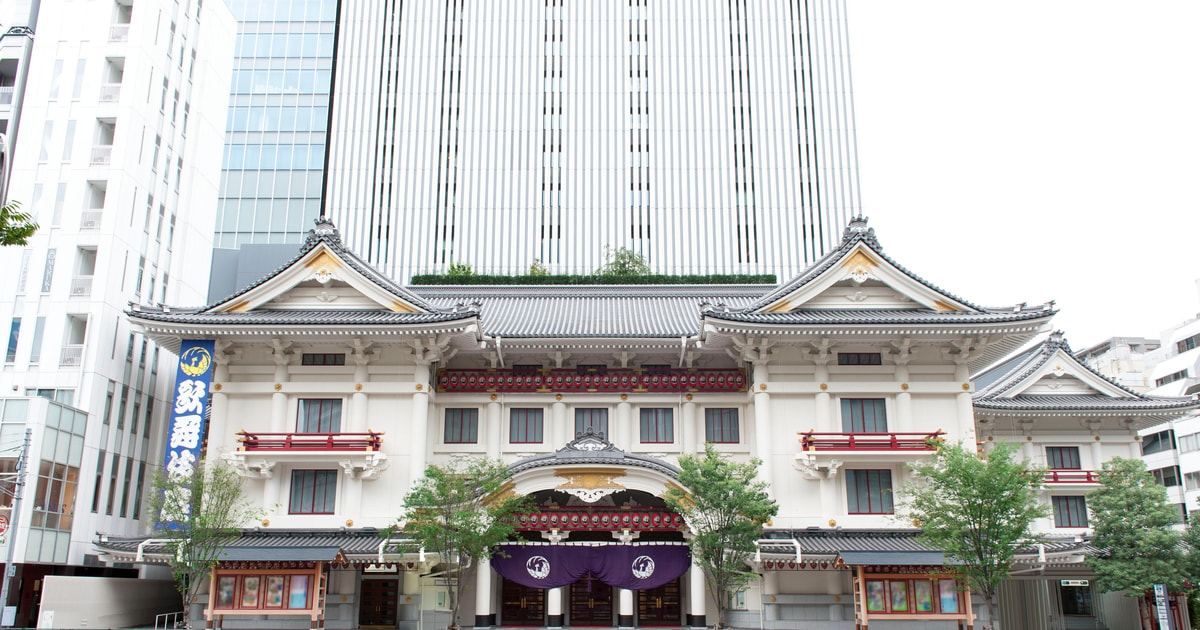
If you’re planning a trip to Tokyo, Kabuki-za is one of the most memorable ways to experience Japanese culture firsthand. GetYourGuide offers English-friendly Kabuki-za tickets and guided experiences, including options with headset translation and pre-show introductions for first-time viewers.
👉 Check Kabuki-za Tickets on GetYourGuide
This section may contain affiliate links. Booking through them costs you nothing extra and helps support this site.


コメント