
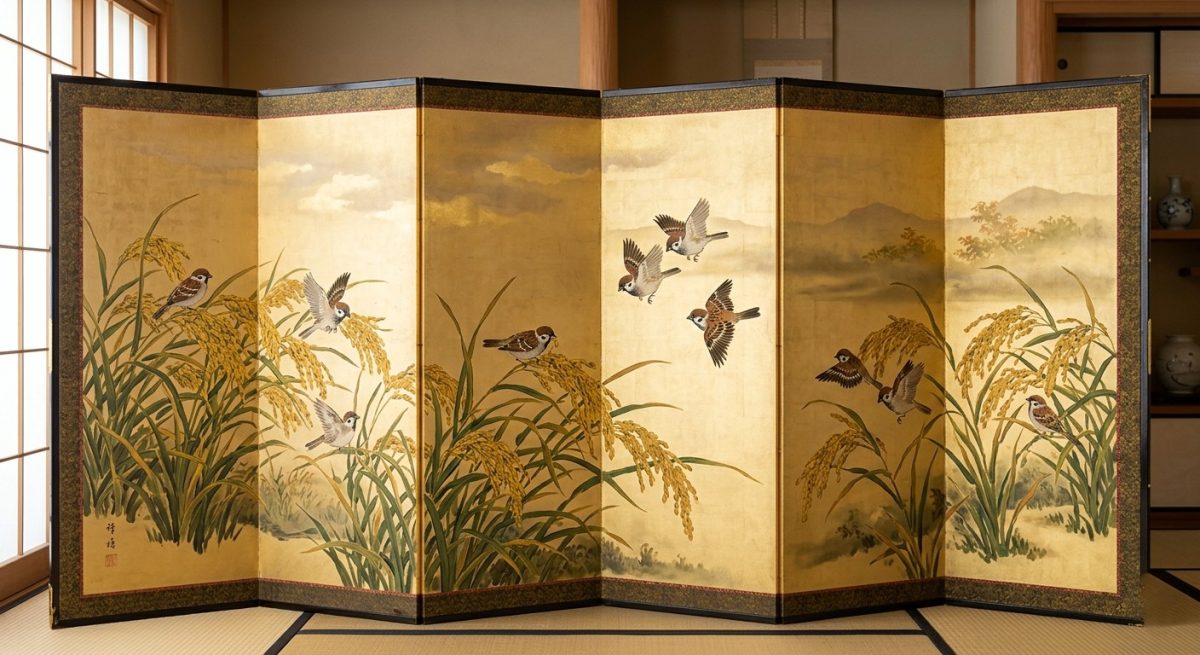
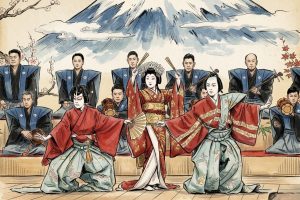
Suehirogari (末広がり) is a light, kyōgen-style kabuki piece built almost entirely on witty wordplay and back-and-forth banter. Usually staged as a matsubame-mono — a piece performed against a Noh-style pine backdrop — it has no dramatic twists to speak of, but it’s a genuine connoisseur’s favorite precisely because it puts an actor’s raw comic timing on full display.
It looks like a modest, simple piece at first glance, but it packs in some of kabuki’s most fundamental pleasures: language, physical comedy, and pacing.
Synopsis
A feudal lord orders his servant, Tarōkaja, to go buy a “suehirogari” — an old word for a folding fan, so named for the way it widens as it opens, and considered a symbol of good fortune. The trouble is, Tarōkaja has no idea what the word actually means.
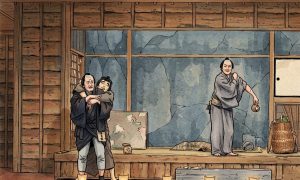
He asks around town for clues, but never quite grasps the answer — and ends up buying something completely wrong. Proud of his purchase, he presents it to his lord anyway. The lord is understandably baffled, but Tarōkaja refuses to back down, piling on increasingly strained justifications for why his purchase counts as a “suehirogari” after all.
His logic makes no real sense, yet somehow sounds oddly convincing the longer he talks — and the lord, worn down, eventually gives in and accepts it. The scene resolves on that note of absurd, good-natured comedy.
Characters
The Lord (Daimyō)
The story’s central authority figure, who sends Tarōkaja off to buy a suehirogari. Dignified but fundamentally good-natured, he’s exasperated by his servant’s confusion yet ultimately gets talked into accepting it — his shifting confusion and reluctant acceptance are what give the scene its comic texture.
Tarōkaja
The lord’s servant and the piece’s true lead. He heads out to buy a fan without understanding what the word even means, and comes back with something entirely wrong. But he’s no simple fool — the more he’s pressed, the more elaborate his reasoning gets, and he somehow talks his way out of the situation entirely. That mix of cluelessness and sheer stubborn persistence is the engine behind the piece’s humor.
Highlights
The appeal of Suehirogari isn’t in what happens — it’s in the texture of the back-and-forth itself.
The entire piece hinges on a simple misunderstanding of one word. “Suehirogari” is meant to refer to a fan, but Tarōkaja pushes ahead without grasping that — and what follows is a cascade of crossed wires and increasingly desperate improvised justification.
What makes it work is delivery and timing: the smallest shift in a line’s rhythm, or a flick of the eyes, can completely change how a joke lands, even with identical dialogue. Tarōkaja himself is central to that — seemingly dim, yet piling on words under pressure until he somehow ends up controlling the entire scene. That mix of foolishness and resilience gives the piece its distinctive humor.
Also worth watching: how props are handled — both the fan itself and whatever mismatched item Tarōkaja brings back instead. With such a simple structure, these small details are exactly where an actor’s skill becomes visible.
What Makes This Piece Work
There’s no major incident here, no dramatic turn. And yet it holds an audience’s attention purely through conversation. A misunderstanding creates the comedy, and the attempt to talk your way out of that misunderstanding becomes the entire show — in other words, this is a piece that makes “nothing happening” genuinely entertaining.
Because it doesn’t lean on spectacle, it’s a stage built entirely on an actor’s skill and sense of timing — the kind of piece that rewards you more, the more times you see it.
Frequently Asked Questions
- Is Suehirogari good for a first-time kabuki viewer?
-
Yes. The story is simple and driven entirely by conversation, making it easy to follow even without prior kabuki experience.
- What does “suehirogari” actually mean?
-
It’s an old word for a folding fan, named for the way it widens toward its outer edge when opened — and by extension, a symbol of expanding good fortune.
- What should I pay attention to while watching?
-
Rather than tracking plot, focus on the actors’ line delivery, comic timing, and how they handle the props — that’s where the piece’s humor really lives.
Summary
Suehirogari is a deceptively simple piece that builds its comedy entirely from language and timing. Beneath its modest surface are some of kabuki’s most fundamental skills on full display — a great entry point for appreciating the depth behind kabuki’s quieter, subtler side.
🎭 Want to See Kabuki Live?
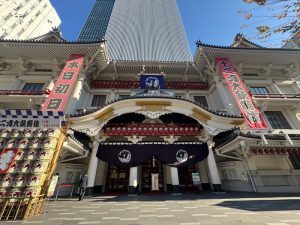
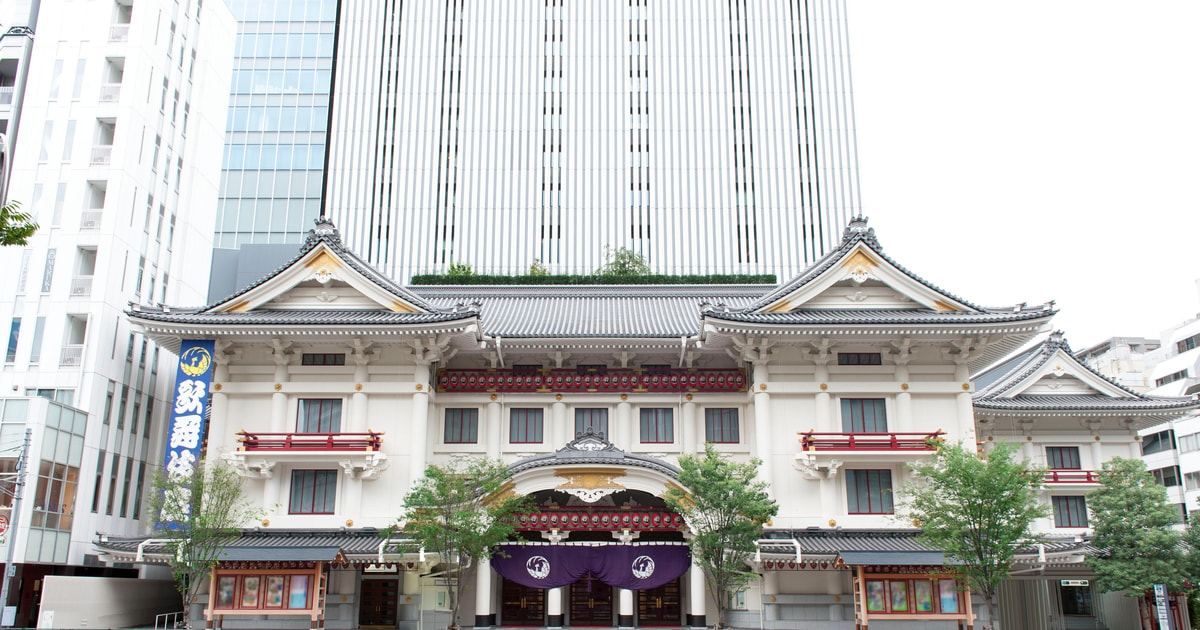
If you’re planning a trip to Tokyo, Kabuki-za is one of the most memorable ways to experience Japanese culture firsthand. GetYourGuide offers English-friendly Kabuki-za tickets and guided experiences, including options with headset translation and pre-show introductions for first-time viewers.
👉 Check Kabuki-za Tickets on GetYourGuide
This section may contain affiliate links. Booking through them costs you nothing extra and helps support this site.
Related Reading



コメント