

Momochidori Okitsu Shiranami (百千鳥沖津白浪) is a rare kabuki work built around one of the art form’s most striking outlaw heroines: the female bandit known as Kijin no Omatsu (“Demon Omatsu”). A 2026 revival at Kabukiza marked its first main-stage performance in 62 years — its last prior run dating back to 1964 — making it a genuine rarity in the modern repertoire.
This guide covers the play’s synopsis, characters, the legend of Kijin no Omatsu, and what makes this piece worth knowing even beyond its rare revival.
What Kind of Play Is This?
Momochidori Okitsu Shiranami centers on the female bandit Kijin no Omatsu, and belongs to the shiranami-mono genre — kabuki plays built around thieves, outlaws, and rogues.
Shiranami-mono are known for a distinct set of pleasures:
- A dashing, charismatic outlaw at the center of the story
- Bold, rhythmic speeches (tanka) delivered with real swagger
- Flashy, stylized combat
- Show-stopping mie poses
What makes the genre so appealing is that its central characters, criminals though they are, are written with genuine loyalty, humanity, and a code of their own. Kijin no Omatsu, the heart of this particular play, is no simple villain — she’s a fan-favorite character carrying both real strength and real sorrow.
Who Is Kijin no Omatsu?
Kijin no Omatsu is counted among kabuki and popular fiction’s “three great bandits of Japan,” alongside Ishikawa Goemon and Jiraiya. She’s believed to be based on a real woman from the mid-Edo period, with legend holding that she became a bandit leader after avenging her husband’s death.
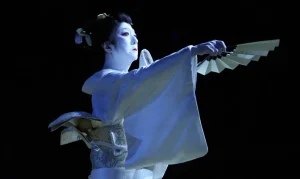
In kabuki, she’s portrayed through the role type akuba (“wicked woman”) — a category that goes far beyond a simple villainess. An akuba is fierce, fearless, and every bit as commanding as her male counterparts, while carrying real emotional depth and sorrow underneath. Kijin no Omatsu also carries the nickname “Skeleton Omatsu,” reflecting a character who is both seductive and genuinely frightening at once.
Synopsis
The story unfolds with the tangled schemes typical of a shiranami-mono — bandits and samurai each pursuing their own agendas. Kijin no Omatsu operates in the shadows as a bandit leader, at times disguising herself as someone else entirely to infiltrate her enemies’ ranks.
Amid a web involving the bandit Kosuke, the Natsume family, and the schemer Shinohara Ichigaku, Omatsu uses her nerve and cunning to slip through one crisis after another — hiding her identity to outmaneuver her rivals, delivering sharp, biting speeches, and engaging in bold, stylized combat. It’s a story that delivers the brisk, satisfying energy that defines the shiranami-mono genre.
What stands out most is Omatsu herself: a woman who commands the stage with an intensity that rivals any male role. That coexistence of menace and magnetism is exactly the kind of character kabuki does best.
Main Characters
| Role | Description |
| Kijin no Omatsu | The female bandit at the center of the story |
| Natsume Shirōjirō | A figure aligned with the samurai establishment |
| Natsume Shirōtarō | A member of the Natsume family |
| Shinohara Ichigaku | A key figure holding the plot’s central secret |
| The bandit Kosuke (actually Kinezumi) | A bandit entangled with Omatsu |
| Fujinami, Monado’s sister | A woman central to the story’s events |
Why a 62-Year Revival Matters
A play absent from the main stage for six decades typically returns only when the right performer and moment align to bring something new to the role. In its 2026 Kabukiza revival, the casting of Kijin no Omatsu drew major attention — an actor celebrated for delicate onnagata work taking on a role that demands not just seductive charm, but real menace and physical presence. Watching how a performer bridges those two qualities is the single biggest draw of any revival of this piece.
Highlights
A Ferociously Compelling Heroine
Kijin no Omatsu’s appeal goes well beyond intimidation. It’s the humanity, loneliness, and emotion underneath her strength that truly draws an audience in — and every actor who takes on the role brings their own answer to who she really is.
The Brisk Energy of a Shiranami-Mono
What defines the genre is pace: quickly shifting scenes, punchy dialogue, and dazzling stylized combat — qualities that make shiranami-mono plays especially accessible even for a first-time kabuki audience.
A Showcase for a Rare Role Type
Akuba roles are relatively uncommon in the modern repertoire, which makes any production of this play a genuine chance to see this particular kind of character — equal parts danger and charisma — brought to life on stage.


Frequently Asked Questions
- Who is Kijin no Omatsu based on?
-
She’s believed to be based on a real woman from the mid-Edo period, with legend holding that she became a bandit leader to avenge her husband’s death. She’s counted among kabuki’s “three great bandits of Japan,” alongside Ishikawa Goemon and Jiraiya.
- What does “akuba” mean as a kabuki role type?
-
Akuba (“wicked woman”) describes a fierce, commanding female character who is far more than a simple villain — carrying real emotional depth, sorrow, and humanity beneath her strength and menace.
- What is a “shiranami-mono” play?
-
A kabuki genre centered on bandits, outlaws, and rogues, known for dashing lead characters, bold speeches, flashy stylized combat, and dramatic mie poses — while still portraying its criminal protagonists with real loyalty and humanity.
Summary
Momochidori Okitsu Shiranami is a rare showcase for one of kabuki’s most compelling outlaw heroines — a character who commands the stage through danger, cunning, and real emotional depth all at once. Its rarity on the modern stage only makes any revival of this piece more worth seeking out.
🎭 Want to See Kabuki Live?
If you’re planning a trip to Tokyo, Kabuki-za is one of the most memorable ways to experience Japanese culture firsthand. GetYourGuide offers English-friendly Kabuki-za tickets and guided experiences, including options with headset translation and pre-show introductions for first-time viewers.
👉 Check Kabuki-za Tickets on GetYourGuide

This section may contain affiliate links. Booking through them costs you nothing extra and helps support this site.




コメント