Hanagamau Ogawa no Nigiwai is a dance-centered kabuki piece capturing the lively energy and stylish sensibility of Edo-period townlife. Rather than following a plot, it invites the audience to simply soak in the atmosphere — a distinctly different, and distinctly rewarding, way to experience kabuki.
What Is Hanagamau Ogawa no Nigiwai?
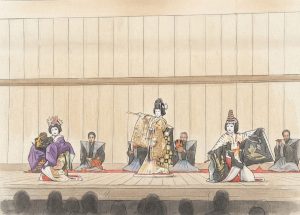
Unlike story-driven genres such as sewamono (contemporary drama) or jidaimono (period drama), this piece is built almost entirely around dance, nagauta music, and stylized gesture — closer in spirit to a pure dance-drama than a narrative play. The emphasis falls squarely on physical expression, the unity between movement and music, and the individual charm each performer brings to the role, rather than on dramatic plot developments.
In short, it’s less a piece to be followed for its story and more one to be experienced for its atmosphere.
What Makes Up the Performance
At the core of the piece is the nagauta dance Niwaka-jishi, based on “Niwaka” — an annual festival once held in Edo’s Yoshiwara pleasure district, where geisha and jesters (hōkan) would dress in costume and perform impromptu dances and skits amid a lively, celebratory atmosphere. “Niwaka” originally referred to improvisational performance art, prizing the energy of the moment and playful back-and-forth with the audience.
Building on that same festive energy, Hanagamau Ogawa no Nigiwai layers dance, music, and stylized gesture together to create a single, unified sense of celebration on stage.
Highlights
The Stylish Restraint of Edo “Iki”
The piece’s greatest appeal lies in the sense of Edo-style iki — a distinctly Japanese aesthetic of understated chic — that runs through the entire performance. In kabuki, physical gesture (shosa) isn’t just movement; it’s a vehicle for a character’s inner feeling and sense of style. Here, that comes through in naturally unforced movement, deliberate pauses that leave space for the audience’s imagination, and a quiet, understated sensuality in small gestures. Rather than leaning on spectacle, the piece charms through restraint — an aesthetic built on subtraction rather than excess.
The Unity of Nagauta Music and Dance
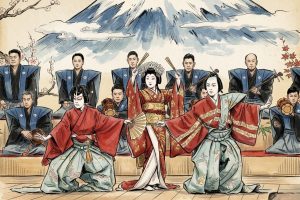
The piece’s nagauta accompaniment and its choreography are tightly interwoven. Nagauta, kabuki’s signature shamisen-based musical form, guides the movement and atmosphere on stage — the body responds to the music’s rhythm, and the movement in turn deepens the music’s impact. That back-and-forth between sound and motion is the essence of a dance-drama like this one. Pay attention to the shamisen’s dynamics, the rise and fall of the vocal line, and the timing of the hayashi ensemble’s entrances, and the performance opens up considerably.
A Lion Head Held, Not Worn
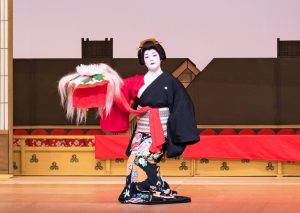
A distinctive feature of the Niwaka-jishi section is that the performer holds the lion head (shishi-gashira) in their hands, rather than wearing it as a headdress the way most “lion pieces” (such as Renjishi) do. Held, manipulated, and given expression by hand, the lion head’s red-and-white tongue flutters playfully in time with the dance — an oddly endearing, almost comic touch. Far from a random flourish, it reflects the improvisational, playful spirit of Edo showmanship — less “performing as a lion” than “playing with one.”
A Steady Stream of Dance, No Dead Air
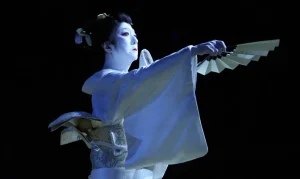
Structured around a continuous sequence of dance rather than dramatic plot beats, the piece keeps moving through elegant fan choreography, rhythmic footwork, and shifting staging without a lull — a dense, uninterrupted stretch of visual highlights packed into a short runtime.
The Live, Improvisational Feel of “Niwaka”
Since the “Niwaka” festival it’s modeled on was originally an improvisational, crowd-pleasing form of entertainment, that same spirit lingers throughout the piece — a strong sense of savoring the moment, a close, informal rapport with the audience, and a freedom from overly rigid form. It’s one of kabuki’s genres that feels closest to a live performance in the purest sense, easy to enjoy on instinct alone even for someone watching kabuki for the very first time.
Frequently Asked Questions
- Do I need to follow a story to enjoy this piece?
-
No — it’s built around dance, music, and atmosphere rather than plot, so it rewards simply watching, listening, and feeling the mood of the stage rather than tracking a storyline.
- What is “Niwaka,” and why does the dance take its name from it?
-
Niwaka was an annual festival in Edo’s Yoshiwara district featuring improvisational dance and comic performance by geisha and jesters. The Niwaka-jishi dance draws directly on that festive, playful tradition.
- How is this different from other “lion dance” pieces like Renjishi?
-
In most lion pieces, the performer wears the lion mane as a headdress. Here, the lion head is held and manipulated by hand instead, giving it a playful, almost puppet-like quality distinct from the grander, more formal lion dances.
Summary
Hanagamau Ogawa no Nigiwai distills the bustle of old Edo, the understated chic of Edo “iki,” the tight fusion of nagauta music and dance, and a playful, hands-on take on the lion dance into one lively piece. It asks nothing of the audience but to watch, listen, and feel — making it an excellent entry point for kabuki newcomers and a genuine pleasure for longtime fans alike.
Related Reading
🎭 Want to See Kabuki Live?
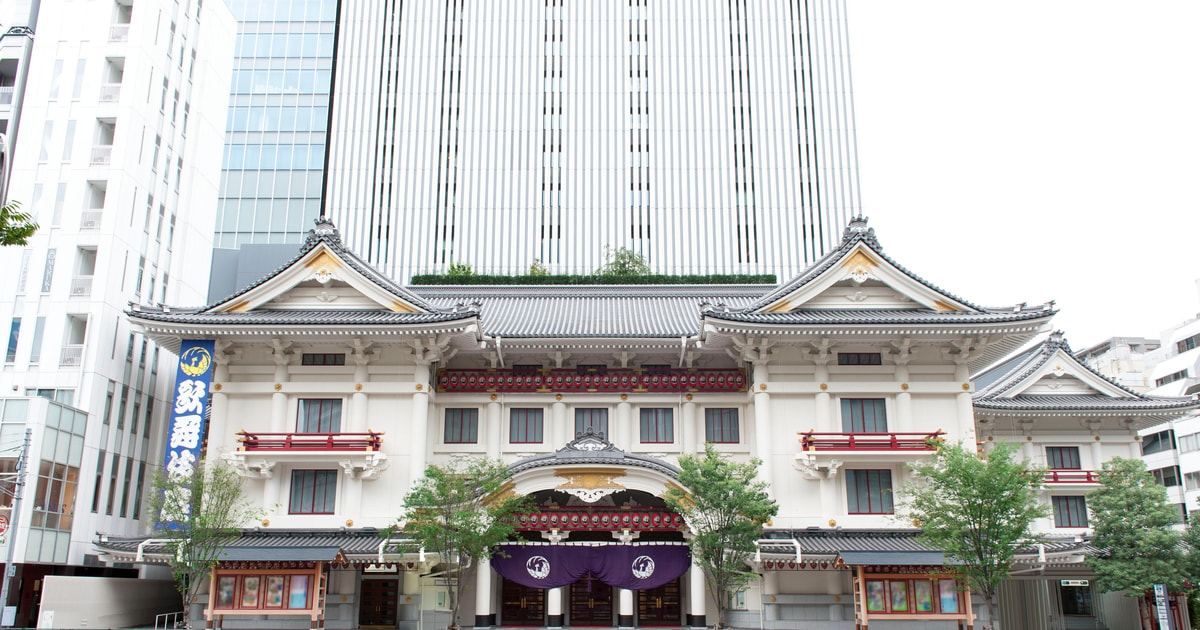
If you’re planning a trip to Tokyo, Kabuki-za is one of the most memorable ways to experience Japanese culture firsthand. GetYourGuide offers English-friendly Kabuki-za tickets and guided experiences, including options with headset translation and pre-show introductions for first-time viewers.
👉 Check Kabuki-za Tickets on GetYourGuide
This section may contain affiliate links. Booking through them costs you nothing extra and helps support this site.


コメント