Hakkenden, kabuki’s stage adaptation of the epic novel Nansō Satomi Hakkenden, hits its first major turning point in the “Hōryūkaku” scene — a rooftop sword battle between two men who don’t yet know they’re destined to become allies. It’s a thrilling piece of stagecraft that also lays the emotional groundwork for one of Japanese literature’s great tales of fate and brotherhood.
What Is Nansō Satomi Hakkenden?
Nansō Satomi Hakkenden is a sprawling 106-volume novel by the Edo-period writer Kyokutei Bakin, centered on eight warriors — the “Eight Dog Warriors” (hakkenshi) — each carrying a jewel representing one of eight Confucian virtues: benevolence, justice, propriety, wisdom, loyalty, sincerity, filial piety, and fraternal duty. Together, they work to restore the fallen Satomi clan of Awa Province (in present-day Chiba). The sprawling tale has been adapted for the stage many times over; the version performed today is based on a script compiled by Atsumi Seitarō in 1947, commonly known simply as Hakkenden.
An Ancestor of the Modern “Super Sentai” Team-Up?
Hakkenden is full of story beats that feel strikingly familiar to modern audiences: a hero holding the line so allies can escape, a rescue mission for a captured comrade, an enemy turned ally, and the electric payoff of the whole team finally assembling to turn the tide. It’s easy to see the story as a genuine ancestor of the modern hero team-up genre — and the moment all eight warriors finally stand together still lands with real emotional power today.
The Birth of the Eight Dog Warriors
As the Satomi clan faces destruction, the princess Fusehime forms a spiritual bond with the divine dog Yatsufusa. After her death, eight jewels burst from her body and scatter across the eight provinces of the Kantō region. The eight warriors are each born carrying one of these jewels — Inue Shinbei Masashi (benevolence), Inukawa Sōsuke Yoshitō (justice), Inumura Daikaku Masanori (propriety), Inusaka Keno Tanetomo (wisdom), Inuyama Dōsetsu Tadatomo (loyalty), Inukai Genpachi Nobumichi (sincerity), Inuzuka Shino Moritaka (filial piety), and Inuta Kobungo Yasuyori (fraternal duty). Scattered at birth, they’re gradually drawn together by the pull of their jewels, united in the cause of restoring the Satomi clan.
The Fate of the Sword Murasame-maru
Inuzuka Shino, one of the central figures among the eight warriors, is born into a family entrusted with the treasured sword Murasame-maru, heirloom of the shogunal Kubō family. Through the treachery of a wicked couple, Shino’s father is driven to take his own life, setting Shino on a path to reclaim the stolen blade.
The Hōryūkaku Scene
The scene opens with a weighty ōzatsuma narration — low, resonant shamisen and powerful vocal delivery building tension ahead of the coming showdown.
Leading Up to Hōryūkaku
Inuzuka Shino, son of a local samurai family from Musashi, travels to present Murasame-maru to the shogunal deputy Ashikaga Narishi. The sword is a treasured heirloom of the Kamakura shogunal house, passed down to Shino through years of turmoil.
But through the scheming of his aunt and uncle, the real Murasame-maru has been secretly swapped for a fake. When the forgery is discovered, the corrupt official Yokobori Zaimura refuses to let Shino explain himself, branding him a spy and setting pursuers after him. Shino flees to the rooftop of the Hōryūkaku tower.
The man called in to capture him is Inukai Genpachi, a master of the arresting arts. Genpachi was once the head of a local prison, but lost his position — and was imprisoned himself — after raising doubts about the harsh policies he was ordered to enforce. He too, in other words, is a man who suffered under an unjust system. And unknown to either of them, he shares the same fated bond as Shino as one of the eight warriors. Neither man realizes this as they face off atop the rooftop.
The Great Rooftop Duel
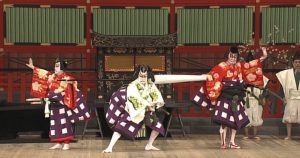
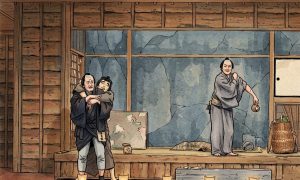
The scene’s signature highlight is the sword duel atop the Hōryūkaku rooftop: the massive roof holding both men suddenly flips backward via stage machinery, the sheer thrill of combat performed at height, and the dynamic energy of the supporting fighters (karami) who heighten the two leads’ performance. It’s a scene that concentrates kabuki’s stagecraft and formal beauty into one spectacular sequence — though at this point in the story, the two men are still very much adversaries, not yet allies.
The Gyōtoku Irie Scene
Having fallen into the river during the fight, Shino and Genpachi wash up together at Gyōtoku Bay, where they’re rescued by Inuta Kobungo, who happens to pass by. It’s here that the story’s true stakes come into focus.
The Arrival of Kanamari Daisuke
A monk named Kanamari Daisuke, connected to the Satomi clan, appears before the three men and explains the origin of the mysterious jewels they carry — jewels imbued with eight virtues, bound together by fate even when scattered, tied to the great cause of restoring the Satomi clan. Only now does it become clear: this was never simply a fight between two young men.
Genpachi and Kobungo, Sworn Brothers in All but Name
It also emerges that Genpachi and Kobungo already share a bond nearly as close as sworn brotherhood — meaning the very man Genpachi fought as an enemy turns out to be deeply connected to his own allies. It’s a fitting piece of dramatic irony for a story built entirely around fate. If Hōryūkaku is a scene of motion and conflict, Gyōtoku Irie is its quiet counterpart — the scene where the first threads of true brotherhood begin to form.
What Comes Next
Shino and Genpachi come to understand the bond shared through their jewels and step forward into their destiny as two of the eight warriors. Two men who once crossed swords as enemies go on to stand side by side under a common cause — setting the story firmly on its path toward the full gathering of all eight warriors.
Frequently Asked Questions
- Do Shino and Genpachi know they’re both “Dog Warriors” during their duel?
-
No — neither man realizes their shared destiny while fighting atop Hōryūkaku. That connection is only revealed afterward, at Gyōtoku Bay, by the monk Kanamari Daisuke.
- What is the biggest visual highlight of the Hōryūkaku scene?
-
The stage machinery that flips the massive rooftop set backward mid-duel, combined with the thrill of a sword fight performed at height — a signature piece of large-scale kabuki stagecraft.
- Is Nansō Satomi Hakkenden based on a true story?
-
No — it’s a work of fiction by the Edo-period novelist Kyokutei Bakin, though it’s loosely inspired by the historical Satomi clan of Awa Province.
Summary
The Hōryūkaku scene turns what looks like a straightforward enemy showdown into the opening chapter of a much bigger story about fate and brotherhood. Two men who fight as strangers atop a flipping rooftop are, without knowing it, already bound together as allies — a twist that gives one of kabuki’s most spectacular action sequences real emotional weight underneath the swordplay.
New to kabuki entirely? Our beginner’s guide covers the basics before you dive into a story this dense.
🎭 Want to See Kabuki Live?
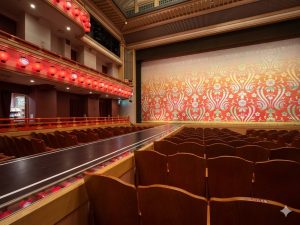
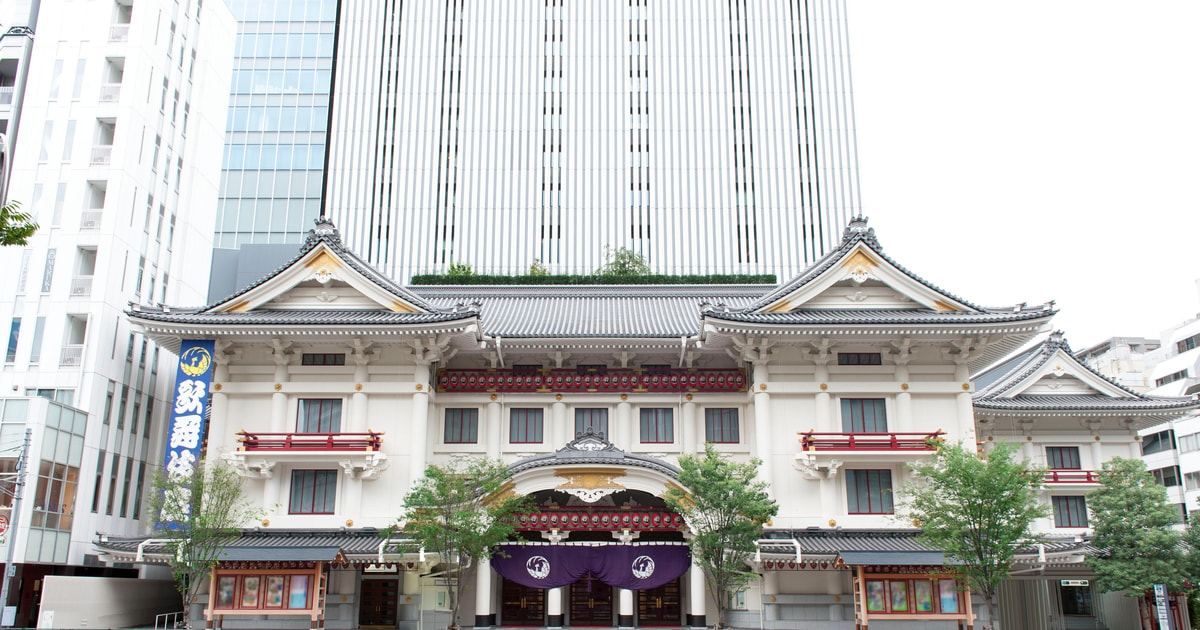
If you’re planning a trip to Tokyo, Kabuki-za is one of the most memorable ways to experience Japanese culture firsthand. GetYourGuide offers English-friendly Kabuki-za tickets and guided experiences, including options with headset translation and pre-show introductions for first-time viewers.
👉 Check Kabuki-za Tickets on GetYourGuide
This section may contain affiliate links. Booking through them costs you nothing extra and helps support this site.




コメント