
Modorikago Iro no Niaikata is a beloved kabuki dance set to tokiwazu music, blending sensuality, comedy, and technical skill into a compact, endlessly rewatchable piece. What starts as lighthearted showmanship takes a genuinely surprising dramatic turn by the end — making it far more than just a pretty dance.
Synopsis
The setting is Murasakino, on the outskirts of Kyoto, where rapeseed flowers bloom across the fields and cherry blossoms color the spring sky. Two palanquin bearers, Naniwa no Jirosaku and Azuma no Yoshirō, arrive carrying an empty palanquin on their way back from Shimabara. Tired from the long road, they set the palanquin down to rest — and soon fall into good-natured bragging about their respective hometowns, Kamigata (the Osaka-Kyoto region) and Edo.
Their friendly rivalry naturally turns to boasting about each region’s pleasure quarters — Osaka’s Shinmachi, Kyoto’s Shimabara, and Edo’s Yoshiwara. They call out to the passenger still waiting inside the palanquin: Tayori, a young attendant (kamuro) serving the celebrated Shimabara courtesan Ogurumadayū. Despite her youth, Tayori shows unexpected poise, even recognizing “Murasakino” as a reference from classical poetry — surprising both men.
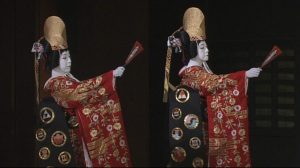
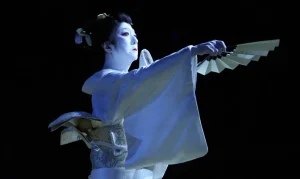
With all three now gathered, their boasting turns into a full dance. Jirosaku uses his short coat and walking staff as props to conjure the bustle of Osaka’s Shinmachi, embodying courtesans and customers alike. Tayori follows with a graceful, refined dance evoking Kyoto’s elegant Shimabara district. Then Yoshirō takes his turn, playfully acting out both courtesan and customer to capture the stylish charm of Edo’s Yoshiwara.
As their dance builds, they use everyday props with playful imagination — a coat becomes a folding screen, a cord becomes a shamisen — transforming the stage into a vivid vision of the pleasure quarters.
But partway through, something falls from each man’s robes: a signed oath document from Jirosaku, and an incense burner from Yoshirō. In an instant, the mood shifts entirely. These two aren’t ordinary palanquin bearers at all — Jirosaku is secretly the great outlaw Ishikawa Goemon, and Yoshirō is Mashiba Hisayoshi (the future Toyotomi Hideyoshi), sworn enemies bound by history. The cheerful atmosphere evaporates, replaced by a tense, dangerous standoff.
As the two men glare at each other, it’s young Tayori who steps between them, defusing the tension with quick wit beyond her years. The confrontation settles, and the stage returns to the quiet spring scenery of Murasakino as the piece draws to a gentle close.
Characters
Naniwa no Jirosaku — a palanquin bearer from the Kamigata region, ruddy-faced and boisterous. Cheerful and easygoing on the surface, he’s secretly the notorious outlaw Ishikawa Goemon.
Azuma no Yoshirō — an Edo palanquin bearer, fair-skinned and stylishly composed, a clear visual contrast to Jirosaku. Behind his playful, charming demeanor lies a hidden past as Mashiba Hisayoshi (Toyotomi Hideyoshi).
Tayori — a young attendant serving the Shimabara courtesan Ogurumadayū. Despite her age, she shows real cultural refinement, including a knowing reference to classical poetry, and ultimately plays the key role in calming the standoff between the two men.
Highlights
Three Dancers, Three Pleasure Quarters
The piece’s biggest draw is watching all three performers each embody a different pleasure district through dance — Jirosaku for Osaka’s Shinmachi, Tayori for Kyoto’s Shimabara, and Yoshirō for Edo’s Yoshiwara. Even though all three represent the same basic type of district, the distinct regional flavor of each comes through vividly in differences of gesture and rhythm.
The Playful Art of Mitate (Imaginative Substitution)
At the heart of this piece’s charm is mitate — the kabuki technique of using ordinary props to represent something else entirely. A coat becomes a folding screen, a coat’s cord becomes a shamisen, a walking staff becomes a sword — and through this kind of imaginative substitution with limited props, the world of the pleasure quarters comes vividly to life on stage. It’s a distinctly kabuki pleasure, one that actively invites the audience’s imagination to complete the picture.
Two Sharply Contrasting Characters
The visual and personality contrast between the ruddy, boisterous Jirosaku and the fair, stylish Yoshirō gives the piece a natural rhythm. When the two take turns playing courtesan and customer, it also becomes a genuine showcase of performer skill, drawing real laughs from the audience.
A Sudden Twist: Hidden Identities Revealed
What plays out as a lighthearted dance suddenly gains real dramatic weight in its final stretch, revealing an unlikely confrontation — Ishikawa Goemon against Toyotomi Hideyoshi. That sharp tonal shift gives the piece genuine depth, elevating it well beyond a simple dance number.
The Rhythm of Tokiwazu Music
Modorikago Iro no Niaikata is also a signature example of tokiwazu-style dance, prized for its brisk tempo, expressive vocal delivery, and tight unity between music and movement — a piece that rewards close listening just as much as close watching.
Frequently Asked Questions
- Why is it called “Modorikago” (“Returning Palanquin”)?
-
“Modorikago” refers to a palanquin making its return trip from the pleasure quarters. Since the piece is set on the road back from Shimabara, it takes its name directly from that detail.
- Is this a good piece for kabuki beginners?
-
Yes — the story is simple and the appeal comes largely from playful dance and banter, making it an easy, enjoyable entry point for first-time viewers.
- What is a “kamuro”?
-
A kamuro is a young girl in service to a courtesan, handling small errands and daily tasks while training to eventually become a courtesan herself.
Summary
Modorikago Iro no Niaikata packs the vibrant world of the pleasure quarters, the clever art of mitate, sharply drawn characters, and a genuinely surprising twist into one tightly constructed dance piece. Easy enough for a first-time viewer to enjoy immediately, yet layered enough to reward longtime fans — it’s often recommended as the perfect first kabuki dance to see.
Related Reading

🎭 Want to See Kabuki Live?
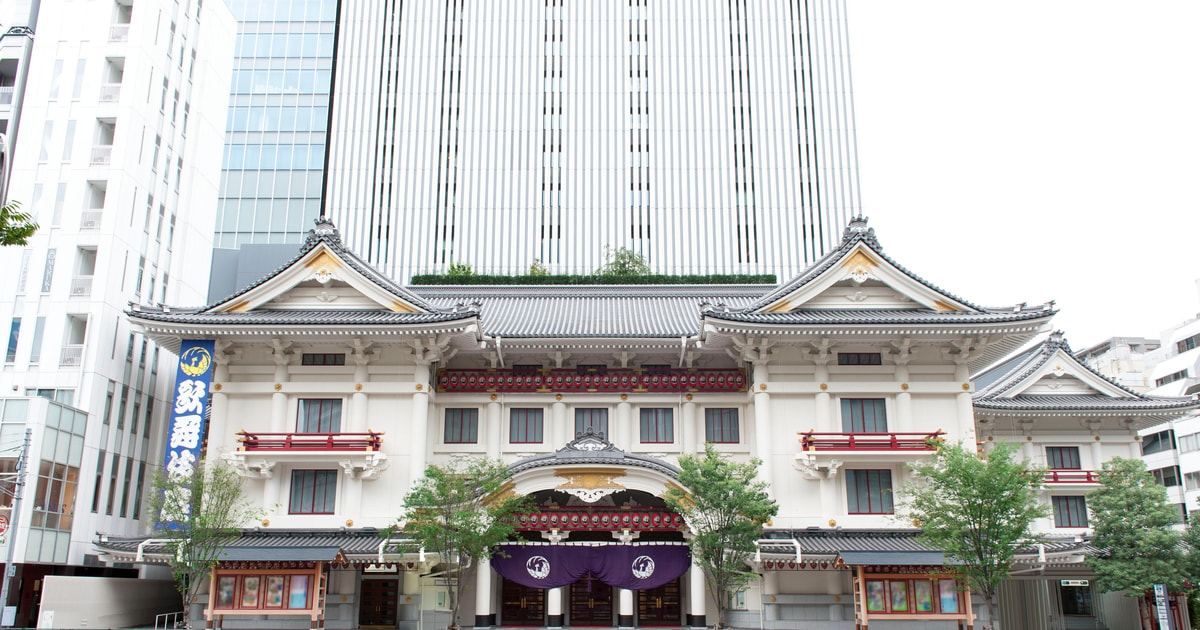
If you’re planning a trip to Tokyo, Kabuki-za is one of the most memorable ways to experience Japanese culture firsthand. GetYourGuide offers English-friendly Kabuki-za tickets and guided experiences, including options with headset translation and pre-show introductions for first-time viewers.
👉 Check Kabuki-za Tickets on GetYourGuide
This section may contain affiliate links. Booking through them costs you nothing extra and helps support this site.




コメント
コメント一覧 (1件)
[…] あわせて読みたい Modorikago Iro no Niaikata Explained|Story, Characters, and the Surprise Twist Two palanquin bearers boast about rival pleasure districts — until a shocking twist reveals who they really are. The story and highlight […]