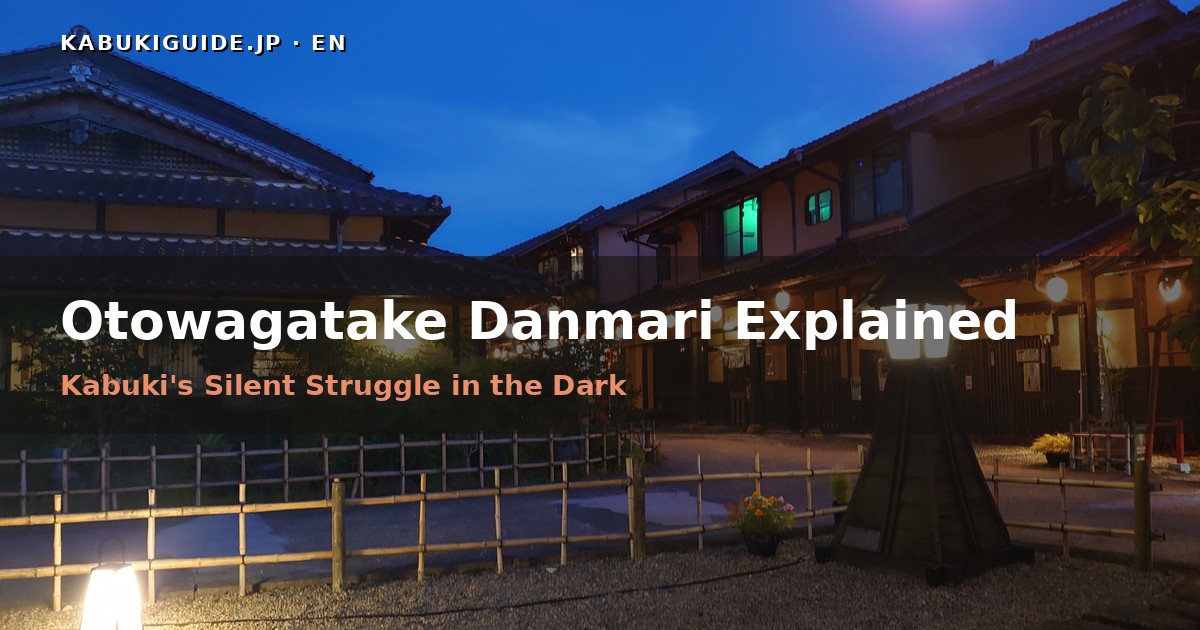
Otowagatake Danmari is a showcase for one of kabuki’s most distinctive performance styles: the danmari, a wordless scene of struggle acted out entirely in darkness. Six characters grope blindly for a stolen banner and sword, and when the lights return, the entire tangled situation resolves itself in a single striking image.
What Is Otowagatake Danmari?
Set on the slopes of Mount Otowa, Otowagatake Danmari is a struggle over a stolen banner and sword, built specifically to showcase the danmari performance style — a scene where multiple characters search for each other silently in darkness. It’s a piece best enjoyed not for its plot, but for its movement, composition, and tension.
Synopsis (Spoilers Ahead)
The story opens at the Hachiman Shrine at the foot of Mount Otowa. After the Minamoto warrior Minamoto no Tsunemoto defeats Taira no Masakado, a ceremony is being prepared to offer a treasured sword and white banner before the shrine to pacify Masakado’s restless spirit.
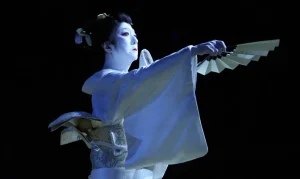
Arriving to perform a sacred kagura dance are the kyōgen performer Matsunojō, his companion Mannojō, and the shirabyōshi dancer Hatsuna. But each of them is concealing a true identity: Matsunojō is secretly the bandit Otowa Yashagorō, Mannojō is secretly Minamoto no Yorinobu, and Hatsuna is secretly Koshikibu.
Mid-dance, Yashagorō suddenly attempts to seize the sword and banner, sparking a struggle. At the shrine’s inner sanctuary, Masakado’s son Tarō Yoshikado, along with Nanaya-hime and Kidōmaru, appear as well, tangling the conflict even further.
The Danmari Sequence: The Scene’s Core Moment
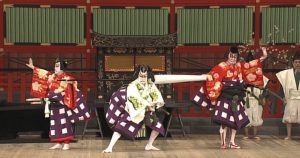
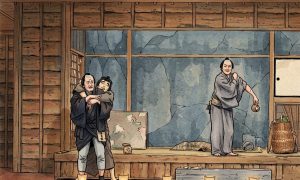
In the midst of the intense combat, the shrine’s eternal lantern goes out, plunging the stage into complete darkness. This is where the danmari begins. All six characters, without speaking a word, grope blindly through the dark, each trying to seize the sword and banner. Since the audience can’t tell who’s holding what, the sequence draws them into actively imagining what’s happening — creating an unusually immersive kind of tension.
The Resolution
The moment the darkness lifts, everything is revealed at once: the white banner has ended up in Tarō Yoshikado’s hands, and the treasured sword in Otowa Yashagorō’s. The performers strike their mie poses, completing the tableau as the curtain falls. That instant of sudden visual clarity, after all the confusion of the dark, is the scene’s greatest pleasure.
Characters
- Otowa Yashagorō — the leader of the bandits, after the treasured sword
- Minamoto no Yorinobu — a Minamoto warrior trying to stop him
- Koshikibu — a woman aligned with the Minamoto side
- Tarō Yoshikado — Taira no Masakado’s son, seeking to reclaim his father’s belongings
- Kidōmaru — Yashagorō’s junior associate, entrusted with the treasure
- Nanaya-hime — aligned with Yoshikado
Simply keeping track of who stands on which side is really all that’s needed to follow the scene.
Highlights
The appeal of Otowagatake Danmari lies less in its story than in how it’s presented. Three things stand out in particular: first, the drama that plays out entirely without dialogue — the tension and relationships between characters conveyed through movement alone. Second, the beauty of the characters’ physical arrangement, which resolves into a single composed image despite all the chaotic movement. And third, the payoff of the reveal after darkness — the satisfaction of an unseen situation suddenly resolving in an instant.
What Is “Danmari”? (A Kabuki Term Explained)
Danmari refers to a distinctly kabuki performance convention in which multiple characters search for one another silently in darkness. Since the scene relies entirely on sound and movement rather than dialogue, it’s considered one of the truest tests of a performer’s physical skill.
Its Connection to the Otowaya
This piece has a deep connection to the Otowaya, the acting lineage of the Onoe family. It premiered in 1935 as part of a memorial performance marking the thirty-third anniversary of the fifth Onoe Kikugorō’s death, and has since been carefully preserved within the Otowaya tradition.

Frequently Asked Questions
- What exactly is a “danmari” scene?
-
It’s a kabuki performance convention where multiple characters silently grope for something in complete darkness, relying entirely on physical movement rather than dialogue to convey the drama.
- Do I need to follow a complex plot to enjoy this scene?
-
Not really — simply knowing which characters are on which side is enough. The real pleasure comes from the choreography, tension, and the sudden visual payoff once the darkness lifts.
- Is this piece connected to a specific acting family?
-
Yes — it premiered in 1935 as a memorial performance for the fifth Onoe Kikugorō and has been passed down within the Onoe family’s Otowaya tradition ever since.
Summary
Otowagatake Danmari is less a story to follow than a technique to watch unfold — six characters searching for each other in total darkness, resolving in an instant into a single beautiful composition. It’s a compact showcase of one of kabuki’s most distinctive and demanding performance conventions.
Related Reading
🎭 Want to See Kabuki Live?
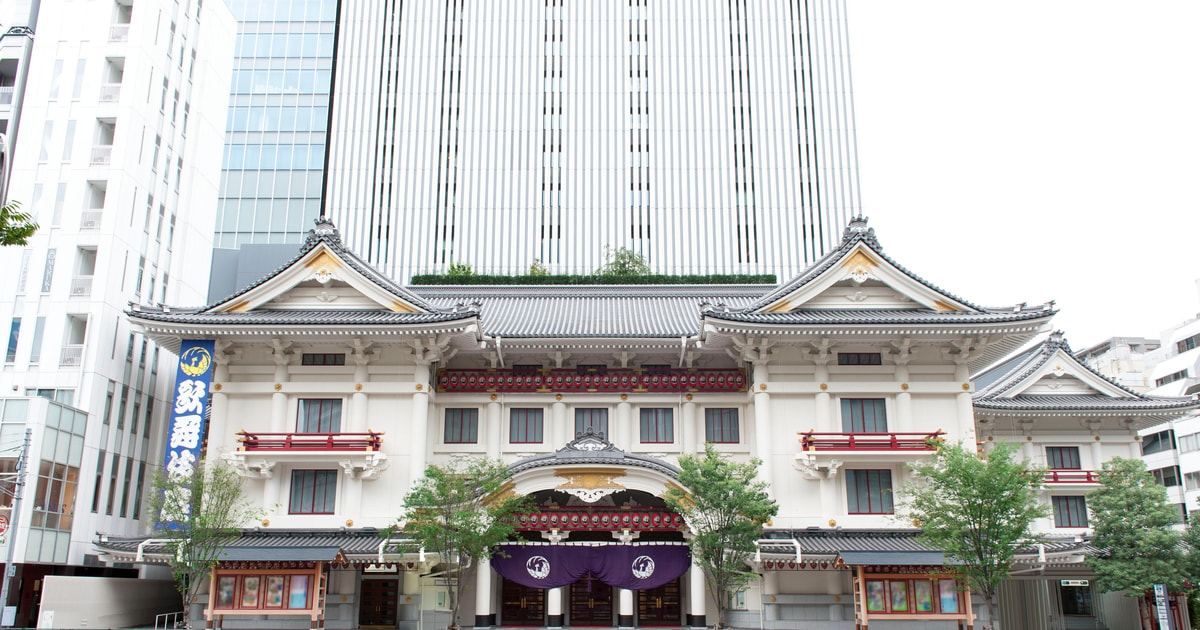
If you’re planning a trip to Tokyo, Kabuki-za is one of the most memorable ways to experience Japanese culture firsthand. GetYourGuide offers English-friendly Kabuki-za tickets and guided experiences, including options with headset translation and pre-show introductions for first-time viewers.
👉 Check Kabuki-za Tickets on GetYourGuide
This section may contain affiliate links. Booking through them costs you nothing extra and helps support this site.




コメント