
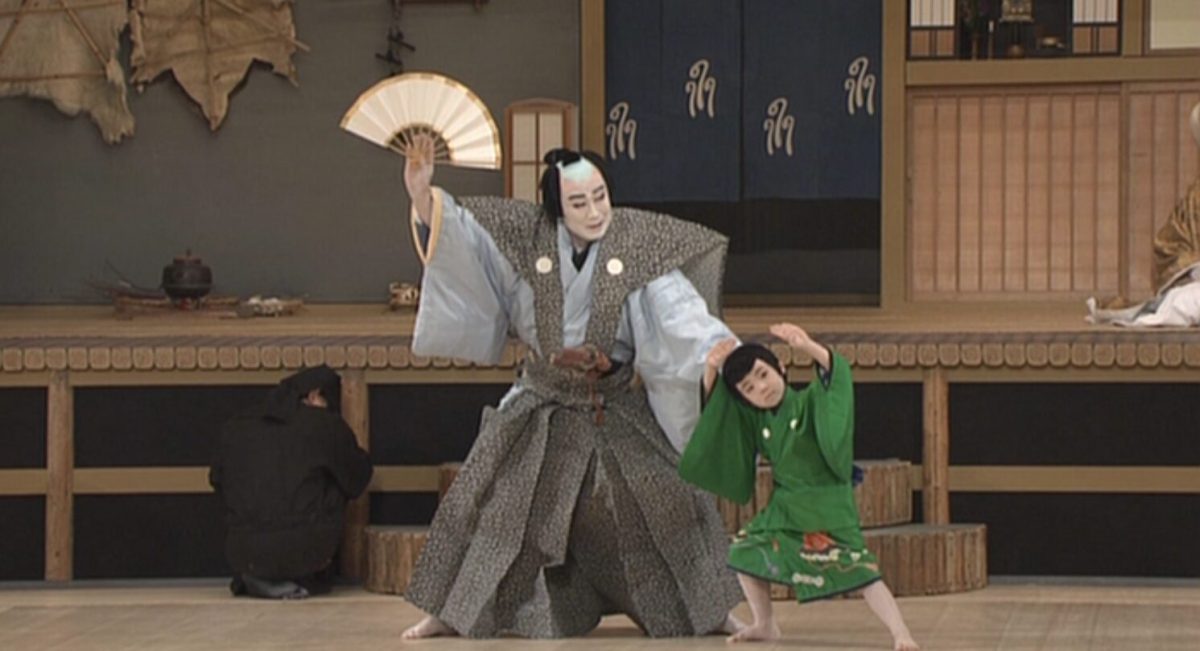
Keyamura (毛谷村) is the most frequently performed scene from Hikosan Gongen Chikai no Sukedachi, an eleven-act jōruri-derived jidai-mono centered on a revenge plot. The full work is rarely staged in its entirety — today, it’s almost always performed as this single scene, the ninth act, following the story of Osono, daughter of Yoshioka Ichimisai, and the humble farmer Rokusuke as they move toward avenging her father’s death.
Background
Yoshioka Ichimisai, a martial arts instructor for the Chōshū domain, is ambushed and killed by Kyōgoku Takumi over a grudge from a match. His wife and daughters are granted permission to avenge him, but during their search, the younger daughter Okiku is killed by Takumi in return. Only Okiku’s infant son, Yasomatsu, survives, and is taken in by Rokusuke, a farmer living in the village of Keyamura.
Rokusuke appears simple on the surface, but is secretly a highly skilled martial artist, once personally trained by Ichimisai himself. Around this time, the Kokura domain has posted a notice: anyone who can defeat Rokusuke in a match will be granted a substantial stipend and a position.
Synopsis
The Match With Mijin Danjō
The scene opens with a match between Rokusuke and a warrior named Mijin Danjō, staged at Rokusuke’s home. As promised beforehand, Rokusuke deliberately loses. Danjō’s demeanor immediately flips — he strikes Rokusuke across the forehead with his fan in an arrogant display, wounding him. Even so, Rokusuke sends him off with a smile, simply glad to have helped a man devoted to caring for his mother.
Soon after, a mysterious old woman appears asking to rest at his home. Rokusuke, suspicious but courteous, lets her in. She abruptly announces that she’ll “become his mother” — leaving Rokusuke baffled, though he lets her rest regardless. When young Yasomatsu returns from playing and cries for his mother, Rokusuke gently puts him to sleep.
The Komusō’s Attack
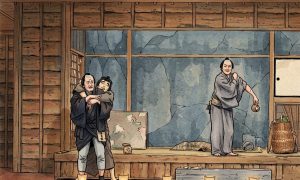
Rokusuke hangs Yasomatsu’s clothing outside, hoping a relative might recognize it. A woman disguised as a wandering komusō monk suddenly appears and attacks him, shouting that he’s her retainer’s enemy. Yasomatsu, startled awake, runs to her crying “Auntie!” — and hearing this, and Rokusuke’s name, the woman’s fierce demeanor collapses entirely: she declares herself his wife.
The Truth Revealed
The woman is revealed to be Osono, daughter of Yoshioka Ichimisai — the very man Rokusuke once trained under. Her father was ambushed and killed by Kyōgoku Takumi, and she and her sister Okiku set out to avenge him. Okiku, too, was killed by Takumi in return — and the child Rokusuke had been raising all along was Okiku’s own son, Yasomatsu.
The traveling old woman then reveals her own identity: she is Ichimisai’s widow, Oyuki, and confirms that Rokusuke and Osono had been betrothed by arrangement while Ichimisai was still alive. Rokusuke, honoring his promise to his late teacher, resolves to join the revenge mission, and with Oyuki acting as go-between, marries Osono on the spot.
The Enemy Revealed
A woodcutter named Onoemon arrives seeking help avenging his own mother’s murder. When Rokusuke examines the body, he realizes it’s the very old woman Mijin Danjō had claimed was his mother — she had been used to deceive Rokusuke, then silenced to cover it up. Enraged, Rokusuke learns from Oyuki and Osono that Mijin Danjō is in fact Kyōgoku Takumi himself, the man they’ve been hunting all along. Rokusuke, Osono, and Oyuki prepare to depart and settle the score at last.
(In the rarely staged finale beyond this point, Rokusuke and Osono finally exact their revenge on Takumi at Toyotomi Hideyoshi’s headquarters in Kokura, following the pacification of Kyushu.)
Highlights
Rokusuke’s Quiet Nobility
Even after deliberately losing a match and being struck in the process, Rokusuke sends his opponent off with a genuine smile, glad only that he could help a devoted son. That understated decency is a large part of what makes him such an appealing lead.
A Cascade of Surprising Reveals
A mysterious old woman claiming to be his mother, a masked attacker claiming to be his wife — the scene builds through one unexpected identity reveal after another, each one recontextualizing what came before.
A Rich Ensemble Cast
Part of this play’s enduring appeal is its cast of vivid, memorable characters — each with their own strong personality — driving a classic revenge story forward with real narrative momentum.
Frequently Asked Questions
- Why does Rokusuke deliberately lose the opening match?
-
He’s moved by Mijin Danjō’s stated devotion to supporting his mother, and agrees to lose on purpose to help him earn a paid position — only to be repaid with an arrogant, injurious blow.
- Who is the child Rokusuke has been raising?
-
Yasomatsu is the son of Okiku, who was killed avenging her father alongside her sister Osono — making him the nephew of the woman who later reveals herself as Rokusuke’s betrothed.
- Is Keyamura usually performed as part of the full 11-act play?
-
No — the full-length version is rarely staged today. Keyamura, the ninth act, is performed almost exclusively as a standalone piece.
Summary
Keyamura combines a modest, big-hearted hero with a cascade of surprising revelations — a mysterious “mother,” a disguised “wife,” and a villain hiding behind a false identity — all building toward a classic tale of loyalty and revenge. Its rich cast and satisfying twists make it one of the more purely entertaining jidai-mono in the kabuki repertoire.
🎭 Want to See Kabuki Live?
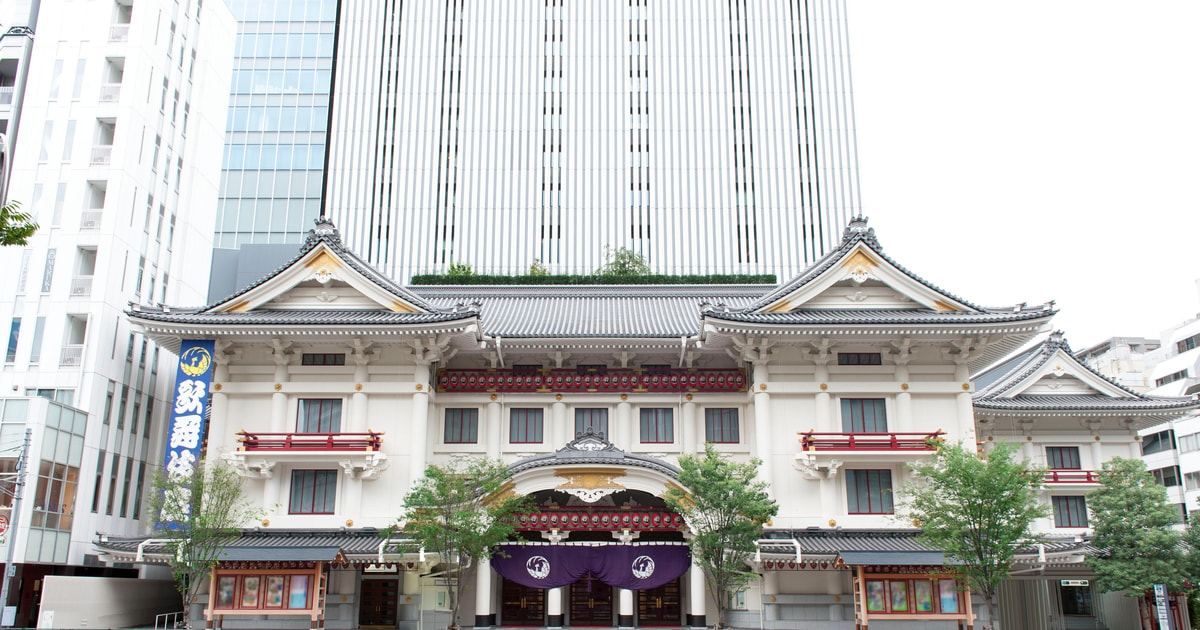
If you’re planning a trip to Tokyo, Kabuki-za is one of the most memorable ways to experience Japanese culture firsthand. GetYourGuide offers English-friendly Kabuki-za tickets and guided experiences, including options with headset translation and pre-show introductions for first-time viewers.
👉 Check Kabuki-za Tickets on GetYourGuide
This section may contain affiliate links. Booking through them costs you nothing extra and helps support this site.
Related Reading






コメント
コメント一覧 (1件)
[…] あわせて読みたい Keyamura Explained: A Humble Hero, Hidden Identities, and a Tale of Revenge Keyamura follows the humble but skilled Rokusuke through a cascade of surprising reveals on the way to a classic tale of loyalty and revenge. […]