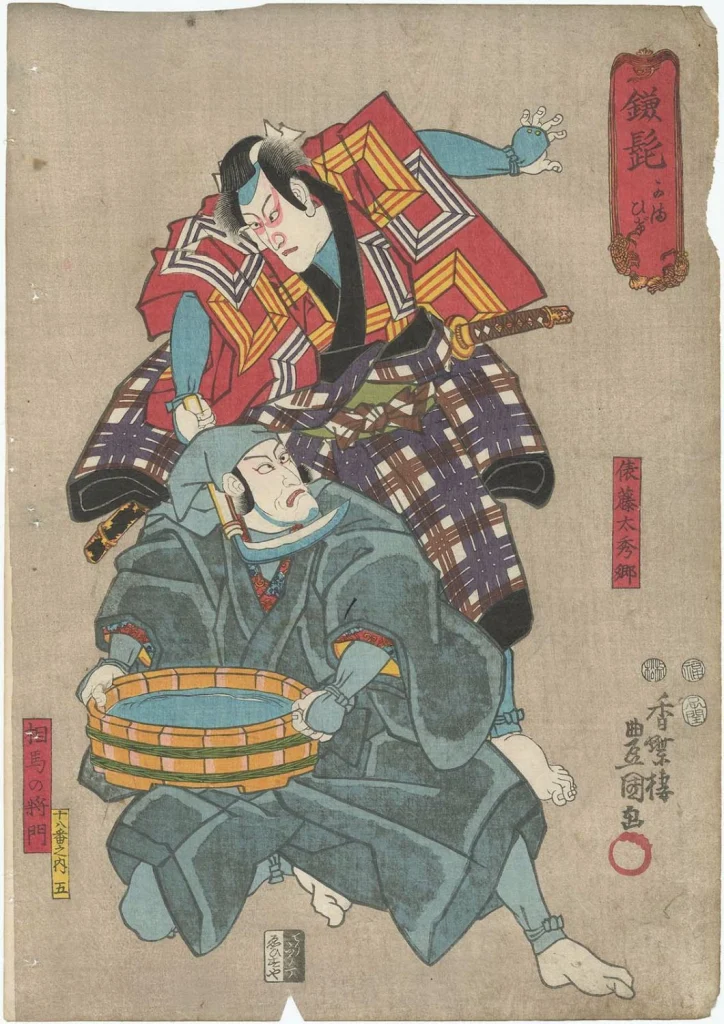
Kamahige (鎌髭, “Sickle Beard”) is one of the Kabuki Jūhachiban — the “Eighteen Best Plays” of the Ichikawa acting family — and a bold aragoto piece built around the unkillable warrior Akushichibyōe Kagekiyo.
It opens with an oddly mundane premise — someone getting a shave — while a plot to behead him unfolds underneath. And no matter how large the sickle wielded against him, Kagekiyo’s neck simply cannot be cut. That impossible premise is exactly what makes Kamahige so memorable.
This guide covers the synopsis, highlights, and performance history of this unusual aragoto classic.
What Is Kamahige?
Kamahige is an aragoto play counted among the Kabuki Jūhachiban. Its hero is Akushichibyōe Kagekiyo, a legendary warrior devoted to restoring the Taira clan — written as a classic aragoto figure with superhuman strength and an indestructible body.
The title, “Sickle Beard,” comes from the play’s strange central scene: someone is shaved using a sickle. What looks like an everyday grooming ritual is secretly a deadly plot in disguise — exactly the kind of delightfully strange premise kabuki excels at.
Synopsis
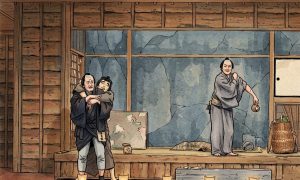
Kagekiyo, a surviving loyalist of the defeated Taira clan, disguises himself as a wandering ascetic and visits a blacksmith’s shop. The blacksmith, however, is secretly a warrior loyal to the rival Minamoto clan, quietly waiting for his chance to kill Kagekiyo.
Kagekiyo himself requests a shave. Seeing his opening, the warrior swings a massive sickle at Kagekiyo’s throat — but the blade cannot cut him. No matter how many times he strikes, Kagekiyo’s body proves entirely indestructible.
Kagekiyo then reveals he knew about the plot from the very beginning — and had intended to let himself be captured all along. Carrying his hatred for the Minamoto clan and his unbroken resolve to restore the Taira, he willingly allows himself to be led away to the capital.
Highlights
Kagekiyo’s Aragoto-Style Invincibility
The single biggest highlight is Kagekiyo surviving an attempt to cut his own throat. It’s a premise with no basis in reality — and that’s exactly the point of aragoto: not realism, but superhuman strength expressed as pure stylized spectacle. That exaggeration is the entire appeal of the genre.
The Bizarre Premise of a Sickle Shave
The single strangest idea in Kamahige is using a sickle — ordinarily a farming tool — as both a shaving implement and a weapon. That coexistence of the mundane and the murderous is what gives the scene its distinctive tension.
Layers of Hidden Identity
Kamahige is built entirely on a stack of “actually” reveals: a wandering ascetic who’s actually Kagekiyo, a blacksmith who’s actually a Minamoto warrior, a shave that’s actually an assassination attempt. That layered structure of hidden truths is a distinctly kabuki pleasure.
Kumadori and Mie That Define Aragoto Power
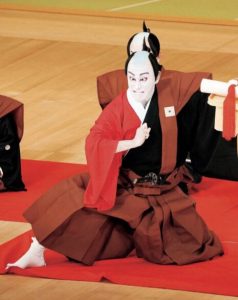
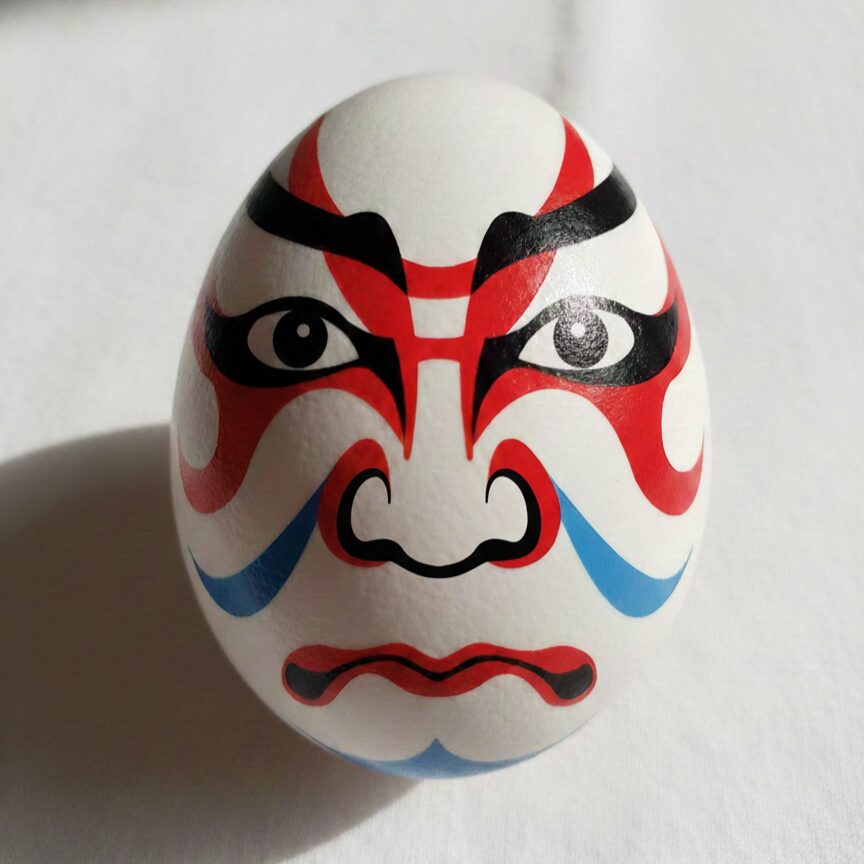
Kagekiyo isn’t just written as invincible — the bold kumadori makeup and mie poses associated with the role are major highlights in their own right. Striking kumadori visually communicates his superhuman strength and fury the instant he appears on stage, and the defiant mie he strikes upon revealing that he’s seen through the entire plot is a quintessential aragoto payoff. Beyond the novelty of “a neck that can’t be cut,” it’s how that superhuman quality gets expressed as pure stylized form that makes Kamahige so compelling.
History and Revival
Kamahige is believed to have premiered in 1774. Its original script was later lost, and the play went unperformed for a long stretch of time. It was eventually revived in May 2013 at Kyoto’s Minamiza, in a production starring Ichikawa Ebizō (now Ichikawa Danjūrō). Running at roughly 46 minutes, it’s a relatively compact piece by kabuki standards, and remains one of the rarer entries among the Kabuki Jūhachiban today.
Who Should Watch Kamahige?
- Anyone interested in the Kabuki Jūhachiban specifically
- Fans of bold, larger-than-life aragoto spectacle
- Anyone curious about other plays featuring Kagekiyo
- Viewers looking for something genuinely unusual in the repertoire
This is a play that rewards viewers who enjoy sheer inventive strangeness as much as spectacular stagecraft.

Frequently Asked Questions
- What kind of play is Kamahige?
-
It’s one of the Kabuki Jūhachiban, a bold aragoto piece centered on the legendary, indestructible warrior Akushichibyōe Kagekiyo.
- Why is it called “Kamahige” (Sickle Beard)?
-
The name comes from the play’s distinctive scene, in which a character is shaved using a sickle — a farm tool doubling as both a razor and an assassination weapon.
- Is Kamahige still performed today?
-
Rarely, but yes — it was revived in 2013 by Ichikawa Ebizō (now Ichikawa Danjūrō) after a long absence from the stage, and remains one of the less frequently performed entries in the Kabuki Jūhachiban.
Summary
Kamahige packs an unusual amount of inventive ideas into one compact piece: an indestructible hero, a razor doubling as a murder weapon, and a life-or-death standoff hidden behind an everyday grooming scene. It’s rarely performed, but it’s an essential piece for understanding what aragoto is really about at its core.
🎭 Want to See Kabuki Live?
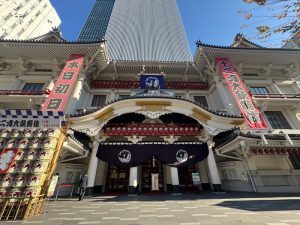
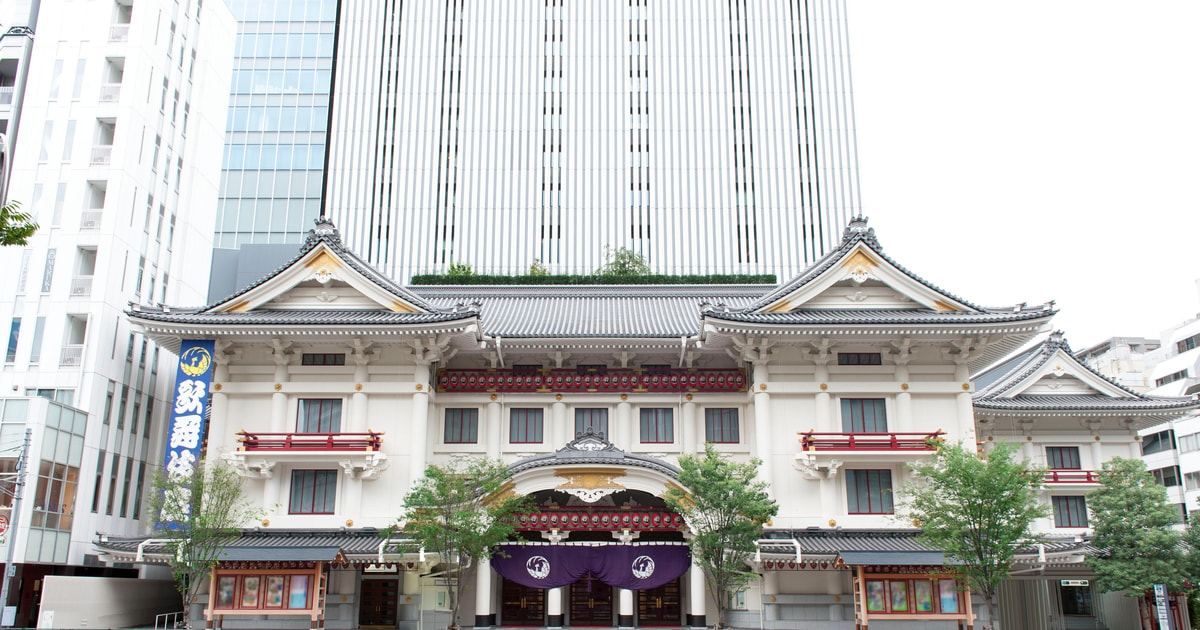
If you’re planning a trip to Tokyo, Kabuki-za is one of the most memorable ways to experience Japanese culture firsthand. GetYourGuide offers English-friendly Kabuki-za tickets and guided experiences, including options with headset translation and pre-show introductions for first-time viewers.
👉 Check Kabuki-za Tickets on GetYourGuide
This section may contain affiliate links. Booking through them costs you nothing extra and helps support this site.



コメント
コメント一覧 (1件)
[…] あわせて読みたい Kamahige Explained: The Indestructible Kagekiyo and Kabuki’s Strangest Shave Kamahige is a Kabuki Jūhachiban play where the warrior Kagekiyo survives an assassination attempt disguised as a sickle-shave. […]