Set against Edo’s criminal underworld, Kamikakete Sango Taisetsu (盟三五大切) traces a chain of money, desire, and betrayal that spirals into brutal revenge. Written by the great Tsuruya Nanboku, it’s remembered as one of kabuki’s bleakest works — a story where nothing resolves into simple justice, and every character’s downfall makes the piece all the more compelling.
Synopsis
Late at night on the waters off Tsukuda, a boat carries the geisha Koman and the boatman Sagorō — secretly husband and wife. Disowned by his father, Sagorō has been asked to raise 100 ryō, and has his wife work as a geisha to help earn it.
Koman has captured the affections of a rōnin, Satsuma Gengobei, and Sagorō schemes to exploit that infatuation to extract even more money. When Gengobei appears, his true identity is revealed: he’s actually Fuwa Kazuemon, a rōnin of the former Enya clan, who needs the 100 ryō to join a mission avenging his lord.
Sagorō and Koman, with accomplices, stage a fake plan to buy out Koman’s contract. Koman shows off a tattoo reading “Godairiki” as a display of devotion, feigning willingness to risk everything. After an agonizing struggle, Gengobei gives up his plan for revenge and hands over the 100 ryō.
But immediately after, Sagorō reveals the truth: Koman already has a husband. The entire affair was a con for money. Upon learning of the betrayal, Gengobei turns to revenge — that night, he attacks the group, killing one conspirator after another. Sagorō and Koman manage to escape.
The story moves to Yotsuya, where Sagorō’s father, Ryōshin (Tokuemon), reveals a devastating truth: the 100 ryō Sagorō stole was, all along, the very money Gengobei needed for his own cause. The entire tragedy was born from what none of them knew. Gengobei’s revenge doesn’t stop there — he poisons a man named Yasuke, then kills Koman and her young child as well.
The Ending (Spoiler Warning)
The story resolves without any real redemption:
- Sagorō, realizing his own fatal mistake, takes his own life
- Koman is killed by Gengobei, along with her young child
- Gengobei, having lost everything, returns to his identity as Fuwa Kazuemon to rejoin the revenge mission
Every character acted for someone else’s sake, and every one of them is destroyed as a result — the deepest irony at the heart of the play.
Characters
Satsuma Gengobei (Actually Fuwa Kazuemon)
A rōnin of the former Enya clan. He loses the money meant for his lord’s revenge to love, and betrayal transforms him into an agent of pure vengeance — a character defined by the stark gap between his fundamental decency and the madness that follows. He’s counted among the forty-seven rōnin of the famous vendetta later depicted in Kanadehon Chūshingura.
Sasanoya Sagorō
A disowned boatman who deceives Gengobei in an attempt to earn back his father’s approval. Upon learning the truth, he confronts his own guilt by taking his own life.
Koman, the Geisha (Also Known as Oroku)
Sagorō’s wife, working as a geisha. She uses Gengobei’s affection for love and survival, and ultimately meets a tragic end, killed alongside her child.
Ryōshin (Tokuemon)
Sagorō’s father, now a monk — secretly a former retainer of Gengobei’s own former lord. His attempt to raise money for his master ends up unraveling everyone’s fate.
Kurimawashi no Yasuke
Koman’s brother, a resourceful townsman who ultimately loses his life to poisoned sake.
What Makes Gengobei So Compelling
The kabuki actor Kataoka Nizaemon once described Gengobei this way: he’s fundamentally not a villain — he’s a bright, good-natured person, and what makes the role compelling is watching deception transform him completely. Gengobei isn’t evil from the start. That’s exactly why his fall, triggered by betrayal, hits so hard — the moment genuine decency flips into madness leaves a powerful impression on the audience.
A Tragedy With No Villains
What defines this play is that it resists simple good-versus-evil framing:
- Sagorō wants his father’s approval
- Koman is fighting to survive
- Gengobei is torn between loyalty and love
Each of them has a real reason for what they do — and still, they collide, and all of them are destroyed. A tragedy born from the collision of individually understandable choices is exactly where this play’s depth lies.
The Irony Built Into the Money Itself
At the center of the story is the 100 ryō. The money Sagorō steals turns out, through a chain of coincidence, to be the very money meant for Gengobei himself. Tragedy born from not knowing — that structure runs through the entire piece.
Kabuki’s “Aesthetics of Killing”
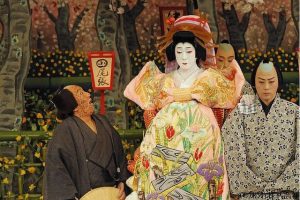
A hallmark of Tsuruya Nanboku’s work is this fusion of beauty and cruelty. The scene where Gengobei carries home Koman’s severed head is depicted as an act of madness — and, simultaneously, as a distorted expression of love. What would be unwatchable in reality becomes something that functions as beauty on stage. That’s part of what makes kabuki’s darker works so genuinely fascinating.
A Companion Piece
Also by Tsuruya Nanboku, Tōkaidō Yotsuya Kaidan is another dark masterpiece exploring human obsession and karma. Watching the two together deepens your understanding of both.
Frequently Asked Questions
- How long is a full performance of Kamikakete Sango Taisetsu?
-
A full, uncut performance runs roughly 2 hours and 45 minutes.
- Is this a scary or violent play?
-
It contains bloody scenes and brutal revenge, making it one of kabuki’s heavier works. That said, these moments function as expressions of human emotion and obsession rather than cruelty for its own sake.
- Is there a clear villain in this story?
-
No — every major character has an understandable reason for their actions, and the tragedy comes precisely from those reasonable choices colliding and destroying everyone involved.
Summary
Kamikakete Sango Taisetsu is one of kabuki’s darkest works: a chain of desire, betrayal, and mutual misunderstanding where no one is truly a villain, and yet no one is saved. That heavy, lingering aftertaste is exactly what gives this Tsuruya Nanboku classic its enduring power.
Related Reading
🎭 Want to See Kabuki Live?
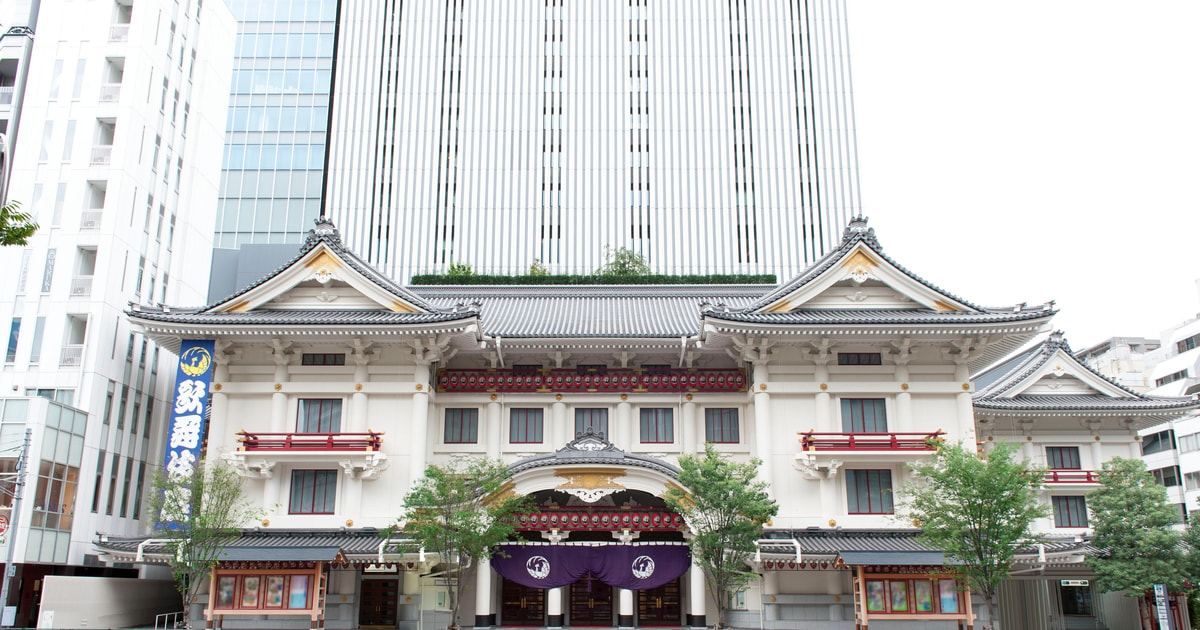
If you’re planning a trip to Tokyo, Kabuki-za is one of the most memorable ways to experience Japanese culture firsthand. GetYourGuide offers English-friendly Kabuki-za tickets and guided experiences, including options with headset translation and pre-show introductions for first-time viewers.
👉 Check Kabuki-za Tickets on GetYourGuide
This section may contain affiliate links. Booking through them costs you nothing extra and helps support this site.



コメント
コメント一覧 (1件)
[…] あわせて読みたい Kamikakete Sango Taisetsu: A Dark Tale of Money, Betrayal, and Revenge One of Tsuruya Nanboku’s bleakest works, where a chain of deception and misunderstanding destroys every character involved. (adsbygoog […]