
A demon disguised as a beautiful woman returns to reclaim her own severed arm — a quiet psychological standoff that suddenly erupts into raw, monstrous confrontation. Ibaraki depicts the showdown between the demon Ibaraki-dōji and the warrior Watanabe no Tsuna, and stands as one of the defining works of the Onoe family’s signature repertoire.
Ibaraki and the Shinko Engeki Jusshu
Ibaraki belongs to the Shinko Engeki Jusshu (“Ten New and Old Plays”) — a collection of signature works passed down within the Onoe family, compiled by the fifth and sixth generations of Onoe Kikugorō as a counterpart to the Ichikawa family’s celebrated Kabuki Jūhachiban and Shin Kabuki Jūhachiban repertoires. The Onoe family has long specialized in plays involving spirits and supernatural transformation, and many pieces in this collection draw on ghost and demon lore. Among them, Ibaraki stands out as a defining showcase, combining onnagata elegance, the sheer menace of a demon, and genuine dance technique all at once.
Synopsis
The play is set in the Heian period, picking up after the famous legend in which Watanabe no Tsuna severs the arm of a demon at Rashōmon Gate — the story told in the separate play Rashōmon.
Rumors had spread that a fearsome demon known as Ibaraki-dōji haunted the Rashōmon gate at Tō-ji temple. Watanabe no Genji Tsuna, retainer to Minamoto no Yorimitsu, travels there and fights the demon fiercely, ultimately severing its left arm — though the demon manages to flee. The onmyōji Abe no Seimei divines that the demon will return within seven days and seven nights to reclaim its arm, and orders Tsuna into ritual seclusion. The severed arm is placed in a box and sealed away.
On the evening of the seventh day, with the Watanabe household tightly sealed off, Tsuna’s aunt Mashiba comes calling. Mashiba had raised Tsuna as a mother figure since childhood. Tsuna tries to explain the situation and send her away, but relents when she laments his coldness toward the woman who raised him, ultimately inviting her inside.
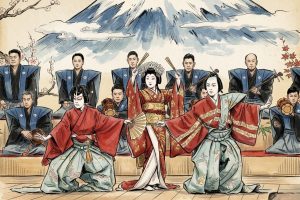
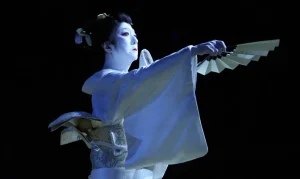
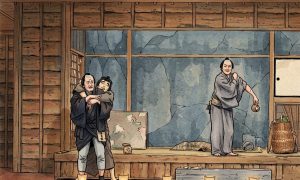
A dance performance follows in the parlor, with the sword-bearer Otowaka, then Mashiba, and finally Tsuna each taking their turn. Tsuna dances out the story of his battle at Rashōmon alongside Hirai Yasumasa, recounting his clash with Ibaraki-dōji with real energy and movement. Hearing this, Mashiba asks to see the demon’s severed arm. The moment Tsuna opens the box to show her — Mashiba seizes the arm and reveals her true, terrifying form.
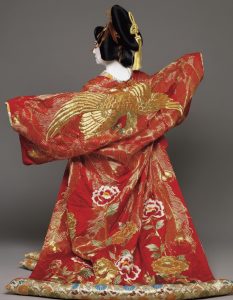
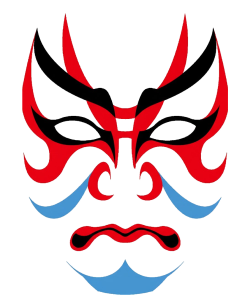
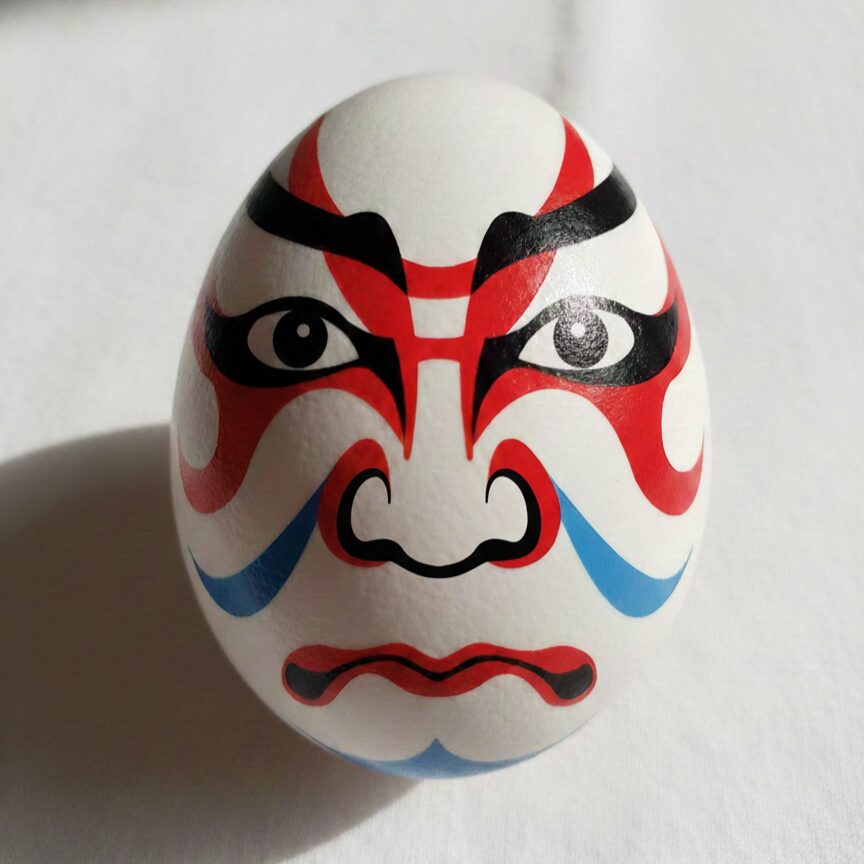
Mashiba was Ibaraki-dōji all along. Kicking aside the chest, the demon snatches back her left arm and flees, with Tsuna in pursuit. Ibaraki-dōji now reappears on stage in full demonic form — horns sprouting from her head, an iron staff in hand, her face covered in bold brown kumadori makeup signifying a demon. Fully transformed, she clashes fiercely with Tsuna once more. As the curtain closes, Ibaraki-dōji remains alone on the hanamichi runway, raising her recovered left arm high and making her exit in a striking one-armed roppō stride.
Highlights
The Eerie Stillness of Mashiba’s One-Armed Dance
One of the piece’s greatest highlights is Mashiba’s dance. Since Ibaraki-dōji has already lost her left arm at this point in the story, the performer must dance with the left hand either fully concealed in the sleeve or, if visible, never moving at all — all while making the restraint look natural to Tsuna within the story, yet subtly unsettling to the audience watching from outside it. Conveying elegance and creeping menace using only the right arm is an extraordinarily demanding technical challenge, and a genuine showcase of onnagata skill.
Tsuna’s Rashōmon Narrative Dance
Tsuna’s dance recounting his battle at Rashōmon is another major highlight — blending dance and stylized combat movement to recreate the moment he severed the demon’s arm. Even set within a quiet parlor scene, the sequence conveys the full intensity of the original battle.
A Bold, Beautiful Closing Mie
In the final moments, after the demon has reclaimed her arm and fled, Tsuna draws his sword and strikes a bold mie pose, mouth open wide — a striking, large-scale image that never tips over into excess, instead landing as a genuinely beautiful composition. It’s a fitting close that distills the Onoe family’s formal aesthetic into a single unforgettable image.
Characters
Ibaraki-dōji — a fearsome demon haunting Rashōmon Gate, who disguises herself as Tsuna’s aunt Mashiba to infiltrate his household and reclaim her severed left arm. A demanding role combining seductive elegance with genuine menace.
Watanabe no Genji Tsuna — one of Minamoto no Yorimitsu’s four legendary retainers, the warrior who severed Ibaraki-dōji’s arm at Rashōmon. Bold and courageous, but his guard drops out of genuine affection for the woman who raised him.
Mashiba — believed to be Tsuna’s aunt and adoptive mother figure, later revealed to be Ibaraki-dōji in disguise.
Otowaka — Tsuna’s sword-bearer, who opens the parlor scene with the first dance of the sequence.
Who Should See This Play?
Ibaraki is an especially good fit for anyone who enjoys kabuki’s demon and supernatural lore, wants to closely study onnagata technique, appreciates a well-constructed dance drama, or simply wants a compact piece that captures kabuki’s distinctive atmosphere in a short runtime.
Frequently Asked Questions
- Is Ibaraki connected to another kabuki play about Rashōmon?
-
Yes — Ibaraki is a direct sequel in spirit to the legend told in the play Rashōmon, in which Watanabe no Tsuna first severs the demon’s arm at the gate.
- What makes the role of Mashiba so difficult to perform?
-
Since the character has already lost her left arm, the performer must dance using only the right arm while keeping the left convincingly still or hidden — all while balancing natural believability toward the other characters with a subtly unsettling effect for the audience.
- What is the Shinko Engeki Jusshu?
-
It’s a collection of ten signature plays associated with the Onoe acting family, compiled as a counterpart to the Ichikawa family’s Kabuki Jūhachiban, with many works centered on ghosts and supernatural transformation.
Summary
Ibaraki turns a quiet family reunion into a slow-building nightmare, then unleashes it in a burst of raw demonic fury — anchored by one of onnagata performance’s most technically demanding roles. As a piece of the Onoe family’s signature repertoire, it offers a rare chance to watch beauty and horror coexist within a single, tightly constructed dance drama.
Related Reading
🎭 Want to See Kabuki Live?
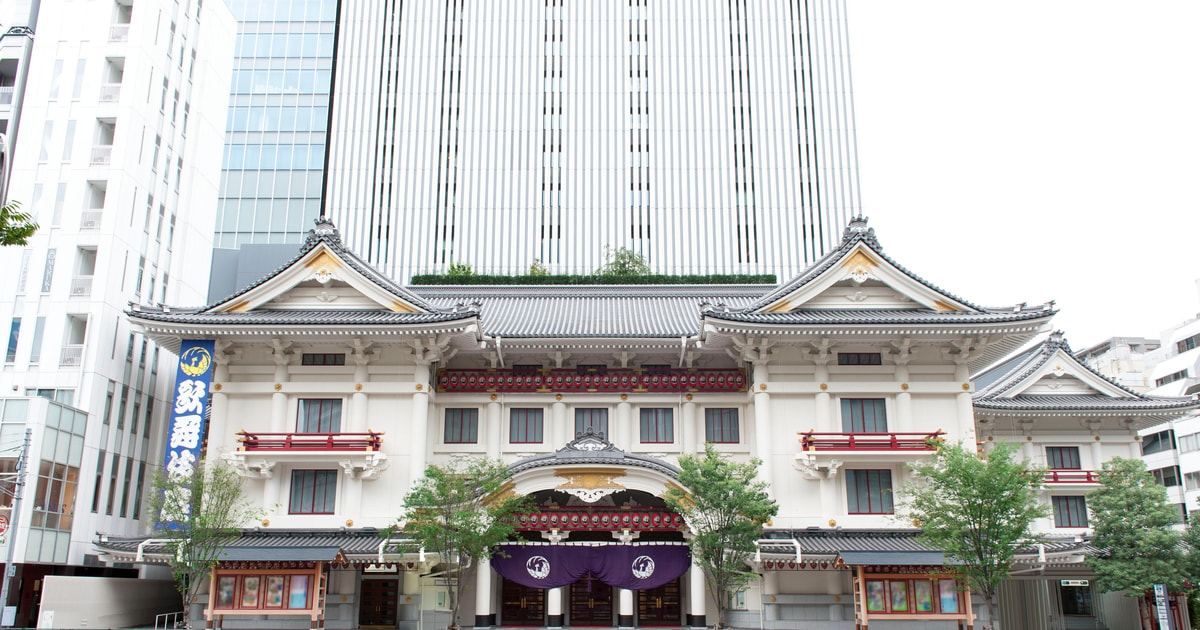
If you’re planning a trip to Tokyo, Kabuki-za is one of the most memorable ways to experience Japanese culture firsthand. GetYourGuide offers English-friendly Kabuki-za tickets and guided experiences, including options with headset translation and pre-show introductions for first-time viewers.
👉 Check Kabuki-za Tickets on GetYourGuide
This section may contain affiliate links. Booking through them costs you nothing extra and helps support this site.




コメント