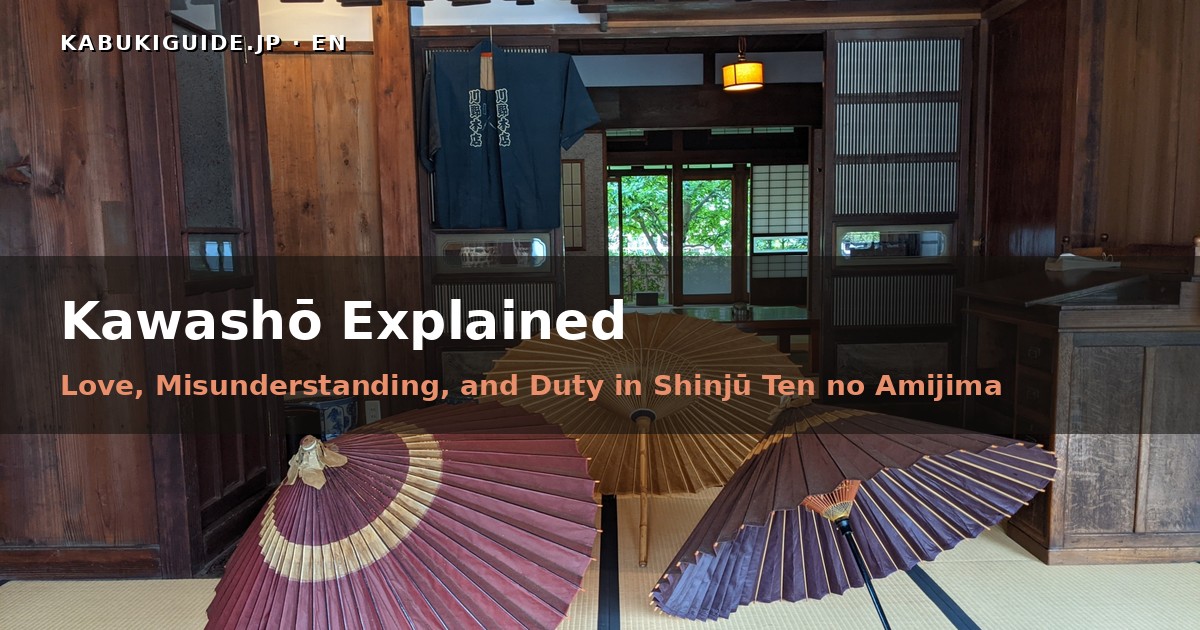
Kawashō (河庄), formally the “Kawashō / Kamiya-uchi” scene from Shinjū Ten no Amijima (The Love Suicides at Amijima), is one of the most beloved scenes drawn from Chikamatsu Monzaemon’s original bunraku puppet play. It’s now regularly performed as a standalone piece, and is counted among the Ganjirō Jūnikyoku — twelve signature works selected by the first Nakamura Ganjirō as the special repertoire of the Narikomaya (Nakamura Ganjirō) acting family.
What Is Kawashō?
Kawashō takes its name from the teahouse where it’s set, in the Sonezaki-shinchi district. It’s a representative sewamono (domestic drama) of Kamigata kabuki, telling a story of ordinary people caught between love and duty. Two lovers who have vowed to die together are pulled apart, again and again, by obligation and family — a genuinely aching story of love and human feeling in tension.
Synopsis
Jihei, owner of a paper shop, is deeply in love with the courtesan Koharu, and the two have pledged to die together. One day, at the teahouse Kawashō, Jihei sees Koharu meeting with another man and, consumed by jealousy, assumes he’s been betrayed.
But the man is actually Magoemon, Jihei’s own brother, who has come in disguise out of concern to try to stop him. And Koharu herself, having just received a letter from Jihei’s wife, Osan, has been quietly trying to distance herself from Jihei for his own sake.
In other words: both of them are trying to protect the other, and it’s exactly that mutual sacrifice that keeps pulling them further apart. Love, duty, responsibility to family — the more each character wishes for the other’s happiness, the more tangled their situation becomes. What looks, on the surface, like a simple romantic misunderstanding is really a story deeply enmeshed in family and social obligation, one whose crossed wires build steadily toward an unavoidable tragedy.
Characters
Kamiya Jihei
Owner of the paper shop, known by the nickname “Kamiji.” Torn between his love for the courtesan Koharu and his responsibilities to his family, he’s prone to emotional, jealous outbursts driven by misunderstanding — the story’s central figure.
Kinokuniya Koharu
A courtesan deeply in love with Jihei, who nonetheless tries to remove herself from his life out of obligation to his wife. Her quiet endurance is one of the play’s most affecting elements.
Osan
Jihei’s wife, whose letter to Koharu sets much of the plot’s tension into motion.
Konoya Magoemon
Jihei’s older brother, who appears at Kawashō disguised in samurai dress to try to stop his brother’s reckless behavior — a figure balancing family duty and genuine affection.
Edoya Tahei
A wealthy man attempting to buy out Koharu’s contract. He’s also lent Jihei money, adding both tension and a touch of comedy to the story.
Gokanya Zenroku
Tahei’s companion, whose witty banter provides much of the play’s comic relief.
The Apprentice Sangorō
Jihei’s young shop apprentice, who delivers a letter early in the story — a charmingly clumsy presence that lightens the mood throughout.
Why This Play Works for Beginners
At first glance, Kawashō can seem like a tangle of complicated relationships — but the core tension is simple: love versus duty. Jihei and Koharu are deeply in love, yet family and social obligations keep them from being together freely. Once you grasp that central, unresolvable bind, the characters’ actions and emotions become much easier to follow.
The play also weaves in real humor alongside its heavier themes — characters like Tahei, Zenroku, and Sangorō bring levity and pacing that keep the story from feeling too heavy. Approached as a human drama rather than an intimidating classic, it’s a piece that draws viewers in naturally.
Highlights
Jihei’s Entrance
Jihei’s entrance along the hanamichi — a white cloth over his head, a short sword at his side, trudging along under the weight of his sorrow — is a major highlight in its own right. In contrast to the flashy spectacle of aragoto, this is Kamigata wagoto style at its finest: a soft, melancholic sensuality distinctly its own.
Comedy and Human Warmth, Kamigata-Style
The witty back-and-forth between Tahei and Zenroku, along with the apprentice Sangorō’s charming performance, thread genuine comic timing through the heavier story — almost like a rhythm borrowed from Osaka comic double-acts.
The Tension of a Psychological Drama
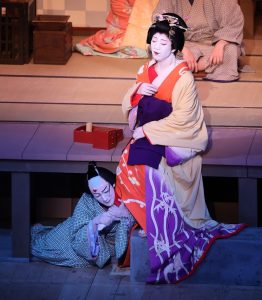
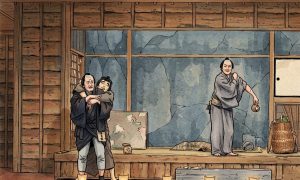
The scene where Jihei, believing Koharu has betrayed him, stabs at her shadow through a paper screen, along with the moment he’s bound to a lattice window, showcases an intense clash of emotion. Even without flashy combat, the sheer force of the characters’ inner turmoil carries real dramatic weight.
Frequently Asked Questions
- Who is the man Jihei sees Koharu with at the teahouse?
-
It’s actually Jihei’s own brother, Magoemon, disguised in samurai dress, who has come to try to stop Jihei’s reckless behavior out of genuine family concern.
- Why is Koharu trying to distance herself from Jihei?
-
After receiving a letter from Jihei’s wife, Osan, Koharu tries to remove herself from Jihei’s life out of a sense of obligation and genuine concern for his family, even though she loves him deeply.
- Is Kawashō part of a larger story?
-
Yes — it’s drawn from Chikamatsu Monzaemon’s Shinjū Ten no Amijima, though it’s popular and self-contained enough to be regularly performed on its own.
Summary
Kawashō is a quintessential Kamigata sewamono: a story where love and duty pull two people apart precisely because each is trying to protect the other. Between Jihei’s melancholic entrance, moments of genuine Osaka-style comedy, and the raw tension of misunderstanding and jealousy, it’s a piece that builds its power through quiet emotional accumulation rather than spectacle — and lingers with the audience long after the curtain falls.
Related Reading
🎭 Want to See Kabuki Live?
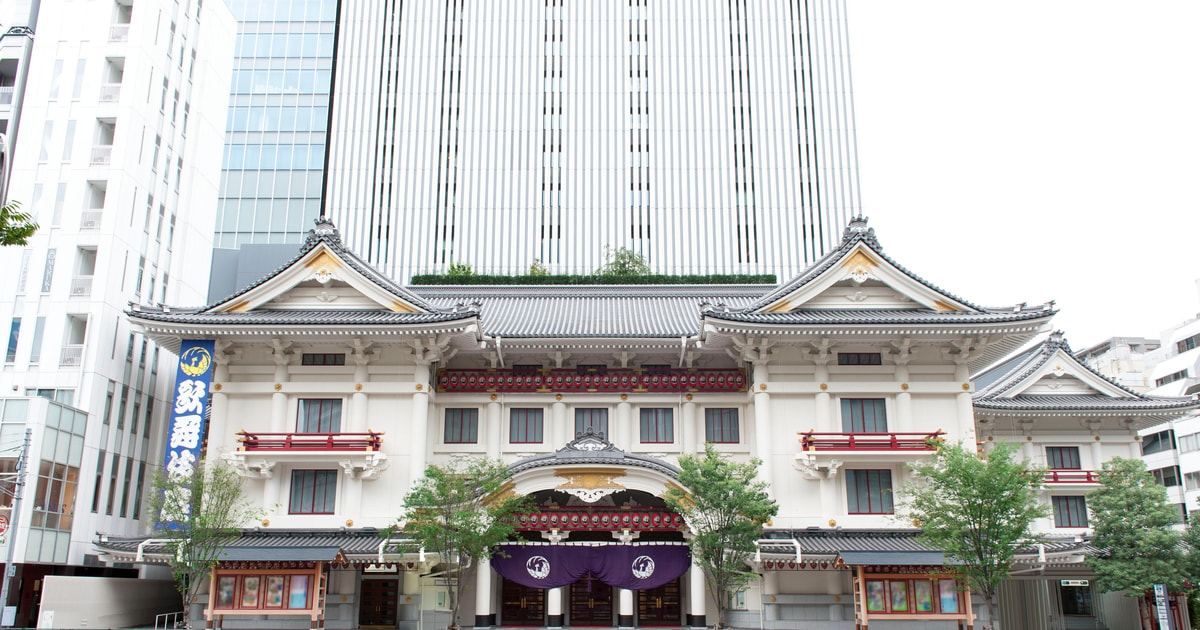
If you’re planning a trip to Tokyo, Kabuki-za is one of the most memorable ways to experience Japanese culture firsthand. GetYourGuide offers English-friendly Kabuki-za tickets and guided experiences, including options with headset translation and pre-show introductions for first-time viewers.
👉 Check Kabuki-za Tickets on GetYourGuide
This section may contain affiliate links. Booking through them costs you nothing extra and helps support this site.


コメント