Long before a single line is spoken, the curtain itself is already telling you something. Kabuki uses several distinct types of stage curtain, each with its own color scheme, purpose, and dramatic function — and once you know how to read them, they add a whole extra layer to watching a performance unfold.
The Striped Curtain: Jōshiki-maku
The curtain most associated with kabuki is the jōshiki-maku — a broad curtain divided into wide vertical stripes, most commonly in black, a reddish-brown persimmon color (kaki-iro), and green. This is the curtain that opens and closes a full act, and its distinctive tricolor stripe pattern has become one of kabuki’s most recognizable visual symbols, appearing everywhere from theater signage to souvenir goods.
The exact color combination and stripe order isn’t universal — different theaters and troupes historically used their own specific color schemes, which functioned almost like a visual signature. A kabuki fan glancing at the curtain colors alone could often tell which theater or lineage was staging the production, long before the curtain even opened.
How the Curtain Is Drawn Matters Too
Unlike a Western theater curtain, which typically rises straight up or splits from the center, the jōshiki-maku is pulled by hand, horizontally, by a stagehand walking briskly across the width of the stage — accompanied by the sharp, rhythmic clacking of wooden clappers (ki). That combination of sound and steadily building visual reveal is part of the theatrical anticipation itself, distinct from anything in Western stage tradition.
The Pale Blue-Green Curtain: Asagi-maku
A second, very different curtain appears within scenes themselves: the asagi-maku, a solid pale blue-green curtain with no stripes at all. Rather than opening a full act, it’s used to conceal a set that’s about to be dramatically revealed — the curtain hangs in place, sometimes with performers or musicians positioned in front of it, and then is suddenly dropped all at once (a technique called furiotoshi, cued by a single sharp clack of the wooden clapper), instantly exposing a fully dressed set behind it.
It’s a genuinely striking piece of stagecraft, closer to a magic trick than an ordinary scene change, and it’s used specifically for moments meant to land as a visual gut-punch. The opening of Sanmon Gosan no Kiri — where a towering temple gate suddenly appears the instant the asagi-maku drops — is one of the most famous examples of this technique in the entire repertoire.
The Decorative Curtain: Dontyō
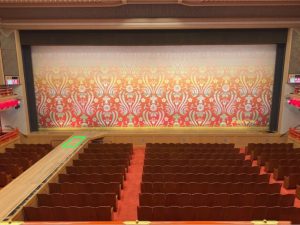
A third type, the donchō, is an ornate, often heavily embroidered curtain, frequently gifted to a theater or a specific actor by patrons, sponsors, or fan associations to mark a special occasion — a name-succession ceremony, an anniversary, or a milestone performance. Unlike the jōshiki-maku or asagi-maku, the donchō isn’t tied to a specific dramatic function within the play itself; it’s more a ceremonial flourish, displayed at the very start of a special program as a mark of celebration and goodwill before the actual performance curtain takes over.
What to Watch For
Once you know the difference, the curtain itself becomes worth watching closely. A striped jōshiki-maku pulled aside signals a full act beginning or ending. A solid pale asagi-maku hints that something is being deliberately concealed, likely for a dramatic reveal to come. And an unusually elaborate, embroidered curtain at the very start of a program is a signal that you’re watching something more than an ordinary performance — a celebration built into the show itself before a single actor even appears.
Frequently Asked Questions
- What are the three stripe colors on the main kabuki curtain?
-
Most commonly black, persimmon (a reddish-brown), and green, though the exact combination and order historically varied by theater and troupe, functioning almost as a visual signature.
- Why does the pale blue-green curtain drop suddenly instead of opening slowly?
-
The asagi-maku is designed to conceal a fully dressed set and reveal it in one dramatic instant, cued by a sharp clack of wooden clappers — a deliberate visual surprise rather than a gradual scene change.
- Is the striped curtain raised like a Western theater curtain?
-
No — it’s pulled horizontally by hand by a stagehand walking across the stage, accompanied by rhythmic wooden clapper sounds, rather than rising vertically.
Summary
Kabuki’s curtains aren’t just functional — the striped jōshiki-maku, the sudden-drop asagi-maku, and the ceremonial donchō each carry their own distinct purpose and dramatic weight. Learning to read them turns even the moments before a play begins into part of the performance itself.
Related Reading

🎭 Want to See Kabuki Live?
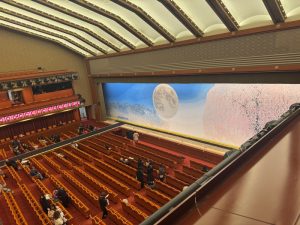
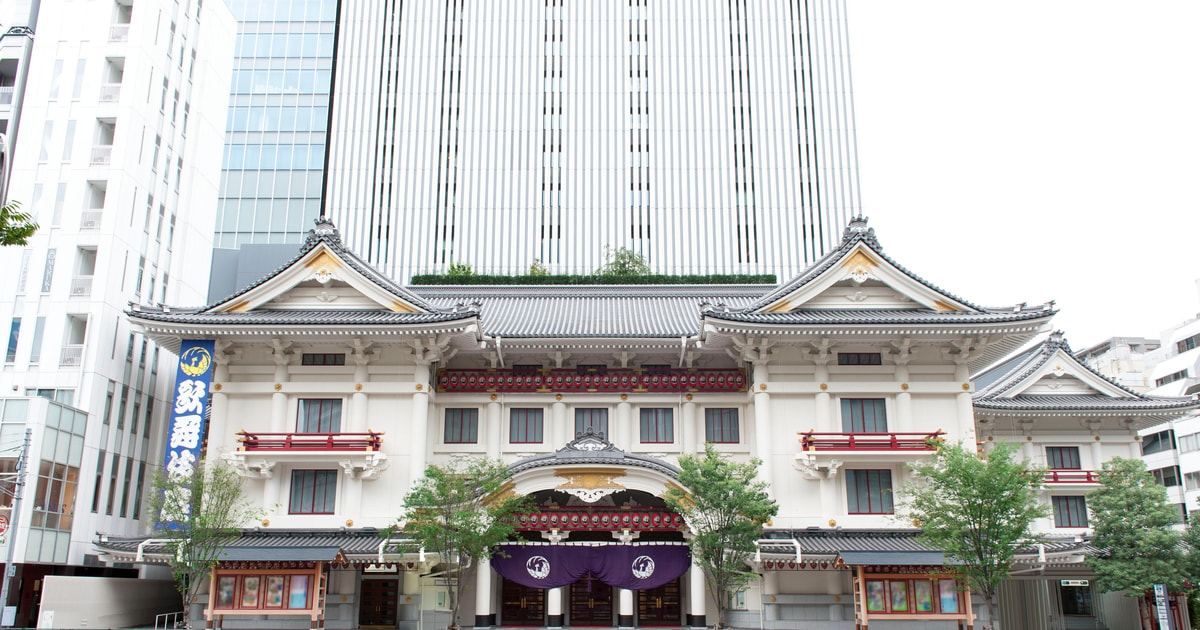
If you’re planning a trip to Tokyo, Kabuki-za is one of the most memorable ways to experience Japanese culture firsthand. GetYourGuide offers English-friendly Kabuki-za tickets and guided experiences, including options with headset translation and pre-show introductions for first-time viewers.
👉 Check Kabuki-za Tickets on GetYourGuide
This section may contain affiliate links. Booking through them costs you nothing extra and helps support this site.

コメント
コメント一覧 (1件)
[…] あわせて読みたい What Do the Different Curtain Colors in Kabuki Mean? Kabuki uses several distinct curtains, each with its own purpose: the striped jōshiki-maku, the sudden-drop asagi-maku, and the ceremonial dontyō. Here’s how […]