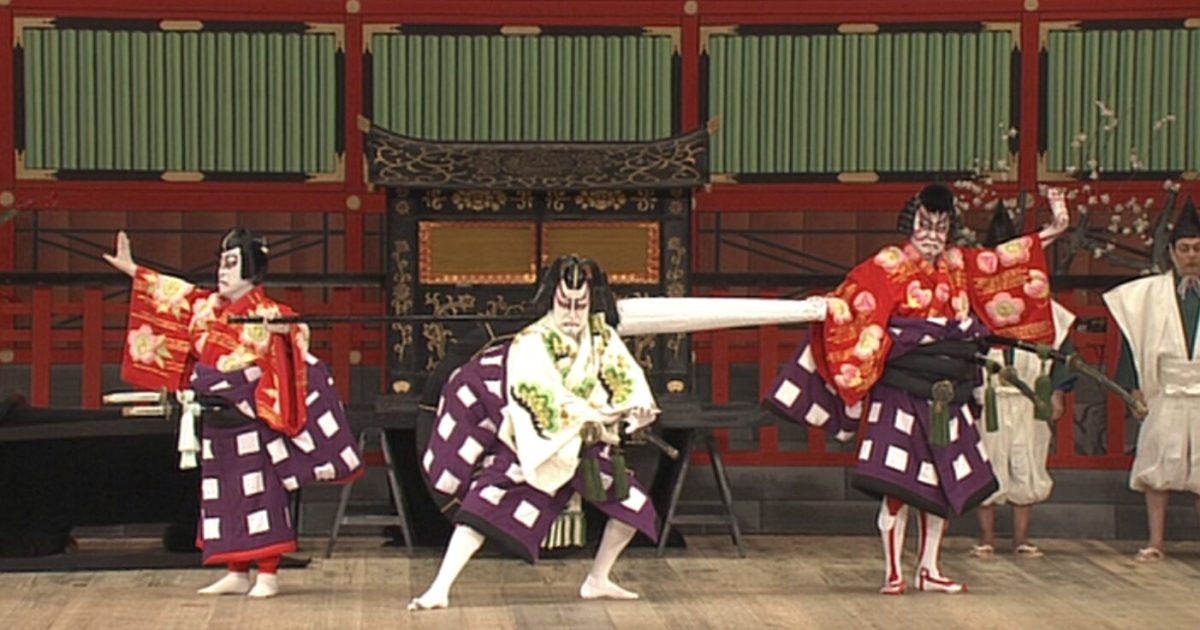
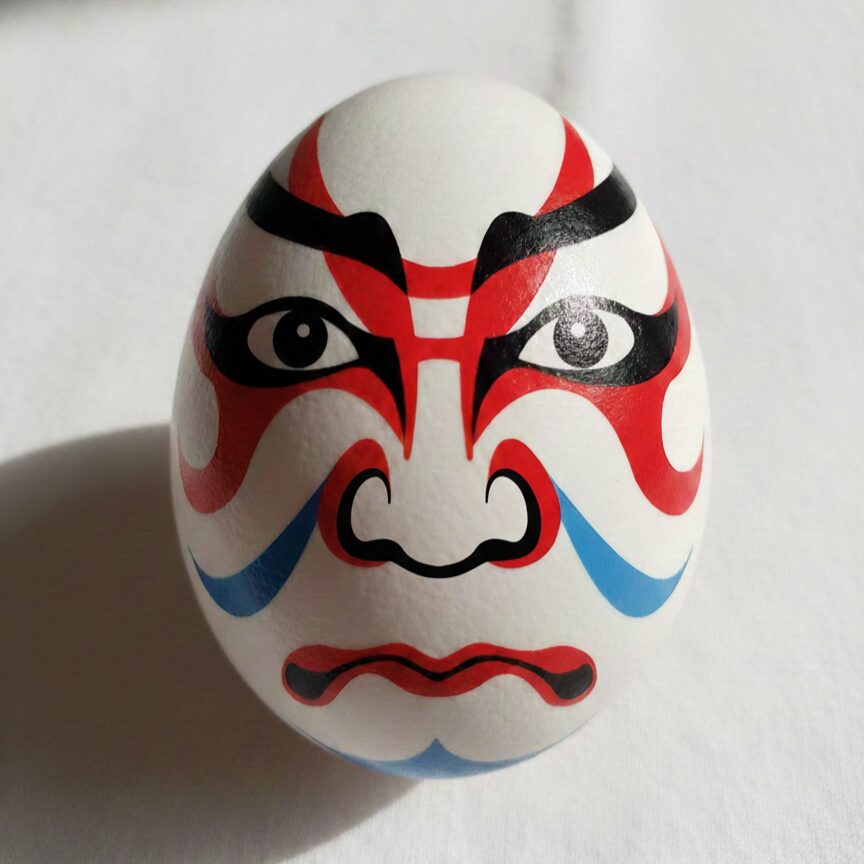
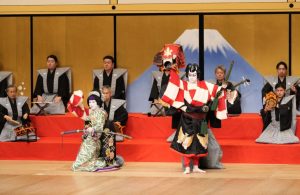
If you’ve ever seen a photo of a kabuki actor frozen mid-pose, eyes crossed and glaring fiercely at the audience, you’ve seen a mie (見得) — the single most iconic technique in all of kabuki.
This guide explains what mie actually is, how it’s built, the many different types you’ll see on stage, and how to spot the moment it happens so you can get the full impact on your next visit.
What Is Mie?
Mie is a kabuki acting technique that expresses the peak of an emotion through stillness rather than motion.
- The actor builds tension, then suddenly freezes at the emotional climax
- It follows a rhythm: build-up → freeze → percussive strike → glare
- The exact pose varies by role, play, and acting family
- It’s most striking when performed at the shichi-san point on the hanamichi runway
Western theater tends to express emotion through movement. Kabuki does the opposite — it stops moving entirely, and that stillness is precisely what makes mie so powerful. The word “mie” comes from miseru (“to show”), reflecting its purpose: presenting the true essence of a character directly to the audience.
The Anatomy of a Mie: “Tame” and Stillness
A mie isn’t just a freeze-frame. Its power comes from the quality of two things: the build-up beforehand, and the stillness itself.
Tame: The Pause Before the Pose
Tame is the brief pause that comes right before a mie. The actor slows down, gathers energy inward, and lets the audience feel that something is about to happen. The deeper this tame, the stronger the mie that follows it.
Stillness and Breath
During a mie, the actor looks completely frozen, but internally, every muscle is engaged. Breath control — whether the actor is inhaling, exhaling, or holding — dramatically changes how powerful the pose feels to the audience.
The Neck Turn and the Glare
Just before locking into stillness, most mie involve a sharp turn of the head, ending in an intense glare (sometimes crossing the eyes for extra intensity). This final head snap and fixed stare is what visually signals “this is the moment” to the audience.
The Sound of a Mie: Tsuke and “Battari”
Tsuke-uchi is a specialized stagehand role: a performer who strikes a pair of wooden blocks against a board at the side of the stage, timed precisely to the actor’s movements. At the exact moment of a mie, the tsuke-uchi typically strikes twice — a sound known in kabuki as “battari.”
That sharp double-strike snaps the audience’s attention and tension into sudden focus, and it’s a huge part of why a mie lands as dramatically as it does. Listen for it — once you know to expect it, you’ll never miss a mie again.
Major Types of Mie
There are dozens of named mie poses, each used for specific roles and situations. Here are the most iconic ones:
Genroku Mie
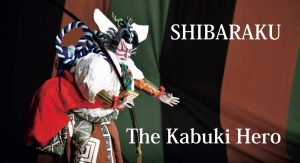
The most representative mie of all: right arm extended horizontally, left arm bent, left leg planted in a wide stance. This is the classic bold aragoto pose, famously performed by Kamakura Gongorō in Shibaraku.
Fudō no Mie
Modeled on the fierce Buddhist deity Fudō Myōō: a scroll or sword in the right hand, prayer beads in the left. Seen frequently in Kanjinchō and Narukami.
Ishinage no Mie (“Stone-Throwing” Mie)
A powerful pose resembling a throwing motion, most famously performed by Benkei in Kanjinchō, one of the Kabuki Jūhachiban (“Eighteen Best Plays” of the Ichikawa acting family).
Hashiramaki no Mie (“Pillar-Wrapping” Mie)
The actor wraps an arm and leg around a stage pillar or long object like a halberd — seen when the priest Narukami erupts in fury in the play of the same name.
Tenchi no Mie (“Heaven-and-Earth” Mie)
Two actors strike a mie simultaneously, one positioned high and one low — a signature moment for Goemon and Hisayoshi in Sanmon Gosan no Kiri.
Hippari no Mie / Emen no Mie (“Group Picture” Mie)
Multiple characters freeze together to form a single striking composition, like a living painting — a hallmark of kabuki’s act-closing scenes, typified by the finale of Kotobuki Soga no Taimen.
Yoko Mie (“Sideways” Mie)
The body twists with the face turned to the side, emphasizing the profile — said to have been created by the 5th Matsumoto Kōshirō for the role of Matsuōmaru.
Rarer Mie Worth Knowing
- Shitadashi no Mie (“Tongue-Out” Mie) — Fujiwara no Shihei’s shockingly intense pose in Kuruma-biki, sticking out his tongue to express villainous madness
- Ushiro Mie (“Backward” Mie) — freezing with the back to the audience, used by Danshichi Kurobei in Natsu Matsuri Naniwa Kagami to convey grim resolve
- Kumo no Mie (“Spider” Mie) — an eerie, spider-like pose used by the yōkai spider in Tsuchigumo
- Seisatsu no Mie — built around a wooden notice board, used in Kumagai Jinya at key turning points in the story
- Jigoku no Mie (“Hell” Mie) — an anguished expression representing suffering, from Sasaki Takatsuna in Kamakura Sandaiki
- Tsuru no Mie (“Crane” Mie) — an elegant, dignified pose performed by Kudō Suketsune in Kotobuki Soga no Taimen
- Tenchijin no Mie (“Heaven-Earth-Person” Mie) — three actors striking mie together in Kanjinchō (Togashi, Benkei, and Yoshitsune), each representing one of the three cosmic principles
Every one of these poses exists to communicate a character’s personality or emotional state in a single instant. Once you can recognize a few, you’ll start reading meaning into moments that would otherwise pass by unnoticed.
Nirami: The Ichikawa Family’s Exclusive Mie
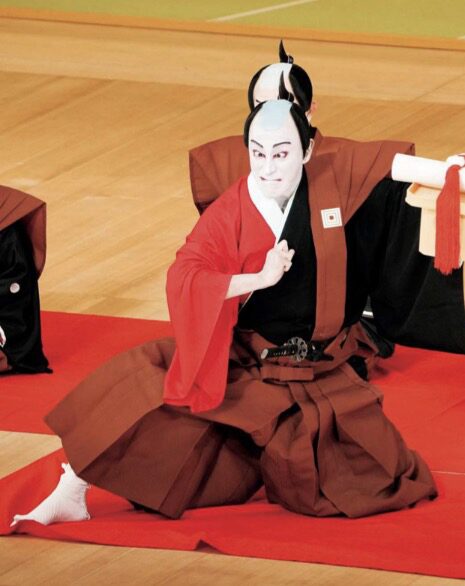
One mie stands apart from all the rest: the nirami (「にらみ」, “the glare”), a technique performed exclusively by actors of the Ichikawa Danjūrō line, usually at celebratory events like name-succession ceremonies.
Since the Edo period, the nirami has been believed to ward off bad luck for anyone who sees it — there’s even a saying that being glared at by a Danjūrō brings a year of good health. When an actor announces “Let me show you a glare” during a formal stage greeting, it’s treated as something close to a ritual blessing, and it remains one of the most distinctive traditions in all of Edo kabuki.
Where on Stage a Mie Happens — And Why It Matters
The same mie pose carries a different weight depending on where it’s performed.
At the Shichi-San
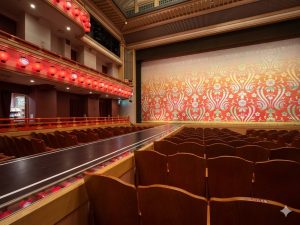
The shichi-san — the point on the hanamichi runway about 70% of the way from the stage — is where audience attention is most concentrated. Mie performed here, usually during an entrance or exit, tend to mark an emotional peak.
At Center Stage
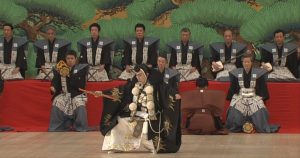
Mie performed center stage, usually facing an opposing character, project confrontation, resolve, or dominance over the whole stage — this is also where multi-actor “picture” mie usually happen.
Family Style: Why the Same Mie Looks Different
Even the “same” mie pose isn’t performed identically by every actor. The exact angle of the arm, the depth of the leg stance, the tilt of the head — these details are passed down within acting families and reflect each lineage’s own artistic interpretation.
The Ichikawa Family (Naritaya)
Descended from the founder of aragoto style, the first Ichikawa Danjūrō, the Ichikawa family holds the richest repertoire of mie in kabuki — Genroku mie, Fudō no mie, Ishinage no mie, Hashiramaki no mie, and the exclusive nirami are all part of their heritage. In many ways, “mie” and “Ichikawa” are inseparable.
Wagoto and Sewamono Style
Families specializing in the gentler wagoto style or domestic dramas (sewamono) perform mie very differently: less forceful, arising naturally out of the flow of the scene, and prioritizing softness and lingering emotion over raw power.
The Audience’s Role: Kakegoe and Shared Timing
A mie isn’t complete with the actor alone — it’s finished by the audience.
At the exact moment of a mie, shouts of the actor’s yago (stage name), like “Naritaya!” or “Otowaya!”, ring out from the audience — a uniquely Japanese form of theatrical appreciation. These calls stretch out the stillness of the mie, giving it extra weight and resonance. Experienced audience members read the tame and call out at exactly the right instant, and that shared sense of timing between actor and audience is one of the things that makes kabuki feel so alive.
Notable Plays and Their Signature Mie
| Play | Role | Mie |
| Kanjinchō | Benkei | Ishinage no mie, Fudō no mie |
| Shibaraku | Kamakura Gongorō | Genroku mie at the shichi-san |
| Narukami | Narukami Shōnin | Fudō no mie, Hashiramaki no mie |
| Sanmon Gosan no Kiri | Goemon & Hisayoshi | Tenchi no mie |
| Kotobuki Soga no Taimen | Full cast | Hippari no mie (group picture finale) |
| Sukeroku | Sukeroku | Mie at the shichi-san, embodying Edo style and charm |
Tips for Spotting Mie on Your First Visit
- Look up the role and play beforehand so you know roughly when a mie is coming
- Learn the lead actor’s yago — but as a first-timer, it’s best to just listen rather than shout it yourself
- Watch for the “tame” beat right before the freeze, and listen for the tsuke-uchi’s double “battari” strike
Just knowing these three things transforms mie from “an actor standing still” into one of the most exciting moments of the entire performance.
Frequently Asked Questions
- Why does the actor freeze instead of moving during a mie?
-
Kabuki uses stillness, not motion, to express the peak of an emotion. Stopping completely at the emotional climax concentrates the audience’s attention and makes that instant feel far more powerful than continuous movement would.
- What is that clacking sound during a mie?
-
That’s the tsuke-uchi, a stagehand who strikes wooden blocks against a board in time with the actor’s movements. The double-strike at the exact moment of a mie is called “battari,” and it’s a key part of the effect.
- What is “nirami,” and can any actor perform it?
-
Nirami is a special glaring mie performed exclusively by actors of the Ichikawa Danjūrō line, typically at celebratory events. Tradition holds it wards off bad luck for a full year for anyone who sees it.
- Do all actors perform the same mie identically?
-
No. Even a named pose like the Genroku mie varies in small details — arm angle, stance depth, head tilt — that are passed down within each acting family, reflecting that family’s own artistic tradition.
Summary: Mie Is the Art of Stopping
Mie is the art form kabuki has refined over centuries: the beauty of stillness. The tension that only stillness can create. The emotion that only becomes clear once movement stops.
On your next visit, focus on that single instant when the head turn locks into a stare and the tsuke-uchi’s “battari” lands at the very same moment — that’s where kabuki’s power is most concentrated.
🎭 Want to See Kabuki Live?
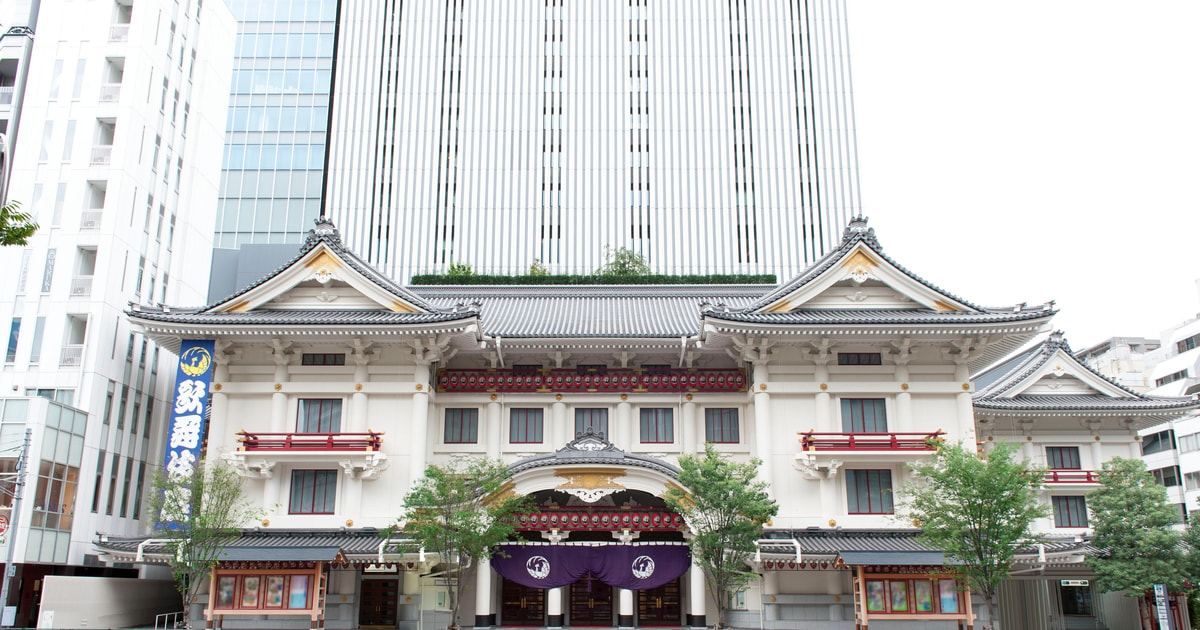
If you’re planning a trip to Tokyo, Kabuki-za is one of the most memorable ways to experience Japanese culture firsthand. GetYourGuide offers English-friendly Kabuki-za tickets and guided experiences, including options with headset translation and pre-show introductions for first-time viewers.
👉 Check Kabuki-za Tickets on GetYourGuide
This section may contain affiliate links. Booking through them costs you nothing extra and helps support this site.

コメント
コメント一覧 (2件)
[…] あわせて読みたい What Is Mie in Kabuki? Meaning, Types, and How to Watch For It Mie is kabuki’s iconic frozen pose technique. Learn its meaning, the many named types, the sound that accompanies it, and how to spot it on stage. […]
[…] あわせて読みたい What Is Mie in Kabuki? Meaning, Types, and How to Watch For It Mie is kabuki’s iconic frozen pose technique. Learn its meaning, the many named types, the sound that accompanies it, and how to spot it on stage. […]