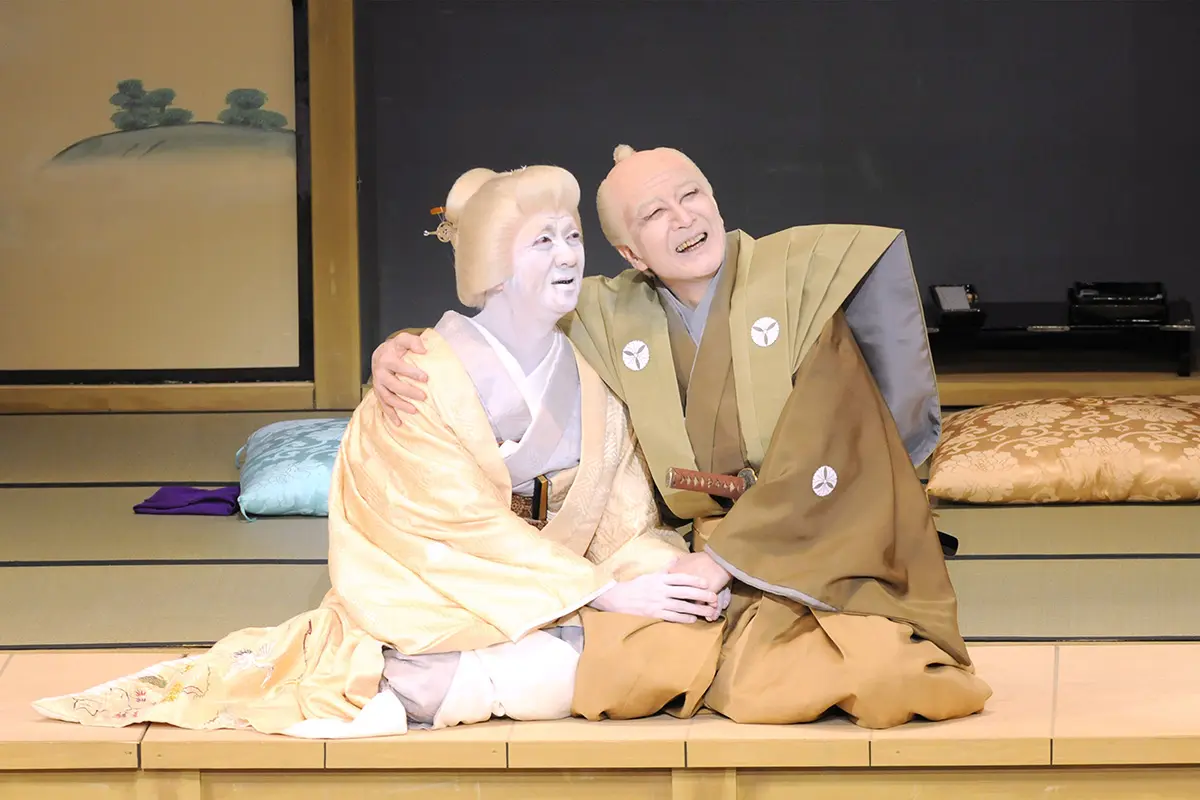
Jīsan Bāsan (“The Old Man and the Old Woman”) is a modern kabuki classic based on a short story by the celebrated novelist Mori Ōgai, adapted for the stage by playwright Uno Nobuo in 1951. It tells the story of a devoted husband and wife separated for decades by an unlucky twist of fate — and their eventual reunion, aged and changed, but still bound by the same quiet devotion.
Background
Mori Ōgai’s original short story, published in 1915, is a quiet, understated tale of a samurai couple in the Edo period. Uno Nobuo — sometimes called “the Mokuami of the Shōwa era” for his skill at adapting literature into kabuki — wrote and directed the stage version, adding a reunion scene not present in the original story specifically to give the play its emotional climax. That reunion is now considered the play’s signature moment. Since its 1951 premiere, it has become one of the most frequently revived pieces in the modern kabuki repertoire, and was even screened nationwide as a Cinema Kabuki release in January 2025.
Synopsis
Minobe Iori and his wife Run are a famously devoted couple living in Edo, raising a young child together in quiet happiness. When Run’s brother is injured and unable to fulfill a work assignment in Kyoto, Iori steps in to take his place for what’s meant to be a single year — promising Run he’ll return by the time the cherry blossoms bloom again.
While in Kyoto, Iori becomes entangled in an unexpected altercation with a colleague, resulting in a duel he never intended. The consequences are severe: he’s placed under house arrest in a distant province, unable to return to Edo, and the promised reunion with Run slips further and further out of reach as the years pass.
Decades later — after 37 years apart — Iori’s case is finally cleared, and he returns home as an old man to reunite with Run, herself now elderly. Time has changed them both so much that recognition doesn’t come immediately. It’s a small, deeply familiar gesture — an old unconscious habit of Iori’s — that finally lets Run see her husband still there beneath the years. In the garden, a cherry tree the couple once planted together as newlyweds has grown tall, blooming at last for the two of them together.
Characters
| Character | Description |
| Minobe Iori | The protagonist — a gentle, devoted husband and honest samurai |
| Run | Iori’s wife, who waits 37 years alone for his return |
| Miyashige Kyūemon | Run’s brother, whose injury sets the plot in motion |
| Shimojima Jin’emon | Iori’s colleague, involved in the fateful altercation |
| Miyashige Hisaya | Kyūemon’s son, who supports Run during Iori’s long absence |
| Kiku | Hisaya’s wife, who cares for the elderly Run |
Highlights
A Promise That Echoes Through the Whole Play
The parting promise — to return by the time the cherry blossoms bloom again — sets up everything that follows. Because the audience carries that promise with them, they wait alongside Run through all 37 years, right up to the reunion.
A Gesture, Not a Declaration
The moment of recognition doesn’t come through words — it comes through an old, unconscious habit that time never erased. Expressing decades of devotion through a single small gesture rather than dialogue is a distinctly kabuki approach to emotional payoff.
The Cherry Tree as a Symbol of Time
A tree planted as newlyweds, now grown tall and blooming for the couple’s reunion, visually communicates the weight of decades apart more powerfully than any line of dialogue could.
Frequently Asked Questions
- Is Jīsan Bāsan based on a true story?
-
It’s based on a 1915 short story by novelist Mori Ōgai, adapted for kabuki by Uno Nobuo in 1951 — a work of fiction rather than a historical account.
- Is the reunion scene in the original novel?
-
No — that scene was written specifically for the kabuki stage adaptation by Uno Nobuo, and is now considered the play’s emotional centerpiece.
- Is this a good play for kabuki beginners?
-
Yes — it uses relatively modern, accessible language and a clear, emotionally direct story, making it one of the more approachable plays in the repertoire for first-time viewers.
You might also enjoy:

Summary
Jīsan Bāsan is a quiet, deeply moving modern classic about a marriage that survives 37 years of separation through nothing but memory and devotion. Its accessible language and clear emotional arc make it a genuinely approachable entry point into kabuki, while its understated reunion scene remains one of the most affecting moments in the modern repertoire.
Related Reading
🎭 Want to See Kabuki Live?
If you’re planning a trip to Tokyo, Kabuki-za is one of the most memorable ways to experience Japanese culture firsthand. GetYourGuide offers English-friendly Kabuki-za tickets and guided experiences, including options with headset translation and pre-show introductions for first-time viewers.
👉 Check Kabuki-za Tickets on GetYourGuide

This section may contain affiliate links. Booking through them costs you nothing extra and helps support this site.




コメント