
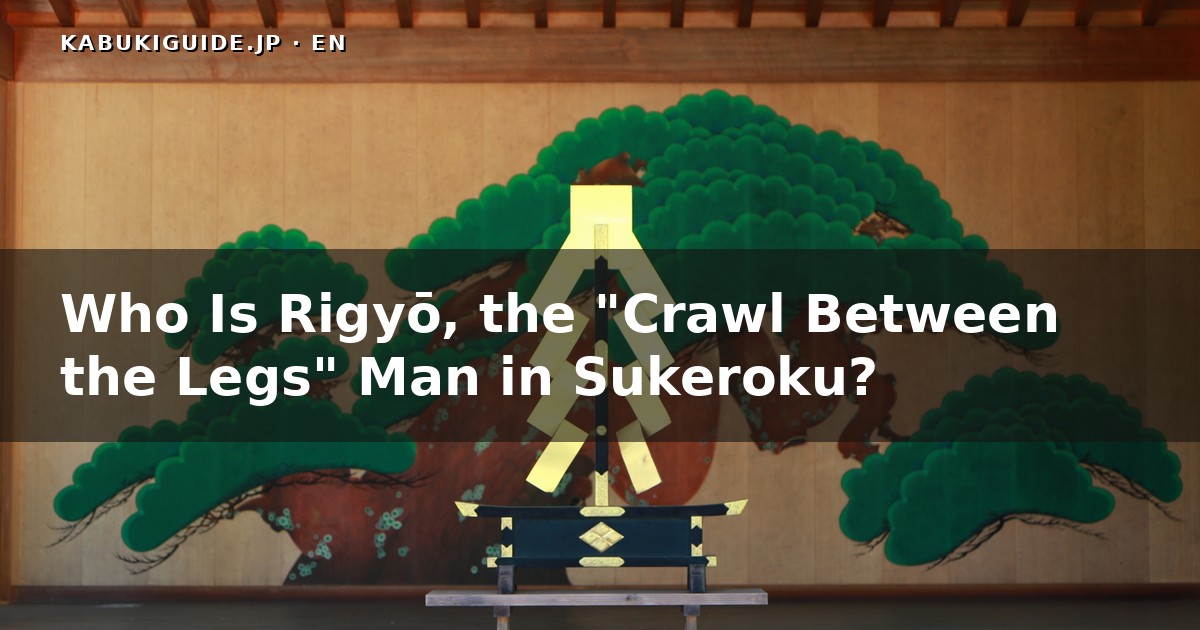
Watching Sukeroku Yukari no Edo Zakura, you may have caught yourself wondering: “Who is that person crawling between Sukeroku’s legs?” or “Who is this oddly chatty, wildly uninhibited character?” That’s the tsūjin (“man of taste”), Rigyō — and he might be the single freest spirit in the entire play.
The Edo Ideal of the “Tsūjin”
A tsūjin isn’t simply someone who’s knowledgeable — the term describes a sophisticated adult, fluent in Edo’s pleasures and social customs, attuned to the room, and deeply versed in the subtleties of human feeling. In short, someone who has fully mastered the art of cultured leisure — the word is even the root of the modern Japanese term for a true connoisseur.
Rigyō carries all the weight of that ideal on paper. But the moment he actually appears on stage, the impression is a bit… off. He has a soft, almost limp bearing, a thin, carefully styled topknot, and a distinctive speech pattern peppered with affected phrases — every inch a man performing sophistication rather than embodying it. Already, it’s clear he’s no ordinary character.
The Bizarre Spectacle of “Crawling Between the Legs”
Sukeroku is secretly Soga Gorō in disguise, provoking fights specifically to make people draw their swords, all in search of the treasured blade Tomokirimaru. By that logic, anyone not carrying a sword shouldn’t be his concern at all — but Rigyō gets swept up in the chaos regardless of the logic.
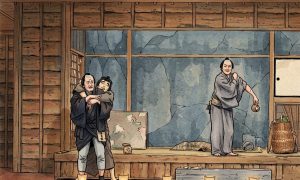
When Sukeroku orders him to “crawl between my legs,” Rigyō pulls a silk cloth (fukusa) from his robes, places it on his head, and crawls along the ground beneath him.
The detail worth noticing is the fukusa itself. It’s reversible, dyed with two different family crests on either side — each belonging to the acting families of the performers playing Sukeroku and the sake seller Shirazake-uri. When crawling beneath Sukeroku, Rigyō shows the side bearing Sukeroku’s crest; when he crawls beneath Shirazake-uri moments later, he subtly flips the cloth to show that family’s crest instead.
On the surface, it looks like pure slapstick. But underneath, it reflects a genuinely refined sensibility — a tsūjin’s ability to hold “respect for the performers” and “playful wit” in balance at the same time. Never settling for a cheap laugh alone, Rigyō reveals real depth of character through details like this.
The Real Highlight: What Happens After
Rigyō’s true showcase comes after the crawling bit is done. As he makes his exit down the hanamichi runway, he turns to the audience and launches into a monologue — one that changes every single performance. Backstage gossip, remarks about the other performers, whatever happens to be topical at the time — he weaves it all into an improvised, one-man commentary.
It’s completely unscripted, and delivered with such uninhibited freedom that even Sukeroku and Shirazake-uri can’t help but crack a smile. For the audience, it creates a genuine sense of live unpredictability — “what will he say today?” — distilling exactly the kind of in-the-moment, one-time-only magic that makes kabuki what it is.
A Character Who Creates Atmosphere, Not Plot
Rigyō isn’t a role that drives the story forward. What makes him so memorable instead is his ability to instantly shift the entire mood of the stage. Dropped into the tense, high-stakes world of Sukeroku, he opens up a pocket of humor and breathing room, closing the distance between performer and audience in an instant. In that moment, the stage stops being simply a story and becomes something happening live, right here, right now.
A Quick Refresher: What Is Sukeroku?
Having focused so closely on Rigyō, it helps to revisit the play itself. Sukeroku Yukari no Edo Zakura, set in Edo’s Yoshiwara pleasure district, is a vibrant sewamono (contemporary-style drama) built on a genuinely solid narrative core.
Sukeroku appears to be a carefree playboy, but he’s secretly Soga Gorō, deliberately picking fights to make people draw their swords in search of the treasured blade Tomokirimaru, tied to his father’s unresolved vendetta. Alongside that central mission, the play weaves in real emotional drama — his romance with the courtesan Agemaki, and his tangled relationships with the bearded villain Ikyū and the sake seller Shirazake-uri Shinbei (in truth his older brother Jūrō).
Into that tense, layered story comes a free-spirited presence like Rigyō, and his presence gives the entire production a distinctive rhythm and sense of breathing room. Knowing the main plot in advance makes Rigyō’s role — and exactly why he’s so entertaining — click into place even more clearly.

Frequently Asked Questions
- Is Rigyō’s monologue really improvised every time?
-
Yes — the content is left largely to the performer, often incorporating current events, backstage stories, or whatever feels timely, which is exactly why the scene feels different at every performance.
- What’s the significance of the reversible cloth Rigyō uses?
-
It’s dyed with the family crests of the actors playing Sukeroku and Shirazake-uri on opposite sides, so Rigyō can display the correct crest for whichever character he’s crawling beneath — a subtle gesture of respect disguised as a comic bit.
- Does Rigyō affect the main plot of Sukeroku?
-
Not directly — his role isn’t to move the story forward, but to shift the mood of the stage and create a lighter, more intimate connection with the audience within the play’s otherwise tense narrative.
Summary
Rigyō is proof that a character doesn’t need to move the plot to become unforgettable. Equal parts affected sophistication and genuine comic charm, his improvised, ever-changing performance captures exactly the kind of one-time-only magic that makes live kabuki so rewarding — the kind of role that has you wondering, long after the curtain falls, “who was that person crawling under Sukeroku, anyway?”
🎭 Want to See Kabuki Live?
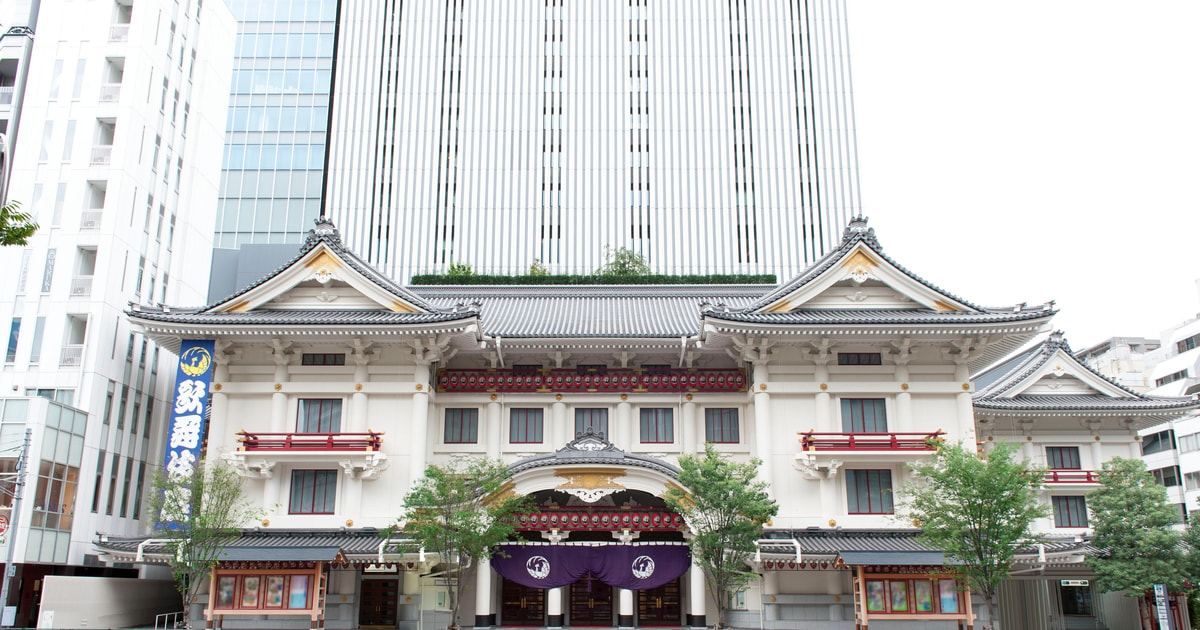
If you’re planning a trip to Tokyo, Kabuki-za is one of the most memorable ways to experience Japanese culture firsthand. GetYourGuide offers English-friendly Kabuki-za tickets and guided experiences, including options with headset translation and pre-show introductions for first-time viewers.
👉 Check Kabuki-za Tickets on GetYourGuide
This section may contain affiliate links. Booking through them costs you nothing extra and helps support this site.



コメント